Home / Blog / Professional Licenses or Certificates: Which One You Need
Professional Licenses or Certificates: Which One You Need
ProfessionLens, 2026-11-04
Fewer than 5% of U.S. jobs were subject to state occupational-licensing laws in the early 1950s, compared with approximately 25% by the early 2010s, according to the OECD's assessment of occupational licensing1/en/pdf). Licensing isn't a niche concern reserved for doctors and lawyers. It affects how workers enter occupations, how employers recruit, and whether professionals can keep working after a move.
Choosing between professional licenses or certificates starts with legal effect, not prestige. Ask what happens if the credential disappears: would you lose permission to perform the work, or lose a qualification an employer values? That distinction determines what you need and where to verify it.
Table of Contents
- Licenses and Certificates Side by Side
- What Legal Authority Changes in Practice
- Requirements Each Credential Demands
- Where Each Credential Fits Real Roles
- How to Verify a License or Certificate
- Moving States and Keeping Credentials Portable
- Choose the Credential Your Role Requires
Licenses and Certificates Side by Side
License and certificate differences at a glance
| Feature | Professional License | Certificate |
|---|---|---|
| Issued by | State, county or city government agency | Nongovernmental body such as a professional association, vendor or training organization |
| Legal effect | Grants legal authority to perform regulated work | Shows knowledge or skill; generally creates no legal right to practice |
| Needed to work | Yes, where the law requires it | Usually no, unless an employer or client requires it |
| Revocation effect | Board can suspend or revoke, stopping practice under that license | Issuer can revoke, and employers may stop accepting it |
| Where to verify | Licensing board's public lookup or direct confirmation | Issuer's certificate registry or credential ID check |
Read the table as a comparison of authority and evidence. A government license authorizes defined work within its scope. A nongovernmental credential provides evidence of learning or competence, but its issuer doesn't ordinarily control your legal permission to practice.
There's also a vocabulary trap: certificate and certification aren't exact synonyms. An educational certificate can document completion of a training program. A professional certification generally assesses competence against an issuer's standards. Neither label alone tells you whether a government requires the credential.
What losing the credential changes
If a board revokes the license required for your work, you can't continue practicing under that authorization. If an association withdraws a voluntary certification, you lose the right to represent yourself as holding it. An employer might also remove you from an assignment, even though the certification itself wasn't a government permission.
For technology roles, Mojolin's certification guidance for IT career planning offers a starting point for comparing skill credentials. Use that kind of career guidance to assess relevance to a role, not as evidence that a credential authorizes regulated work.
Practical rule: If practicing without the credential would be illegal, look for the government authorization behind it. If it only demonstrates skill to an employer or client, you're evaluating a qualification rather than a practice right.
Holding both is common and entirely sensible. A licensed engineer might also hold a project management certificate. The credentials address different questions, so neither makes the other redundant.
What Legal Authority Changes in Practice
A license is government authorization to work in an occupation. A certification indicates knowledge or skills, but it doesn't independently create the same legal permission. The consequences of unauthorized practice come from the applicable law, not from how demanding a training program was.
The scale makes careful terminology important. In 2018, 43.7 million people in the U.S. civilian noninstitutional population, or 16.9%, held a currently active certification or license, according to the Bureau of Labor Statistics figures associated with its certification and licensing workforce tables. Those are combined credential counts, not a count of people legally authorized to perform a particular regulated service.
Match the authorization to the task
Say a property owner hires someone to replace electrical equipment. Where local rules reserve that work or the associated permit application to a licensed electrical professional, a networking certificate doesn't satisfy the requirement. The owner needs the appropriate electrical authorization, including any relevant contractor or business credential.
Now consider a network engineer configuring switches in the same building. A vendor certification may help demonstrate competence for that assignment. It doesn't authorize the engineer to take responsibility for regulated electrical work because both tasks involve equipment and wiring.
The key distinction is task scope. A job title can include regulated and unregulated duties, while a license may authorize only a defined class of work. Don't infer permission from a broad title such as engineer, consultant or technician.
A credential can be difficult to earn and still be irrelevant to the legal permission a particular assignment requires.
For workforce analysts, the same principle changes the counting method. Keep occupation, credential type, jurisdiction and current status in separate fields. A combined credentialed-worker category can be useful for studying qualifications, but it shouldn't be relabeled as a licensed-practitioner population.
Check the statute or regulator first, then the employer's requirements. Read the credential provider's marketing last. That order prevents a persuasive course description from answering a legal question it has no authority to settle.
Requirements Each Credential Demands
A licensing board and a certificate issuer can demand the same categories of evidence. The difference lies in who sets the rules and what failure costs. A government board attaches conditions to a legal permission; a private issuer attaches conditions to a credential it grants and can withdraw.
Entry and maintenance requirements by credential
| Requirement | License | Certificate |
|---|---|---|
| Education | Prescribed program or degree for many occupations | Course or training program; preparation may be optional |
| Examination | State or national examination accepted by the board | Vendor or association examination, when the credential includes assessment |
| Supervised experience | Logged experience where board rules require it | Experience prerequisite where the issuer specifies one |
| Background check | Required for designated occupations under board rules | Required only where the issuer's rules specify it |
| Renewal cycle | Set by the licensing authority | Set by the issuer; some completion certificates don't expire |
| Continuing education | Required where renewal rules prescribe it | Required where the certification's maintenance rules prescribe it |
| Fees and time to complete | Board fee schedule plus required education, examinations and experience | Issuer fee schedule plus preparation, assessment and maintenance |
The biggest time commitment may come before you're eligible to apply. An examination fee tells you little about the cost of a license if the board also requires an approved degree and documented supervised practice. Compare the full route, not just the application checkout page.
Education rules deserve especially close attention. A course can teach useful material without satisfying a board's approved-program requirement. Before enrolling, match the program's exact name and approval status to the regulator's eligibility instructions. Many professionals maintain both columns at once, a license for legal permission and one or more certifications for specialty credibility, so these checks often run in parallel rather than once.
Compare the complete pathway
For a worked example, walk through the requirements for a licensed professional counselor in Kansas item by item against the state board's current application instructions. The questions worth answering are specific: which education qualifies, who may supervise, and what documentation must accompany the application?
Consider a hypothetical plumbing pathway that requires supervised experience before an examination. The applicant would need acceptable work records and supervisor confirmation, not a certificate saying a course was completed. If the board audits the experience, the underlying log matters.
A cloud-security certification might instead use an examination-centered pathway, with experience prerequisites or maintenance credits set by its issuer. Check whether passing the examination earns the full certification or only completes part of the process, because issuers split these steps differently.
Build your comparison around these costs:
- Eligibility costs: Tuition, prerequisite courses and document evaluation.
- Assessment costs: Examination registration, retakes and preparation materials.
- Practice costs: Time spent obtaining qualifying supervised experience.
- Maintenance costs: Renewal charges, continuing education and recertification.
The renewal row is easy to overlook. A permanent course-completion record works like a receipt: it proves a course happened. A renewable certification or license works more like a subscription with conditions attached. An examination pass isn't necessarily a current license, and a lapsed certification isn't an active credential. Save the governing rules when you enroll, then check the current rules again before applying or renewing, because the stakes differ by column: a lapsed certification costs standing with employers, while a lapsed license can end your legal authority to practice until reinstatement.
Where Each Credential Fits Real Roles
Start with the duties, not the badge. A nurse delivering regulated patient care, an electrician performing restricted electrical work and a real estate broker undertaking licensed brokerage activities must meet the applicable jurisdiction's authorization rules. Additional certificates can demonstrate specialization, but they don't replace those permissions.

Share of workers in jobs requiring a credential, 2025
The BLS Occupational Requirements Survey credential factsheet reports the following requirements; cells marked “Not reported here” aren't zeroes.
| Group | License or certification | Educational certificate | Apprenticeship |
|---|---|---|---|
| All civilian workers | 22.9% | 6.5% | 1.2% |
| Healthcare practitioners and technical workers | 93.4% | Not reported here | Not reported here |
| Healthcare support workers | Not reported here | 22.8% | Not reported here |
These categories measure job requirements, not everyone who happens to hold a credential. They also distinguish educational certificates from licenses or certifications. Don't combine the columns into a single workforce total without checking the survey's category definitions and overlap.
Employer requirements aren't licensing laws
In an unregulated role, an employer can make a certification a condition of hiring. A cloud-security credential might help a candidate qualify for an interview or a client assignment. That makes it consequential for employment, but not equivalent to government authorization.
Read job postings carefully:
- Required by law: Identify the regulator and the exact authorization.
- Required by the employer: Confirm the accepted credential, issuer and active-status requirement.
- Preferred: Treat it as a selection advantage, not an automatic eligibility barrier.
- Equivalent experience accepted: Ask what evidence the employer will evaluate instead.
A posting that says “must hold” doesn't settle whether the requirement comes from law, a contract or an internal hiring policy. Ask which one applies. That answer affects whether an employer can accept an alternative.
Mixed roles require a task-by-task reading. A licensed electrician with a building-automation certificate might use the license for regulated installation work and the certificate to demonstrate familiarity with control systems. The certificate could influence who gets the assignment without expanding the electrician's legal scope.
For analysts, preserve that distinction in the dataset. Record mandatory authorization, employer preference and educational completion separately. Otherwise, a count intended to describe legal workforce capacity may instead describe a mixture of training histories and hiring preferences.
How to Verify a License or Certificate
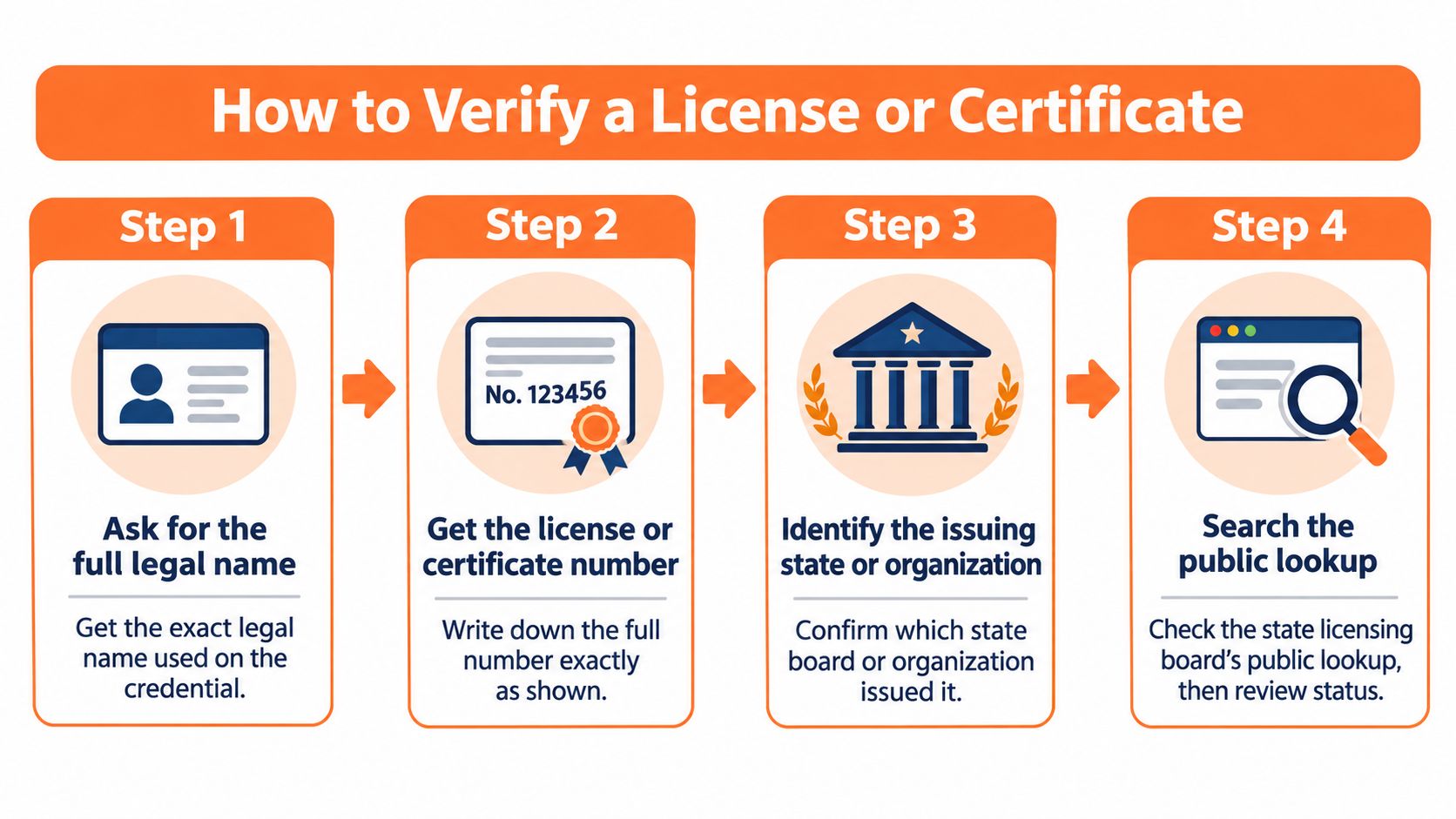
Verification means checking the issuing authority's current record, not accepting a photograph of a framed credential. A printed expiry date can't reveal a suspension imposed after the document was issued.
Follow the record to its issuer
Collect the identifying details. Ask for the full legal name, credential number and issuing state or organization. The number helps distinguish people with similar names and avoids guessing from a job title.
Find the official licensing lookup. Explore the regulator's website instead of relying on a commercial directory. Check the reported status, issue and expiration dates where available, and any restrictions or disciplinary information.
Use the certification issuer's verification service. Enter the credential ID or follow the issuer's official verification procedure. Confirm the credential name and holder's identity, not merely that a badge image opens.
Check scope and conditions. A license may cover a particular specialty, class or jurisdiction, while a certification may relate to a particular product or examination version. For therapy-related roles, our licensed professional therapist guide provides context for identifying the relevant professional category before searching.
Record what you checked. Save the source, check date, credential identifier and status shown, subject to your organization's privacy rules. A dated record documents the basis of your decision without implying that the status will remain unchanged.
Recheck before a consequential decision. Verify again before assigning regulated duties, signing a service contract or approving access that requires an active credential. Where the record is ambiguous, obtain confirmation from the issuing body before proceeding.
Separate population counts from individual clearance
At ProfessionLens, our counts are computed from public licensing rolls and federal files as pulled on the count date. A roll can carry errors, duplicates or lapsed licenses, so a population count isn't an individual clearance decision.
Verification caution: A directory entry tells you that a record exists. It doesn't, by itself, establish that the person can perform the work you're assigning today.
If there's no match, don't immediately conclude that the credential is false. Check spelling, former names, name changes and the issuing jurisdiction, especially after a move. If the result still doesn't resolve, ask the issuer to confirm the record and explain any discrepancy before making a significant decision.
Moving States and Keeping Credentials Portable
A professional license is tied to a jurisdiction. A nongovernmental certificate may be recognized across locations under its issuer's rules, but acceptance by an employer isn't the same as permission from the destination state.
Universal recognition doesn't necessarily mean automatic transfer. A research paper hosted by North Dakota State University identifies materially different recognition rules, including residency conditions, substantial-equivalence tests, experience thresholds, temporary licenses and occupational exclusions.
Recognition is an application pathway
A professional in good standing might qualify through recognition and still need to submit an application before working. Another applicant might face a jurisdiction-specific examination, additional documentation or a restriction tied to license scope. Don't set a start date from a general statement that a state recognizes out-of-state licenses.
Interstate compacts offer another route, but only within the professions and participating jurisdictions they cover. Compact participation also shouldn't be read as permission to ignore the compact's own application or practice requirements.
For a destination-specific starting point, our Washington State professional license guide can help frame the questions to take to the relevant authority.
Use this sequence before committing to a move or employment start:
- Identify the destination pathway. Confirm whether your profession and current license qualify for recognition, endorsement or a compact route.
- Ask about processing. Find out which documents the board needs and how it communicates missing items or approval.
- Check interim practice rights. Establish whether temporary or supervised practice is permitted, and obtain the required authorization before starting.
- Confirm good standing. Resolve status problems and arrange any direct verification required from your existing board.
- Check remaining obligations. Review application fees, local coursework, examinations and ongoing renewal requirements.
Define the point when work may begin
Low-friction recognition systems can accept comparable scope and level, recognize good-standing licenses and allow provisional practice during verification. Those features matter because they affect the gap between arriving and earning.
For a hiring team, record a documented legal start condition, not just an expected approval date. For the worker, keep the original license current where necessary while the destination application proceeds. Ask the destination board directly whether approval, issuance or another formal step is required before you take on regulated duties.
Choose the Credential Your Role Requires
A nurse whose board certificate is current but whose state license has lapsed cannot legally practice. That gap is the whole point of the choice ahead: a license grants a legal right to work, while a certificate signals a qualification employers may prefer or require. If you are legally ineligible for the work, a voluntary badge cannot fix that. If you are already authorized but a posting names a skill you lack, a certificate may be the cheaper, faster fix.
Use this decision order before paying for a program:
- Establish legal eligibility. Identify the regulator, license category and scope relevant to your intended duties.
- Test hiring relevance. Compare actual job postings and confirm whether named certifications are mandatory, preferred or replaceable with experience.
- Compare the full commitment. Include prerequisite education, supervised practice, preparation, fees and maintenance in your budget.
- Verify the proposed credential. Confirm who issues it, how employers can check it and what successful completion earns.
- Plan continued eligibility. Set reminders and retain renewal evidence so an administrative lapse does not interrupt work that requires active authorization.
Use earnings as context, not a promise
An NBER analysis of occupational licensing associated licensing with approximately 14% higher wages, while its governmental-certification estimates were smaller and generally statistically insignificant. That finding describes an association across the workforce, not a guarantee for any individual worker.
Median weekly earnings by credential status, 2024
BLS data on certification and licensing status of the employed report median weekly earnings for full-time wage-and-salary workers aged 16 and over:
| Credential status | Median weekly earnings |
|---|---|
| With a license | $1,531 |
| With a certification but no license | $1,410 |
| With neither credential | $1,081 |
These rows deserve a careful reading. Credential holders differ in occupation, education, experience and industry, so the gaps partly reflect who tends to hold each credential rather than what the credential itself delivers. Compare people doing similar work with similar educational backgrounds before attributing an earnings difference to the license or certificate.
The risk profile also differs between the two objects. A regulator can suspend or revoke a license and end your legal right to work, and employers can check that status against the public roll. A lapsed certificate usually means losing a hiring preference, which stings but does not bar you from the job.
So the decision comes down to a single written answer. Before enrolling, complete this sentence for yourself: does this credential let me do the work, or does it help me get hired for it?
ProfessionLens publishes professional workforce counts by profession, geography and employer, with documented sources and count dates. Visit ProfessionLens to compare licensed populations and build workforce research that keeps legal authorization separate from job titles and other credentials.