Home / Blog / Licensed Professional Therapist: Credentials Explained
Licensed Professional Therapist: Credentials Explained
ProfessionLens, 2026-10-26
No single U.S. license carries the name licensed professional therapist. The phrase is shorthand for a state-licensed mental health clinician, usually an LPC, LPCC or LMHC, LCSW, LMFT, licensed psychologist, or psychiatrist.
That surprises many clients because a directory profile can look uniform. Two people listed under the same label may hold different degrees, report to different boards, and lack the same legal authority. One may practice independently, another may work under supervision, and a third may be licensed only in a state where you don't live. Learning how to separate a title, a license, and a scope of practice turns a confusing label into three answerable questions, and it protects you from assuming a profile promises more than the law allows.
Table of Contents
- What the Phrase Means and Does Not Mean
- Credentials Behind the Label by Profession
- Why Licensing Changes at State Lines
- Counting Therapists Without Overstating the Number
- Why License Totals Do Not Equal Available Care
- Verify a Credential Before You Book a Therapist
What the Phrase Means and Does Not Mean
No single U.S. license is called licensed professional therapist. Clients, directories, and clinics use the phrase as a convenient umbrella for a clinician who holds a state license to provide psychotherapy. Behind that umbrella sit several distinct professions, each with its own training route and regulatory board.
Think of licensed driver as a comparison. The phrase tells you a person may legally drive, but it doesn't tell you whether they hold a motorcycle endorsement, a commercial license, or only a learner's permit. It also doesn't tell you which state issued the card.
Three Questions Hidden in One Label
A useful profile answers three separate questions. First, what's the title the person uses, such as therapist, counselor, or psychotherapist? Second, what's the license a regulator granted, and in which state? Third, what's the scope, meaning what that license legally permits the person to do?
Those answers don't always match. A person can call themselves a therapist in conversation while holding a license as a clinical social worker. Another person can hold a graduate degree and a private certification but hold no state license at all.
A title describes how someone presents their work. Only a license issued by a state board grants legal authority to practice.
In many places, therapist isn't a protected word, so an unlicensed person may use it in marketing. That doesn't mean every unlicensed provider is dishonest, but you can't treat the word alone as proof of training, supervision, or permission to diagnose and treat. You need the credential behind it, the state that issued it, and its current status.
Credentials Behind the Label by Profession
Common therapy credentials by profession
| Profession | Typical credential | Minimum degree | Typical supervised training | Can prescribe |
|---|---|---|---|---|
| Professional counselor | LPC, LPCC or LMHC (name varies by state) | Master's | About 2,000 to 4,000 supervised hours | No |
| Clinical social worker | LCSW (some states use LICSW) | Master's in social work (MSW) | About 3,000 supervised hours | No |
| Marriage and family therapist | LMFT | Master's | About 2,000 to 3,000 supervised hours | No |
| Licensed psychologist | State psychology license | Doctorate (PhD or PsyD) | Internship plus postdoctoral hours | No in most states, with limited exceptions |
| Psychiatrist | Medical license (MD or DO) | Medical degree plus psychiatry residency | Residency of about 4 years | Yes |
| Pre-licensed associate | LPC-Associate, LCSW-Associate or LMFT-Associate (varies) | Master's | Working toward full license | No, practices under supervision |
Read the table by columns, not just by row. The minimum degree tells you the formal education behind the license, while supervised training tells you the clinician practiced under an experienced licensee before earning full authority. The prescribing column shows a sharp legal boundary that everyday language often hides.
The Master's-Level Route
Counselors, clinical social workers, and marriage and family therapists follow a broadly similar path. Each completes a graduate degree, works through a supervised period of clinical practice, and passes an examination recognized by the state. Hour totals, course requirements, and exam names differ by state and by board, so don't assume an LPC in one state completed an identical checklist to an LMHC elsewhere.
Their graduate training also shapes their viewpoint. Counselors often center individual development and mental health treatment, social workers connect clinical care with family and community resources, and marriage and family therapists focus heavily on relationships and family systems. In practice, experienced clinicians in all three groups may treat anxiety, depression, trauma, and relationship problems, so profession alone doesn't predict the quality of your fit.
Doctoral and Medical Routes
Psychologists hold a PhD or PsyD, complete an internship, and usually add postdoctoral supervised hours. Their training often includes psychological testing and assessment in greater depth. Psychiatrists take a different route entirely. They earn an MD or DO, finish a psychiatry residency, and hold a medical license, which is why they can prescribe medication in every state.
Say a client with panic attacks sees a counselor each week for talk therapy and visits a psychiatrist to review medication. A directory might call both people licensed therapists, yet only the psychiatrist can prescribe, and the counselor may spend far more time providing psychotherapy. Neither role is automatically better. They're different tools.
The last row matters for a different reason. A pre-licensed associate can often see clients, but only under supervision while working toward a full license. When you see a credential on a profile, match it to a row in the table. That quick match tells you what education, supervision, and authority stand behind it.
Why Licensing Changes at State Lines
One title can't carry one national meaning because the United States doesn't license most therapists at the federal level. Each state has its own licensing board and practice act, so the credential name, required hours, examination, renewal rules, and legal scope are set locally. A clinician who qualifies in one jurisdiction may need additional coursework, hours, or paperwork in another.
That's why one master's-trained counselor may hold an LPC in one state, an LPCC in another, and an LMHC in a third. The letters differ, but broadly similar graduate training may stand behind each one. Reading the letters without naming the state leaves out the regulator that defines them.

Physical therapy shows the same jurisdictional principle in another health profession. The American Physical Therapy Association licensure guidance explains that physical therapists must hold a license in every state, the District of Columbia, Puerto Rico, and the U.S. Virgin Islands where they practice, with state boards generally requiring an accredited program and passage of the National Physical Therapy Examination. Similar state-by-state logic appears in other regulated fields, which is why comparing a licensed professional therapist with a licensed professional engineer can help you notice where a national exam ends and state authority begins.
Title Protection Is Local Too
Some states restrict words such as therapist or psychotherapist to licensed people. Others protect only specific titles, such as licensed professional counselor or licensed psychologist. In a state with narrower protection, an unlicensed coach or counselor may legally use therapist in some contexts, even though that person can't claim a protected license title.
This creates a practical reading rule. Don't ask only, "Are you a therapist?" Ask, "What's your exact license, which board issued it, and what's its status?" The second question produces a record you can verify.
Licensed, Independent, and Authorized Here
Three ideas often collapse into one. Being licensed means a board granted a credential. Being independently licensed means the clinician can practice without required supervision. Being legally able to treat you means the clinician holds authority in the state where you're physically located during the session, including a telehealth session.
A fully licensed counselor in Colorado doesn't automatically gain authority over a client sitting in Kansas. The client's location generally determines which state's rules govern the encounter. An associate license adds another limit, since supervision and employment rules may restrict where and how that clinician can work.
Practical rule: Match the license to the client's physical location on the day of the session, not to the therapist's mailing address or website.
The Counseling Compact tries to reduce this friction, but it isn't a national license. The text of the Counseling Compact legislation in Congress reflects a model in which eligibility generally requires an unrestricted independent-level license, qualifying graduate education, supervised experience, and a national examination, while associate, provisional, and intern licenses aren't covered. As of mid-2026, the compact had been enacted by roughly 39 states plus the District of Columbia, but only a smaller number were operational and issuing privileges.
Three common cases show why enactment and usable access aren't the same:
- A client moves mid-treatment: The therapist needs authority in the new state, a compact privilege if available, or a lawful transition plan. Continuity alone doesn't create authorization.
- A telehealth session crosses a state line: Ask where you'll sit during the appointment and whether the therapist can practice there. A vacation, college dorm, or work trip can change the answer.
- A new graduate wants compact access: An associate can't use a pathway built for independent licensees. Portability initially favors experienced, fully licensed clinicians and leaves early-career providers outside it.
Counting Therapists Without Overstating the Number
Count a therapist as practicing only when the record shows an active status in an identifiable jurisdiction. That single rule prevents expired credentials, duplicate records, and out-of-state licenses from inflating a local workforce estimate. If the status or jurisdiction isn't explicit, don't include the record and hope the error cancels out.
License status categories and whether to count them
| Status | What it means | Count as practicing? | Why it matters |
|---|---|---|---|
| Active | Full license in good standing | Yes, in its own state | Baseline for any local count |
| Inactive | License kept but not currently practicing | No | Inflates raw totals if included |
| Associate or provisional | Supervised pre-licensed status | Separate line | Can see clients only under supervision |
| Expired or lapsed | Not renewed by the deadline | No | May be restored; check reinstatement rules |
| Out-of-state license | Valid in another jurisdiction | No, for local practice | Does not authorize local clients without a local license or compact privilege |
| Compact privilege | Practice in member states under compact rules | Separate line | Depends on home-state eligibility |
| Certified or registered only | Credential without a state license | No | Often confused with a license |
Employment Counts and License Counts Answer Different Questions
An occupational employment count measures people working in jobs. A license count measures credentials in a regulatory file. Those numbers can differ because one person may hold licenses in two states, another may keep an inactive license after retiring, and a third may work in the occupation under an associate credential.
For one federal employment benchmark, the U.S. Bureau of Labor Statistics occupational outlook for these counselors reported 533,400 jobs for substance abuse, behavioral disorder, and mental health counselors in 2025. It also projects the occupation to grow by 18% from 2025 to 2035, which is a projection about jobs, not a promise that license files will rise by the same share in every state.
The same distinction matters when you compare therapy with related licensed occupations, including in research on how many physical therapists there are in the U.S. A job estimate and a board roster can both be accurate while producing different totals because they're counting different things.
A Worked Example
Say a hypothetical state file contains 10,000 records. You identify 1,800 inactive, 600 expired, and 400 associate records. Removing the inactive and expired records and reporting associates separately leaves 7,200 active full licenses before you check practice location.
That still isn't a local access count. Some active licensees may live elsewhere, work in administration, or hold the license as a backup. Record the count date, source, status filter, and jurisdiction beside every number you cite. Without those four details, another researcher can't reproduce your result or judge whether two totals are comparable.
Why License Totals Do Not Equal Available Care
A large number of licensed therapists doesn't guarantee that a person in a particular county can book a suitable session soon. Clinicians may cluster in metropolitan areas, work part time, maintain full caseloads, decline local insurance plans, or lack independent practice authority. A headline count treats every credential alike, but a client experiences location, openings, cost, and fit.
Say a county lists 40 licensed counselors. Most work full time at one clinic in the county's largest town, none accepts the public insurance plan used by many rural residents, and several licenses belong to people who no longer see clients there. The roster looks healthy, yet a resident an hour away may have no realistic appointment.
Shortage Designations Measure Something Else
Recent shortage reporting summarized in Triad's behavioral health workforce shortage analysis cited approximately 7,022 mental-health Health Professional Shortage Area designations covering about 151 million people. It estimated that roughly 7,000 additional practitioners would be needed to remove those designations. A shortage-area designation signals thin service relative to need. It isn't a count of licensed professional therapists, and you shouldn't swap the two measures.
More licenses improve access only when the people behind them practice where clients need care, offer usable appointments, and accept a workable form of payment.
Ask a stronger question instead: How many independently practicing therapists are available per underserved resident, by county? That question forces you to combine license status, practice authority, county location, specialty, payer participation, and full-time-equivalent availability. It also reveals gaps a statewide average can hide, such as a shortage of child therapists or trauma specialists in one region.
When a report claims a shortage or surplus, ask what it counted and where those people actually work. The answers matter more than the headline total.
Verify a Credential Before You Book a Therapist
Book only after a license check and an approach check. The first confirms legal authority in your state. The second asks whether the clinician's methods fit your concern, preferences, and circumstances.
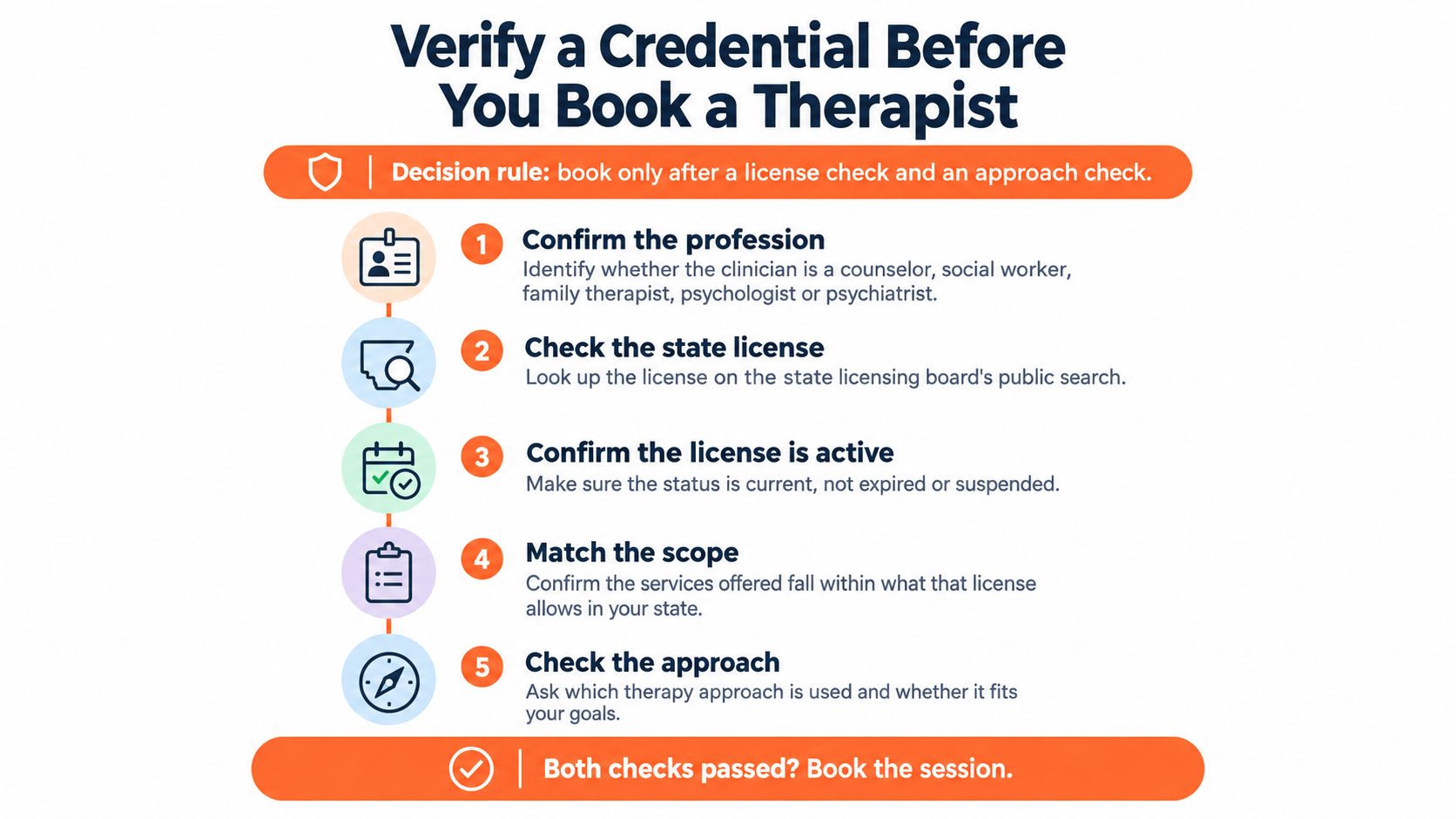
- Confirm the profession: Identify whether the profile describes a counselor, social worker, marriage and family therapist, psychologist, or psychiatrist. Don't rely on therapist alone.
- Name your session state: Use the state where you'll physically sit during appointments. Tell the clinician if you'll travel, attend college elsewhere, or move soon.
- Search the state board lookup: Enter the clinician's legal name on that state's licensing board site and record the license type, number, and status.
- Read the status carefully: Look for active and in good standing. If you see inactive, expired, associate, or provisional, ask what supervision, renewal, or practice limits apply.
- Match the scope: Confirm prescribing authority if medication is part of the plan, or a compact privilege or separate license if care will cross state lines.
- Ask about the approach: Ask how the therapist would treat your concern, what research supports those methods, and how you'll both judge progress.
A license shows legal authority, not clinical effectiveness. The American Psychological Association statement on evidence-based practice defines evidence-based practice as integrating the best available research with clinical expertise while accounting for patient characteristics, culture, and preferences. The APA also reports that rigorous clinical research finds psychotherapy effective across many disorders, ages, and treatment formats, with benefits substantially exceeding no treatment.
Use reliable directories as leads, not as substitutes for board records. Guidance on choosing among the best licensed professional data sources can help you compare where a listing came from, but the issuing board remains the authority for status. If the license is active in your state and the approach fits your concern, book. If either check fails, keep searching.
Visit ProfessionLens to explore dated, source-documented counts of licensed professionals by profession, state, county, and employer. Use those pages to compare active workforces without confusing raw license files with available care, then verify any individual therapist through the state board before you book.