Home / Blog / Licensed Professional Engineer Counts by State
Licensed Professional Engineer Counts by State
ProfessionLens, 2026-10-24
A count of engineers in the labor market can look precise while telling you nothing about who is authorized to sign and seal regulated work. That's because a licensed professional engineer isn't defined by a degree, a job title, or an exam score. The defining unit is the licensing record held by a specific jurisdiction, at a specific date, under a specific status.
Treat any headline total that doesn't disclose those three facts as incomplete.
Table of Contents
- Why Engineering Employment Is Not a License Count
- Defining the Licensed Professional Engineer Population
- How State Licensure Became the Governing System
- The Model Licensure Pathway and State Control
- License Records Versus Occupational Employment Data
- Building a Complete Licensing Record Count
- Status and Attribute Fields That Change the Meaning
- Detailed Entries for State and Discipline Analysis
- Counting Multi-State Licenses and Practice Authority
- Cross-References for Related Workforce Questions
- Quick Reference for Verifying Engineering Counts
Why Engineering Employment Is Not a License Count
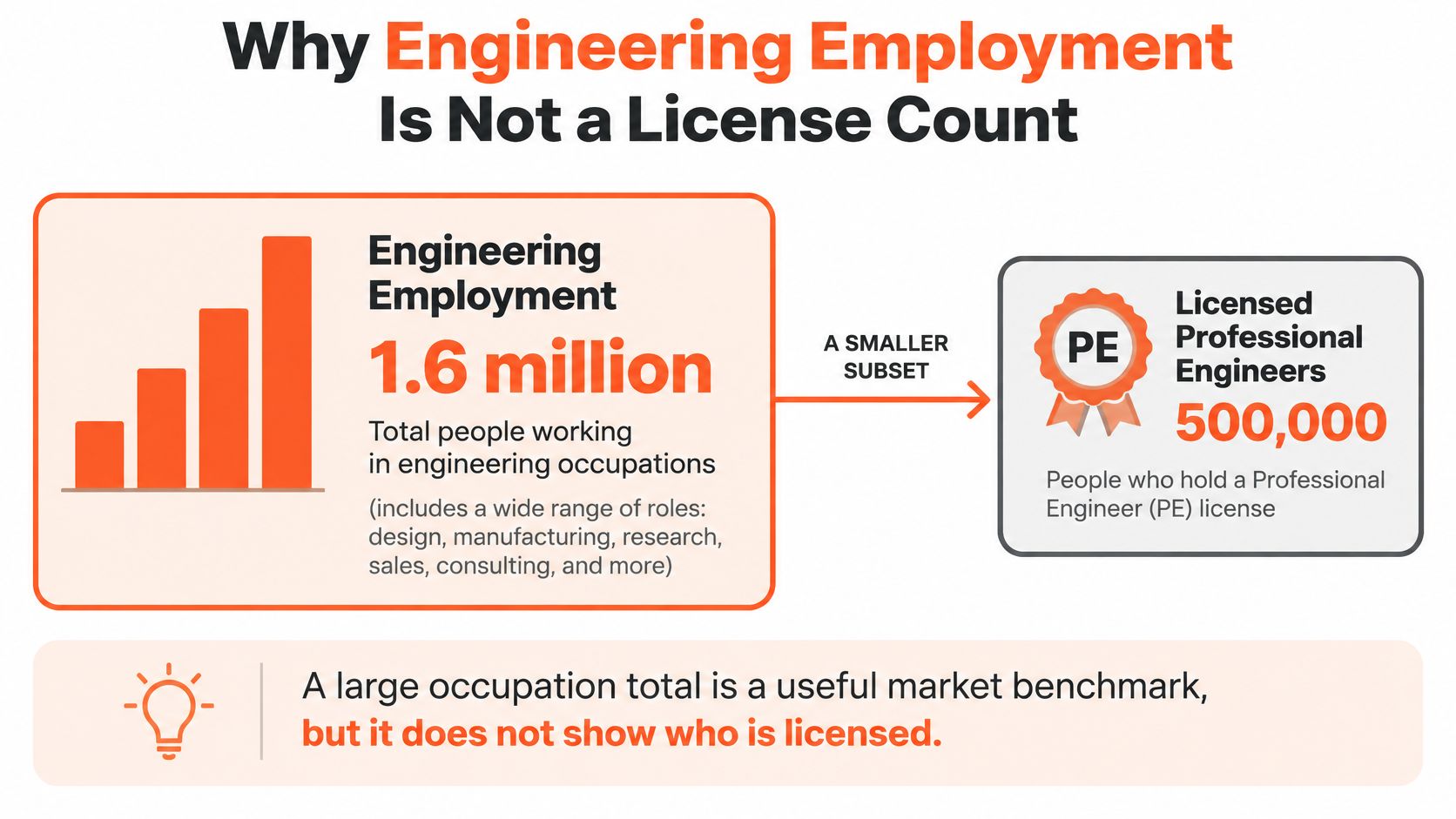
Engineering employment measures jobs. Licensure measures authorization. Confusing the two produces a total that answers neither question well.
A broad occupation figure gives researchers, journalists, analysts, employers, and workforce planners a sense of market scale. It doesn't identify which individuals a state board has authorized to offer or approve regulated services, which licenses remain active, or where that authority applies.
What a Defensible Count Discloses
- Source and count date: Which board file was read, and when.
- Jurisdiction: Which state or territory issued each record.
- Status treatment: Whether expired, inactive, or retired records were included.
- Unit: Whether you're counting people, licenses, or person and license pairs.
Without that metadata, two analysts can publish different totals from the same underlying profession and both appear authoritative. The difference usually sits in hidden filters, not in real workforce change.
Employer questions need the same discipline. A ranking such as largest engineering employers in Texas only means something if the underlying records define a licensed person the same way across every firm. Employment headcount at a company and licensed headcount at that company are different measures, and they shouldn't be swapped.
A large occupation total is a useful market benchmark, but it does not show who is licensed.
Defining the Licensed Professional Engineer Population
An engineer licensed in Colorado, Wyoming, and Texas is one person and three license records. Both totals can be accurate at the same time. The definition you apply decides which number your count produces, so the definition has to come first.
For counting purposes, a licensed professional engineer is an individual represented as licensed in a jurisdiction-specific record, once you have documented how status, entities, and duplicates were handled.
That definition excludes several groups that get folded in by mistake. Degree holders who never applied to a board are outside it. Employees with engineer in their job title may work in settings that don't require licensure. Exam passers have cleared one step without necessarily receiving authorization to practice. A degree, a title, and a test score each describe a step toward licensure. The license record is what puts someone inside the population.
The unit of analysis is the decision that moves the headline number.
| Counting question | Unit of analysis | The three-state engineer counts as |
|---|---|---|
| How many unique licensed individuals are available nationally? | Persons, deduplicated across states | One |
| In how many jurisdictions can regulated services be offered? | Person and license pairs | Three |
Workforce estimates need the first unit. Regulatory workload, market coverage, and legal authorization need the second. Mixing them inside a single total inflates the figure and conceals multi-state practice.
Practical rule: State the unit in the label itself. Write active individual licenses or unique licensed persons, never just engineers.
What the file cannot tell you matters as much as what it can. A license record confirms that a board recorded authorization on a given date. It says nothing about whether the holder intends to practice, currently works in engineering, or plans to renew. Defining the population means deciding which records belong in the count and writing that rule down before you total anything.
How State Licensure Became the Governing System
Professional engineering licensure in the United States didn't begin as a national system. It began state by state, and that origin still determines where the controlling record lives today.
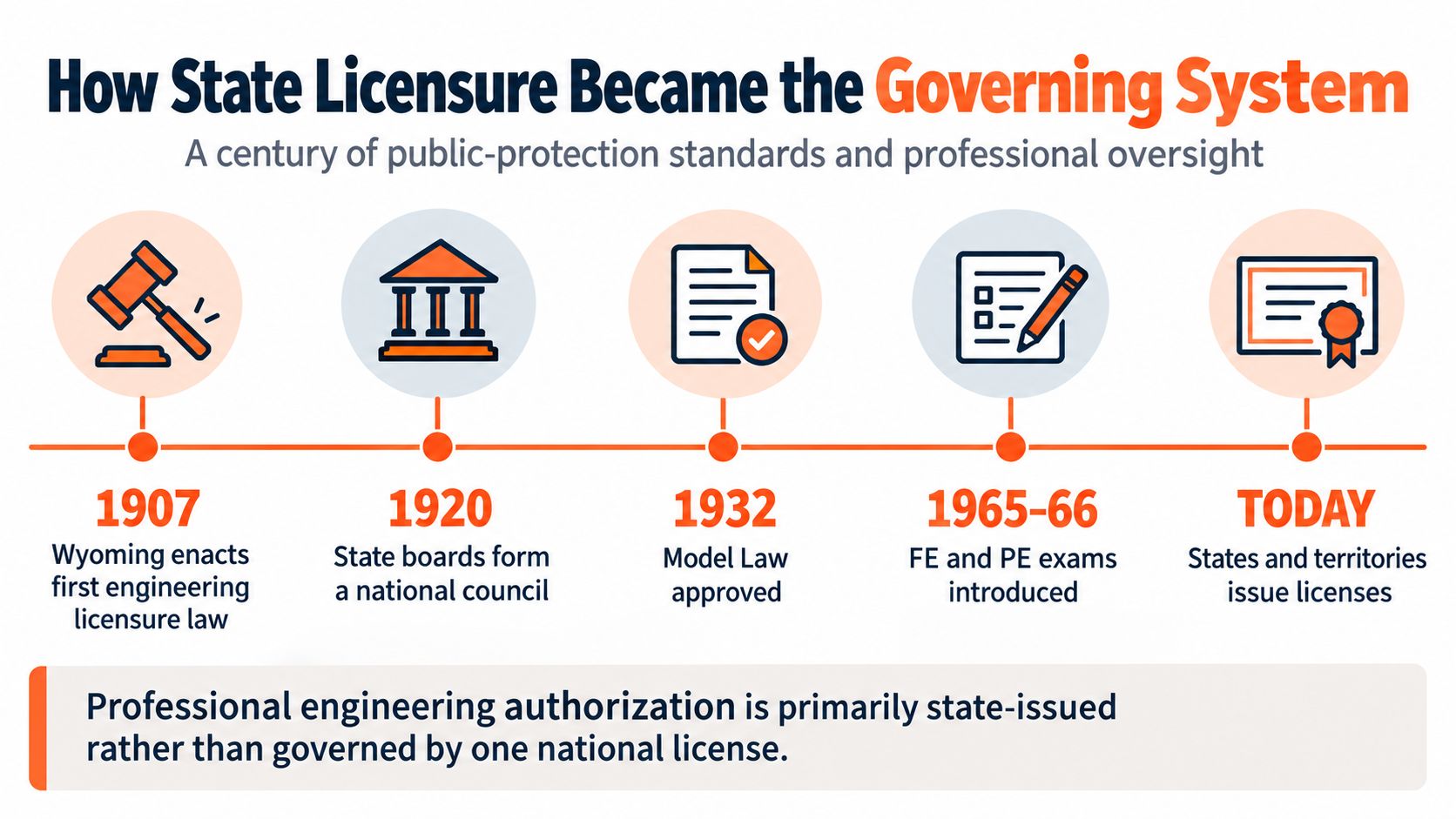
Wyoming enacted the first engineering registration law in 1907, requiring people who represented themselves publicly as engineers or land surveyors to register, and Louisiana followed in 1908, while Florida and Illinois adopted laws in 1915, as summarized in NSPE history of the professional engineer. By 1921, 19 states had laws regulating engineering practice under the same history. Montana became the final state to enact licensure legislation in 1947, and by 1950 every state, the District of Columbia, and Puerto Rico had some form of licensure law according to that account.
National Exams on a State Foundation
Examinations standardized later than the laws. Eight northeastern states administered a common Engineer in Training examination to 277 engineering seniors in 1955, 30 states offered the first Fundamentals of Engineering examination in May 1965, and a national uniform Principles and Practice of Engineering examination became available in 1966. By 1984, all state engineering boards administered both the FE and PE examinations.
The contrast matters for data work. Exams converged nationally. Authorization didn't. State boards retained legal control, so a national count is an aggregation of separate jurisdictional files, each with its own fields, statuses, and update timing.
That's why jurisdiction isn't a breakdown you add after counting. It's part of the identity of every record. Remove it, and you can't tell duplicate multi state licenses from duplicate errors.
The Model Licensure Pathway and State Control
The benchmark pathway is useful for understanding how a person enters a licensing file. It isn't a substitute for being in that file.
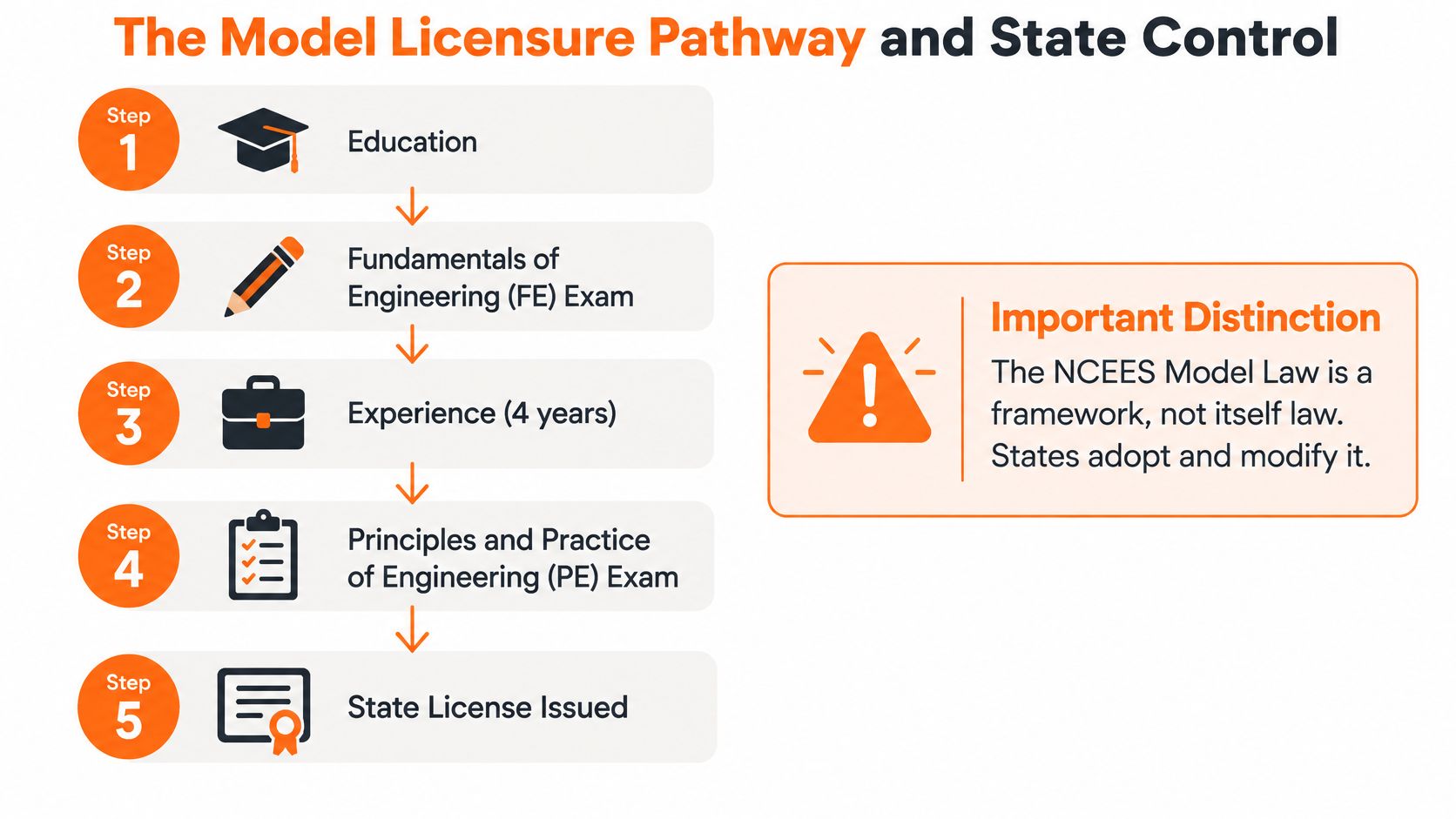
Under the framework described in NSPE licensure qualifications referencing the NCEES Model Law, the sequence runs as follows.
- Education: Earn an engineering bachelor's degree from an ABET Engineering Accreditation Commission program.
- FE examination: Pass the Fundamentals of Engineering examination.
- Experience: Complete at least four years of acceptable post degree engineering experience.
- PE examination: Pass the Principles and Practice of Engineering examination.
- Ethical standing: Maintain a record without ethical violations.
Why the Model Is Not the Law
The Model Law is a framework. It isn't itself controlling law. State boards decide education equivalency, examination eligibility, experience documentation, references, and renewal obligations. Two applicants with similar backgrounds can face different documentation requirements depending on where they apply.
For workforce research, that distinction separates candidates from licensees. Degree completions count graduates. Exam rosters count candidates or passers. Neither establishes that a board issued a license, that the license remains active, or that the holder can practice in a given state today.
Count from jurisdiction specific license records rather than inferring licensure from a degree, a job title, or exam participation.
Analysts should also resist treating each pathway step as a funnel you can estimate with fixed conversion rates. Licensing files don't show everyone who started the pathway. They show who completed it and remained in the record under the board's rules on your count date.
License Records Versus Occupational Employment Data
Occupational data and licensing data were built for different decisions. Use the one that matches your question, and don't average them into a hybrid figure.
The scale gap is easy to see. The Bureau of Labor Statistics reported 355,410 civil engineers, 350,230 industrial engineers, 286,760 mechanical engineers, 188,790 electrical engineers, and 150,750 engineers in the all other category in May 2024, totaling 1,331,930 jobs across those five groups in BLS occupational employment featured data. The same data counted 93,940 electronics engineers, 75,710 computer hardware engineers, and 111,140 architects. Across architecture and engineering occupations, employment totaled approximately 2.648 million in 2024, with a projection to about 2.788 million by 2034, an increase of 139,900 positions or 5.3%, in that BLS data.
None of those figures counts licensed Professional Engineers. Many engineering jobs don't require a PE credential, and requirements vary by state, discipline, work setting, and whether someone offers services to the public or seals regulated plans.
Choose the Measure That Matches the Question
| Measure | What It Represents | What It Cannot Establish | Best Use |
|---|---|---|---|
| BLS occupation count | Jobs in an occupation | Licensure or sealing authority | Market scale and labor demand |
| License record count | Authorizations in a file | Current employment or workload | Regulated capacity by jurisdiction |
| Degree count | Completed education | Exam passage or licensure | Pipeline analysis |
| Exam count | Candidates or passers | Board issued active status | Pathway progression |
Adjacent occupations add context, not licensees. Architects, electronics engineers, and computer hardware engineers interact with engineering projects, but folding them into a PE total changes the population without saying so.
Building a Complete Licensing Record Count
A count of licensed Professional Engineers is only as defensible as its row-level arithmetic. Samples, search exports, and scraped profile pages cannot produce one, because licensing populations are administrative universes: either the full public file was read, or the total is an estimate wearing a total's clothes.
Start with provenance. For each jurisdiction, record the source agency, file name, download date, and the board's stated reference date. Then track every row through the build:
- Read the complete file and log its row count.
- Standardize formats for identifiers, statuses, and dates so files can be combined.
- Separate entities under a written rule for spotting firms and organizations, kept distinct from person-level deduplication.
- Resolve duplicates by distinguishing repeated rows for one license from one person legitimately licensed in several jurisdictions.
- Reconcile the retained count against totals the board itself publishes, and explain every gap rather than adjusting without explanation.
Each stage records rows in, rows out, and why. That log is what turns a figure into a method.
Identity matching across jurisdictions is where national counts most often go wrong. Names repeat. License numbers are unique only inside a jurisdiction, so a match key that performs well within a single state file can fabricate merges when applied nationally. Document the fields used for matching, and flag uncertain pairs for review instead of forcing them together.
Reporting needs a floor too. As a working rule, publish shares only when the underlying base holds at least 20 rows; below that, a handful of records produces a percentage that looks stable and isn't. Report the count alone or suppress the share.
ProfessionLens applies this standard by publishing retained and dropped row counts and checking results against figures boards release. Any guidance on choosing among licensed professional data sources deserves the same test: can a reader trace the number back to rows?
Audit test: Rows read, retained, and dropped are the minimum disclosure. Without them, you have a figure, not a method.
Status and Attribute Fields That Change the Meaning
Two files with identical row totals can describe different populations. The fields inside the rows determine what your count means.
Fields to Retain in Every Extract
- Jurisdiction and license number: Together they identify the authorization.
- Status value: Captures categories such as active, inactive, retired, or expired as the board defines them.
- Expiration and renewal dates: Let you test status against your count date instead of trusting a label alone.
- Discipline or branch: Supports specialty analysis where the board records it.
- Issue date: Helps separate new authorizations from long held records.
- Entity indicator: Flags organizations so they don't inflate individual counts.
Don't collapse status values across states without a crosswalk. One board's inactive may permit limited activity while another's doesn't. Keep the original value, add your standardized category beside it, and publish the mapping.
Experience Is Not Elapsed Time
Qualifying experience also resists simple proxies. The NCEES Model Rules dated August 2025 specify that experience should be on engineering projects, show increasing quality and responsibility, follow qualifying education, comply with the licensure act, and include engineering mathematics, physical and applied sciences, material properties, and design principles. Experience is generally expected under a licensed professional engineer, and applicants must explain work that wasn't. Graduate study may receive limited credit, but a degree used for education requirements can't be double counted for experience.
For an employer or data audit, capture jurisdiction, status and expiration, discipline, supervising PE relationship where available, and project responsibility. Years employed alone doesn't establish qualifying experience, and a license record alone doesn't prove current project activity.
Detailed Entries for State and Discipline Analysis
A workforce analyst might open with a concrete case. Two published figures for the same state disagree by thousands of engineers, and neither is wrong. One counts every record on the register; the other counts only individuals whose status authorizes practice. The discrepancy lives in the label, not the data.
That case generalizes into a labeling rule. Every filtered entry derived from the verified population should carry four elements: state, status, unit, and date. Drop any one and readers will compare the figure against totals built differently.
The specification work differs by entry type. State entries remove entities and must note the method used. Discipline entries keep the board-recorded branch as published, showing unclassified records rather than redistributing them across known categories. County entries exist only where the source file supplies usable geography, and missing geography deserves its own reported category. Multistate entries require an explicit choice between unique persons and person-license pairs.
Entries such as licensed professional engineers in Texas illustrate the geographic version of this pattern. The value isn't the page format. It's whether the metadata travels with the figure when someone cites it elsewhere.
Two design decisions protect every downstream entry. First, resist filling gaps the source doesn't support: if a file lacks county, don't infer it from employer address without labeling that as a different geography. Second, keep geography, specialty, and status as separate dimensions in the table design. Combining them into one category field makes later verification nearly impossible. A smaller, bounded entry serves planners better than complete-looking coverage built on silent imputation.
Counting Multi-State Licenses and Practice Authority
A single engineer can appear three times in a national licensing file without any error in the data. Authorization stops at the state line, so an engineer whose projects cross borders must hold a license in each jurisdiction. Sum the state totals and the result overstates the unique workforce. Deduplicate aggressively and the result understates regulatory coverage.
The resolution is to name the unit before publishing the number. Four counting units exist, and each answers a different question:
| Counting unit | What one record represents | Typical misuse |
|---|---|---|
| Unique people | A distinct individual, deduplicated across jurisdictions | Labeling summed state totals as people |
| Active licenses | A record meeting the active status rule | Reporting license counts as headcount |
| Person-license pairs | One person counted once per jurisdiction of licensure | Treating pairs as evidence of practice |
| Practice-authorizing records | The subset whose status permits regulated practice on the count date | Equating an active flag with authorization |
Mobility between states remains an open administrative burden. Professional polling summarized in NSPE PE Magazine insights on industry issues shows 84% of respondents support aligning state requirements to make interstate practice easier. That summary also notes ASCE's observation that states differ in professional development hours, renewal periods, and documentation, a burden that grows with each license an engineer maintains.
A mobility dataset worth building would capture application fees, approval time, documentation demands, renewal schedules, continuing education hours, and whether inactive or retired status permits limited practice. It would also separate obtaining an additional license through comity from the recurring work of maintaining it.
The harder question follows the first count: what does each added jurisdiction cost to keep active, year after year?
Cross-References for Related Workforce Questions
A county engineer total and a hospital staffing file answer different workforce questions, so start by naming the unit your question needs: person, license, employer, or job.
For profession level comparisons, count pages covering physicians, dentists, pharmacists, nurse practitioners, real estate agents, insurance producers, and contractors use the same record centered logic. Treat each one as an authorization population defined by its regulator, and read the status definition before ranking states or professions.
Employer questions belong with named organization pages such as eXp Realty, Compass, Kaiser Permanente, and Cleveland Clinic. Questions about retention, distribution, or executive titles call for dated research reports. Reuse questions call for the underlying CSV when a report publishes rows.
Aggregate licensing counts can show how many records meet a rule and where those records sit. Exits, recruiting, satisfaction, and pay need surveys, employer sources, or longitudinal files. A question framed around a named firm loses evidence when it is answered with a statewide estimate, while a statewide question built from one roster invents coverage. Match scope to scope: statewide data for statewide questions, employer rosters for employer questions, row data for replication.
Quick Reference for Verifying Engineering Counts
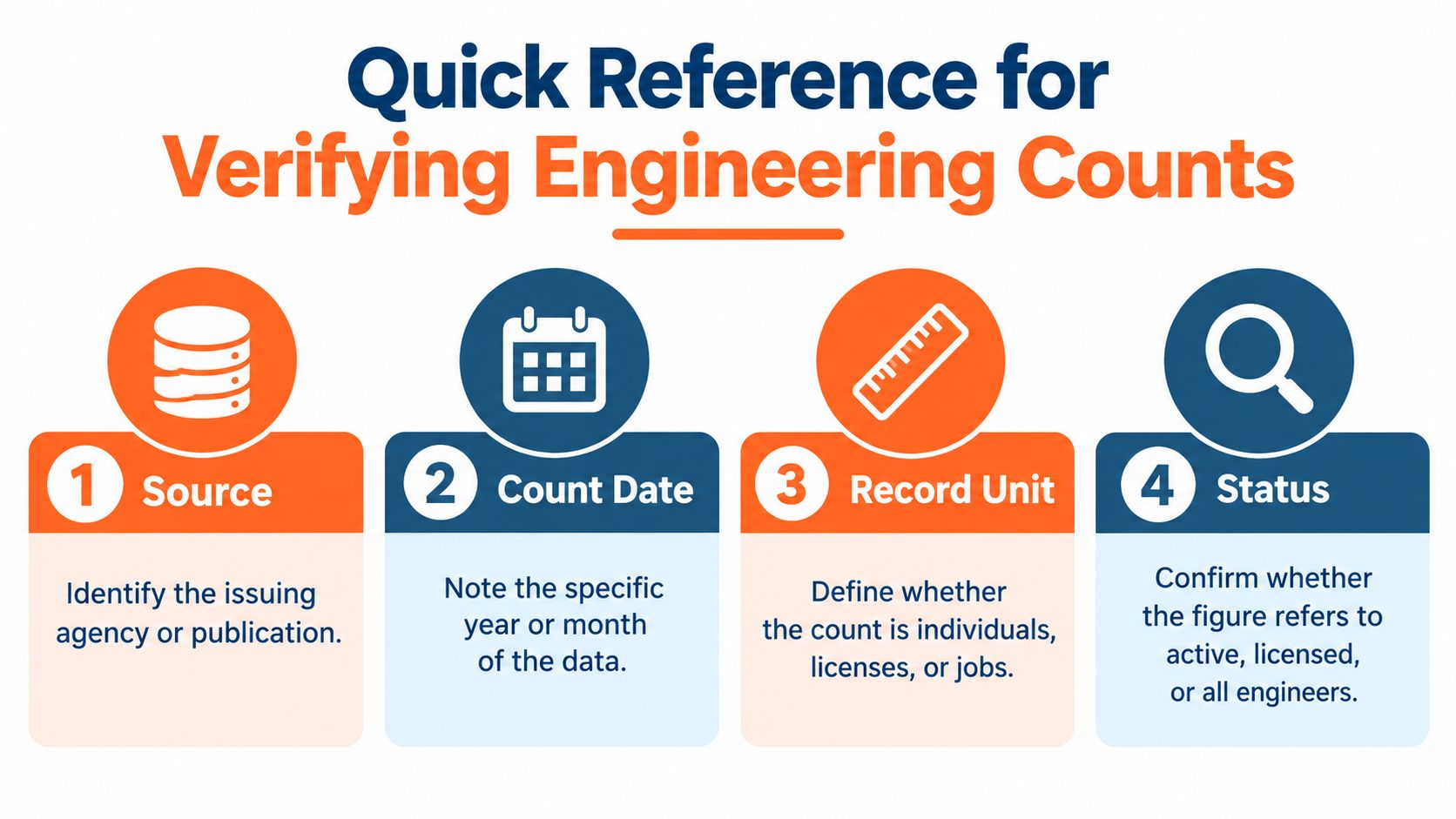
When you encounter a licensed professional engineer statistic, run it through a short verification sequence before you cite, chart, or compare it.
Six Checks Before You Cite a Figure
- Source: Which board or agency file produced the number.
- Count date: The reference date for status and expiration.
- Record unit: People, licenses, or person and license pairs.
- Status rule: Which status values were included, and how expiration was applied.
- Entity and duplicate handling: Whether organizations were removed and repeated rows resolved.
- Available dimensions: Whether geography, discipline, or employer fields come from the source or were inferred.
If a figure fails the first three checks, don't compare it with other totals. Label it as unverified context or leave it out. If it passes, cite it with its unit and date attached so the next reader inherits the definition, not just the number.
Keep the central distinction in front of every audience. A licensing population counts authorizations recorded by boards. Broader employment data counts jobs. Both are legitimate. They're answers to different questions, and a careful analyst won't let one stand in for the other.
ProfessionLens publishes dated, source documented counts of licensed professional engineers by state, county, and employer, with methods that show rows read, retained, and dropped. If you need a figure you can cite and verify rather than a headline you have to trust, visit ProfessionLens and start from the engineering count for your state.