Home / Blog / Licensed Professional Counselor Kansas: Counts and Rules
Licensed Professional Counselor Kansas: Counts and Rules
ProfessionLens, 2026-11-03
No published figure reviewed for this guide tells you how many people hold an active Kansas professional counselor license today. That's the starting point for any honest discussion of Licensed Professional Counselor Kansas counts. The numbers that are published measure employment in a broader occupation, pay in that occupation, or a later secondary summary of employment. They don't count active LPCs, and they don't count active LCPCs. If you quote one as if it did, you've changed the question without changing the number.
Table of Contents
- Kansas LPC Counts at a Glance
- Why License Counts and Workforce Counts Differ
- Kansas Counselor Licensure Timeline
- LPC and LCPC Requirements Side by Side
- Renewal, Continuing Education and Expiry Rules
- Clinical Hours and the Path From LPC to LCPC
- Checking a Count Before You Cite or Use It
- Confirm a Kansas LPC Status Before You Decide
Kansas LPC Counts at a Glance
There's no verified count of active Kansas LPC or LCPC licenses in the sources reviewed for this report. That isn't a gap you can fill with an employment figure. It's a missing row, and it should stay marked as unknown until someone pulls the state licensing board's roll, filters it by status and license level, and records the pull date.
What is published is narrower and older than most summaries suggest. The U.S. Bureau of Labor Statistics Kansas table counted 1,950 employed substance-abuse, behavioral-disorder, and mental-health counselors in Kansas in May 2023, with an annual mean wage of $54,170. Read that sentence carefully. It's an employment count for an occupational group, at a reference date, from an employer survey. It's not a license roll.
Published Kansas Counselor Counts by Source and Date
| Figure | Count | Reference date | Source and scope |
|---|---|---|---|
| Employed substance-abuse, behavioral-disorder and mental-health counselors, Kansas | 1,950 | May 2023 | U.S. Bureau of Labor Statistics employment survey, statewide |
| Same occupation, nonmetropolitan areas of Kansas | 550 | May 2023 | U.S. Bureau of Labor Statistics employment survey, nonmetropolitan areas |
| Same occupation, Kansas | 2,410 | May 2024 | Counseling workforce summary citing BLS data, secondary source |
| Active licensed professional counselors (LPC) | Not published | Pull date required | State licensing board roll, no count found in this research |
| Active clinical professional counselors (LCPC) | Not published | Pull date required | State licensing board roll, no count found in this research |
The nonmetropolitan row is a subset of the statewide occupation, not a separate workforce you can add to it. The May 2024 row needs different handling again. It comes from a secondary summary that cites federal data but gives no method of its own, so you shouldn't treat it as confirmed until you've checked it against the primary agency table for the same date and definition. Secondary doesn't mean wrong. It means unverified for citation purposes.
What the Occupation Includes
That BLS occupation is broader than LPCs. It can include people working under other credentials, people in roles that don't require a Kansas professional counselor license, and people whose job title fits the occupation even though their license, if they hold one, sits in another category. It also excludes a licensed counselor who isn't employed in that occupation in Kansas during the survey period. Neither direction cancels the other out.
Citation rule: Before you quote any figure, write down the measure, the reference date, the source, and the geography. If you can't fill in all four, you don't have a citable count yet.
For hiring, policy, or market sizing, the two unknown rows are often the ones you need. An employer asking how many independently licensed clinical counselors could fill a role needs the active LCPC row. A training provider estimating renewal demand needs active licenses by expiration period. An employment total answers neither question precisely, however clean the survey behind it is.
Why License Counts and Workforce Counts Differ
A license roll and a workforce survey count different populations on purpose. The roll lists people the state has authorized to use a title, subject to status and expiration. A workforce survey asks employers how many people they pay in an occupation group. One is about authorization, the other is about employment. You shouldn't expect them to match, and a mismatch alone doesn't prove either source is broken.
The Kansas geography split shows why labels matter. The U.S. Bureau of Labor Statistics nonmetropolitan Kansas table counted 550 employed substance-abuse, behavioral-disorder, and mental-health counselors in Kansas's nonmetropolitan areas in May 2023, with an annual mean wage of $56,980. Against the statewide employment figure, that's a nonmetropolitan share of 28.2%, calculated as 550 divided by 1,950. The nonmetropolitan mean wage also runs $2,810 above the statewide mean, calculated from the two published wage figures.
Three Questions, Three Measures
- How many people may use the title: Use an active-license count from the board roll, split by LPC and LCPC.
- How many people work in the occupation: Use an employer-based employment count, and name the occupation exactly.
- What does the occupation pay: Use a wage figure from the same survey and date, and don't present it as LPC-specific pay.
That nonmetropolitan wage gap is a good example of a finding that invites overreading. It describes pay across the broad occupation in nonmetropolitan areas. It doesn't show that rural LPCs outearn urban LPCs, because the underlying group isn't limited to LPCs and the mix of employers, credentials, and full-time roles can differ by geography. Report the gap with its scope, or don't report it as a counselor-license finding.
Timing creates a second trap. You can't subtract a May 2023 survey count from a license roll pulled in a later year and call the difference growth, decline, or unlicensed practice. The populations differ, and the dates differ. Our counts at ProfessionLens are computed from public licensing rolls and federal files as pulled on the count date, and a roll can carry errors, duplicates or lapsed licences. That's why the pull date belongs next to the number, a discipline that also applies when you compare professions such as the state patterns in nurse practitioner counts by state.
Choose the measure that matches your question before you choose a number. If you start with the number you found first, you'll bend the question to fit it.
Kansas Counselor Licensure Timeline
Kansas didn't move from no regulation to a two-level license in one step. The Kansas Behavioral Sciences Regulatory Board history records that the 1987 Session Laws of Kansas, Chapter 315 expanded the board's jurisdiction to professional counselors. That step put counselors inside the regulatory system without yet creating the current licensure structure.
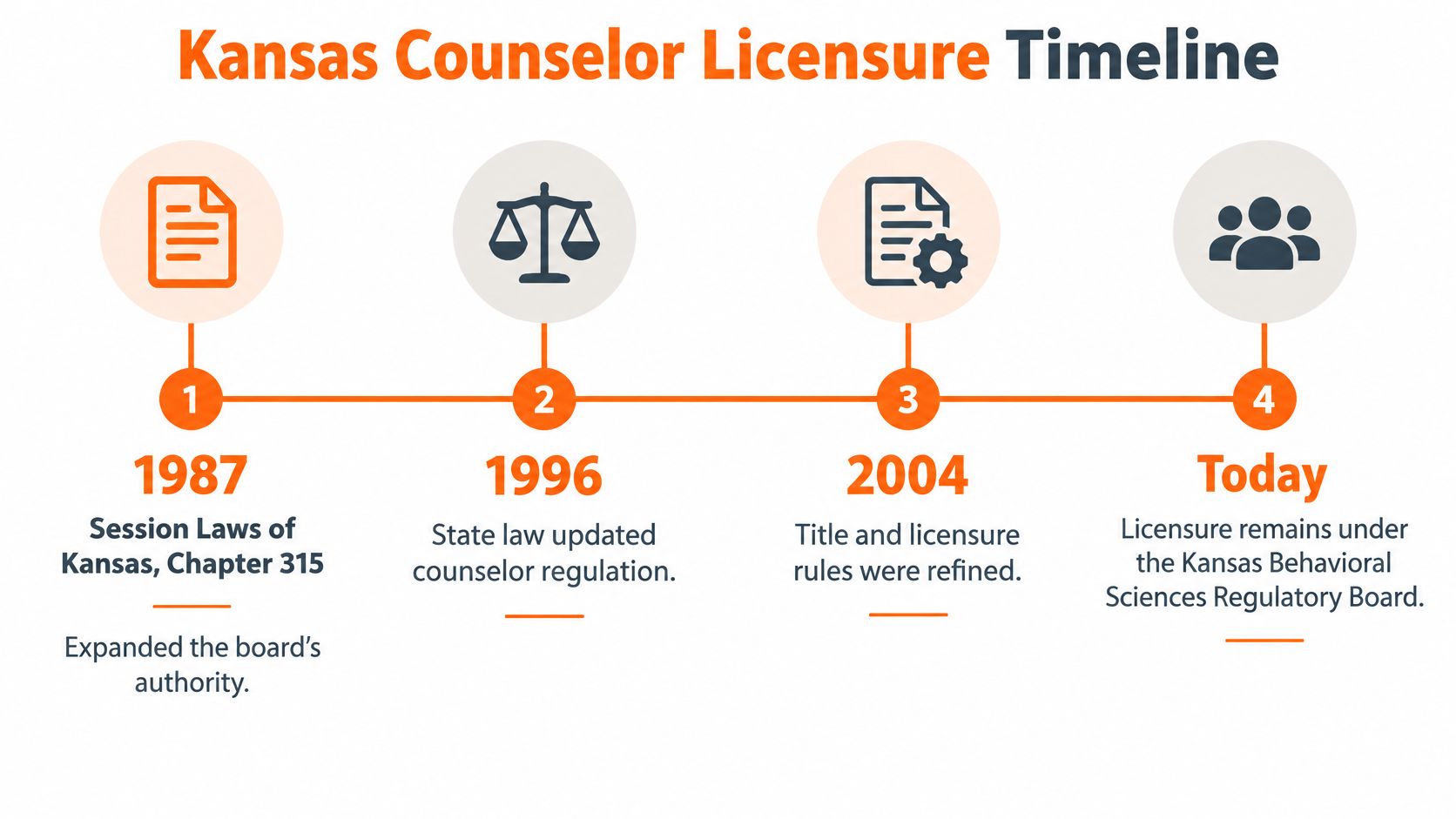
The 1996 legislative session then substantially amended the statutes governing professional counselors, including requirements tied to education, supervised experience, and examinations, according to the same board history. On January 1, 1997, professional counselors and several other behavioral-health groups moved from a registration system to formal licensure. That date matters for counting: a pre-1997 registration record and a post-1997 license record describe different credential statuses, even when a legacy database carries both in one list.
The clinical tier arrived later still. As the statute developed after the 1997 switch to licensure, the legislature added clinical licensure levels, including the clinical professional counselor credential that became today's LCPC. The result is a tiered structure where the LCPC is a separate, higher credential than the LPC, built on additional supervised clinical work.
That sequence explains why a useful Kansas count has to split LPC from LCPC. A combined total can't show how many people hold the clinical credential, and it can hide movement from one level to the other. It also sets a limit on trend claims: a count taken under one statute's definitions can't be compared cleanly to a roll kept under an earlier regime. When you review an individual record, match the issue date to the rules in force on that date before assuming current education or renewal rules explain how the license was first granted.
LPC and LCPC Requirements Side by Side
Start with the shared base, then look for what the clinical level adds. Under the 2024 Kansas statute, an applicant must be at least 21 years old and complete 60 graduate semester hours, including a graduate degree in counseling or a related field from a board-approved institution. Applicants must also pass an examination required by the board and demonstrate that they merit the public trust. Those thresholds define who's inside the licensed population. A person with a counseling degree who hasn't met them isn't an LPC for counting purposes.
At least 45 of those 60 hours must be counseling coursework distributed across 10 specified areas. The statute lists counseling theory and practice, the helping relationship, group dynamics, human growth and development, lifestyle and career development, appraisal, social and cultural foundations, research and evaluation, professional orientation, and supervised practicum and internship. The distribution is part of the standard, so a transcript review has to test both the total and the coverage rather than treat the requirement as a generic graduate degree.
Entry Requirements for Kansas LPC and LCPC Licenses
| Requirement | LPC | LCPC |
|---|---|---|
| Minimum age | 21 | 21 |
| Graduate semester hours | 60, including a board-approved graduate degree | 60 total, plus 15 credit hours on diagnosis and treatment of mental disorders |
| Counseling coursework within graduate hours | At least 45 across 10 areas | Same 45-hour base across the 10 areas |
| Supervised experience | Practicum and internship within the 10 areas | At least 3,000 hours over a minimum of 24 months |
| Direct client contact | Within the supervised practicum and internship | 1,500 hours of postgraduate direct client contact, and at least 280 hours in the practicum or qualifying experience |
| Supervision hours | Within the graduate practicum and internship | 100 hours with board-approved postgraduate supervisors |
| Examination | Board-required examination | Board-required examination |
| Character standard | Demonstrate merit of public trust | Demonstrate merit of public trust |
The clinical pathway adds specialized preparation on top of that base. It requires 15 graduate credit hours addressing diagnosis and treatment of mental disorders and supervised clinical experience involving psychotherapy and assessment, with at least 280 hours of direct client contact within the supervised clinical practicum or qualifying postgraduate experience, as specified in the statute linked above. Read the table left to right. The LCPC column doesn't replace the LPC base. It layers diagnosis and treatment coursework and defined clinical experience onto it.
Check each row against your transcripts and the board's current requirements before you apply, since application checklists and supervision paperwork can ask for more documentation than the thresholds above suggest. The same caution applies when you compare counselor titles with adjacent roles such as those covered in licensed professional therapist guidance, where similar job language can hide different state credentials.
Renewal, Continuing Education and Expiry Rules
An active license is a dated status with an end date attached. The Kansas statute on expiration and renewal states that licenses expire 24 months after issuance and that renewal requires evidence of completed continuing education. Kansas LPC licenses therefore operate on a two-year renewal cycle, and a count of license records that ignores expiration will overstate the active workforce.
Each renewal period requires 30 documented, approved continuing-education hours. The education must enhance professional practice, values, ethics, skills, or knowledge, and the cited framework carves out category minimums inside that total: three hours of professional ethics plus a minimum number of hours addressing the diagnosis and treatment of mental disorders under the Kansas administrative rule described in that source. The size of that second minimum depends on when your renewal period began, so confirm which version applies to your dates before logging hours by category.
The July 1, 2025 Change
There's a transition you need to date correctly. The Kansas Behavioral Sciences Regulatory Board professional counselors page describes current requirements as 30 total hours, with at least 3 hours in ethics and 3 hours in diagnosis and treatment, and states that the diagnosis-and-treatment minimum was reduced from 6 hours to 3 hours for periods beginning July 1, 2025. A renewal period that began before that date falls under the earlier six-hour floor, and a period beginning on or after it falls under three. Don't apply the later minimum backward, and don't cite the earlier figure as current without attaching its dates.
A lower statutory minimum doesn't mean a counselor needs less clinically relevant training. It sets a compliance floor. A counselor preparing for LCPC work, assessment, supervision, or higher-risk practice may still need substantially more diagnosis and treatment education than the renewed minimum requires, and an employer can set expectations above the state floor. Readers comparing professions will see the same distinction between a regulatory floor and practice readiness in continuing education requirements for physicians from Documind, where the documented hours and the clinical need measure different things.
Plan backward from your expiration date, log hours by category as you complete them, and confirm board approval before the deadline rather than during a last-month scramble.
For research, use the licensing authority's status and expiration fields, separate active licenses from expired or lapsed records, and preserve the count date.
That counting rule matters because status can change throughout the biennial cycle. A roll pulled before a large renewal deadline and the same roll pulled after it can produce different active totals without any real change in the underlying profession. Record the date, the status values you included, and the license levels you counted. Without those three notes, another analyst can't reproduce your figure.
Clinical Hours and the Path From LPC to LCPC
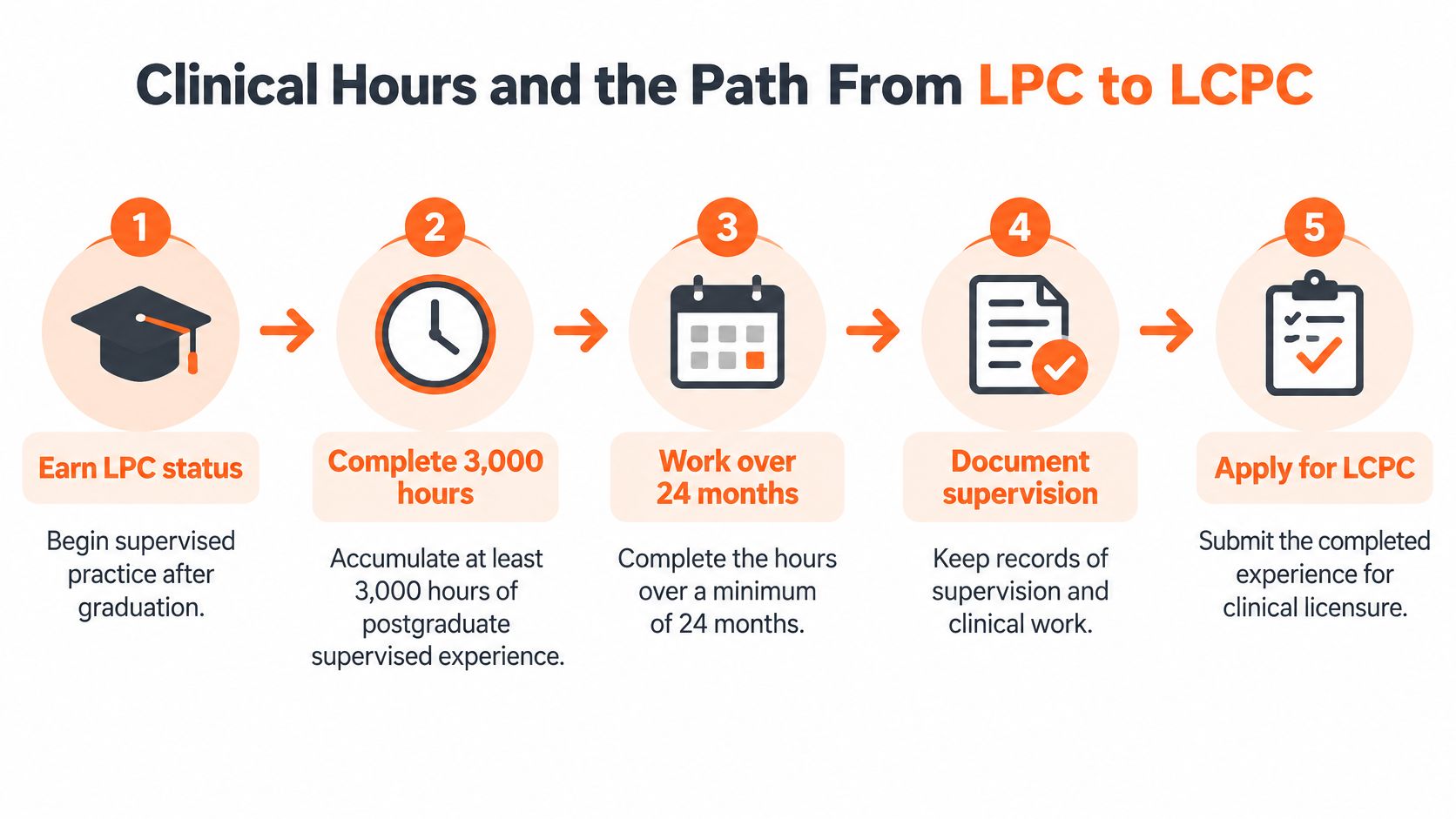
The arithmetic comes first, because it controls your timeline. The Kansas statute text for clinical licensure requires at least 3,000 hours of postgraduate supervised experience over a minimum of 24 months, including 1,500 hours of direct client contact and 100 hours of supervision. Postgraduate clinical supervisors must be board-approved. That last point isn't paperwork trivia. It can decide whether your hours are accepted.
Weeks and Months to Reach 3,000 Supervised Hours at a Steady Pace
| Weekly supervised hours | Weeks to 3,000 hours | Approximate months |
|---|---|---|
| 40 | 75 | 17 |
| 30 | 100 | 23 |
| 10 | 300 | 69 |
Weeks equal 3,000 divided by weekly supervised hours, and months equal weeks divided by 4.33. At 40 hours a week, you reach the hour total in about 75 weeks, but you still can't finish before the 24-month minimum. At 30 hours a week, the hour total takes about 23 months, so the minimum period again sets the earliest finish. At 10 hours a week, the hour total dominates and stretches to about 69 months. In practical terms, the floor starts to bind around the high-20s in weekly supervised hours, because 3,000 hours spread over 24 months requires about 125 hours a month.
Don't model only the 3,000-hour total. A job can give you plenty of supervised hours and too little direct client contact. If administrative work, documentation, meetings, and nonclinical duties fill your week, you may approach 3,000 hours while falling behind the 1,500-hour direct-contact target. Track the two clocks separately from your first week. Retrospective reconstruction from calendars and payroll records is slower, less convincing, and harder for a former supervisor to verify.
Steps That Protect Your Hours
- Confirm approval first: Verify that your postgraduate clinical supervisor is board-approved before you count the experience.
- Use separate columns: Log total supervised hours, direct client contact, and supervision against the 3,000, 1,500, and 100 hour targets.
- Keep admin time separate: Don't place administrative duties in the direct-contact column, even if they concern a client case.
- Test out-of-state entries: Ask the Kansas Behavioral Sciences Regulatory Board whether hours earned under a different state's license, supervisor, or setting will count toward clinical licensure before you build them into your plan.
- Document before you leave: Secure hours, dates, setting details, and supervisor information before you change employers.
Say you move to Kansas after two years of supervised work elsewhere. The useful question is specific, not general: will this exact job, this exact supervisor, and this exact out-of-state history count toward Kansas clinical licensure? Put that question to the Kansas Behavioral Sciences Regulatory Board before you set a start date or build a caseload plan around the answer. Get the response in a form you can file, with dates and hour categories intact. A supervisor change, a gap in supervision, or a caseload heavy on administrative work can each shift which hours qualify, and finding out late means the 24-month clock effectively restarts under a different arrangement.
Checking a Count Before You Cite or Use It
A 23.6% one-year jump is a verification trigger, not a headline. A counseling workforce summary citing U.S. Bureau of Labor Statistics data reports 2,410 employed substance-abuse, behavioral-disorder, and mental-health counselors in Kansas in May 2024, against 1,950 in May 2023: an increase of 460, or 23.6%. That is an employment count for a broad counselor occupation; a Kansas LPC or LCPC license count measures a different population.
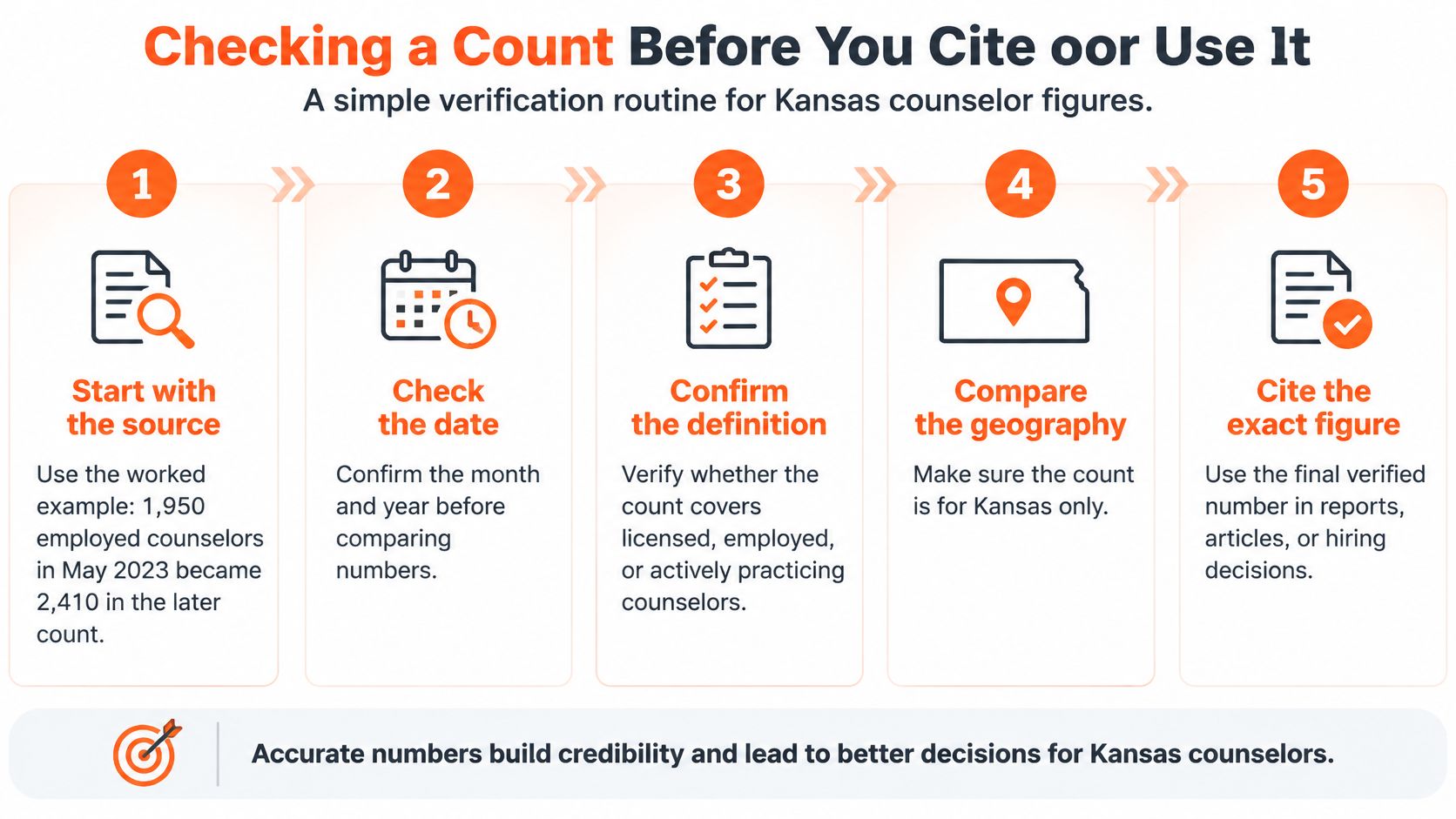
Treat the gap between those measures as the first check. The employment figure can include counselors who hold other credentials, hold no Kansas license, or work under job titles that do not match licensure level; a license roll answers a different question. Before citing the increase, confirm that both years use the same occupation definition, statewide geography, and survey basis. If they do, the rise may be real. If any element changes, the apparent trend can be an artifact.
Verification Routine
- Confirm the reference date: Use the survey or record date, not the webpage publication date.
- Confirm the source type: Separate a statistical agency table from a summary citing one.
- Confirm the geography: Statewide and nonmetropolitan figures answer different questions.
- Confirm the population: Ask whether the category includes people with no Kansas LPC or LCPC license.
- Handle disagreement openly: Prefer the primary agency table, and report both figures with dates rather than choosing one without explanation.
- Cite the full label: Give the measure, date, source, and scope together every time.
Keep notes stable enough that the same figure lands in the same row every time. The recordkeeping insights from Planstone concern the spelling of "recordkeeping" versus "record-keeping"; the useful lesson is narrower, that consistent labels matter more than which spelling you choose. Apply the same source discipline you would expect from licensed professional data sources, then place the figure in its row in the opening table. If it fits only after you soften the label, it does not belong in the comparison.
Confirm a Kansas LPC Status Before You Decide
Confirm an individual's Kansas LPC or LCPC status before you hire them, refer a client, enroll them in supervision, or cite them as part of a licensed count. Don't rely on a resume, a directory profile, or an old roster export. Start with the license lookup run by the Kansas Behavioral Sciences Regulatory Board, because the board record is the source of truth for status and level.
Lookup Steps
- Check status: Look up the individual and confirm the license status is active.
- Check expiration: Note the expiration date and compare it with the two-year renewal cycle.
- Check level: For a clinical role, confirm the LCPC level is listed, not only the LPC.
- Check identity: Match the person's name and license number so a duplicate or lapsed record isn't mistaken for an active one.
- Date the check: Record the date you checked, because status can change between checks.
Then act on the result. If the status is active and the level matches the role, proceed with the dated record in your file. If it's expired, lapsed, or unlisted, don't treat the person as licensed until the board confirms otherwise. That pause protects clients, employers, supervisors, and anyone who later relies on your count.
We count health professions nationally at ProfessionLens, and every ProfessionLens count is free to read and to cite, with no account and no paywall. You may cite, quote and link to any ProfessionLens count with attribution and a link back to the page it came from. For an individual Kansas decision, though, the board lookup outranks any aggregate page, including ours. You should leave with three things: a verified status, the correct license level, and a dated check you can show to the next person who asks how you decided.
Use ProfessionLens when you need dated, attributable counts of licensed professionals by profession, geography, and employer, with the source and scope stated next to the figure. For Kansas counselors, pair those aggregate counts with a same-day board lookup before you hire, refer, or publish. Visit ProfessionLens to compare the available profession counts and cite the exact figure, date, and page your decision depends on.