Home / Blog / Professional License Washington State Counts
Professional License Washington State Counts
ProfessionLens, 2026-10-31
Washington's licensing system covers 83 health-care-related professions through the Department of Health or health boards and commissions, alongside 45 professions through the Department of Licensing, according to the legislative breakdown described with Washington's Department of Licensing Professional License Count. That split changes how a researcher should read any professional license Washington State count. A DOL total describes one administrative system, not the state's entire licensed workforce.
Table of Contents
- Who Issues a Professional License in Washington State
- Landscape Architect Licenses in the 2024 Review
- Renewal Rules Under WAC 246-12
- Continuing Education Hours by Profession
- Reciprocity and Military Portability Routes
- Lookup Groups and Misreading Checks
- Verify an Individual License Step by Step
- Choose the File Before You Cite
Who Issues a Professional License in Washington State
Washington credentials sit in five public record systems listed below. Each system records a different kind of credential or activity, so its totals answer different questions about the licensed workforce.
Washington professional-license authorities
| Authority | Scope named in public sources | What a count measures | Do not treat it as |
|---|---|---|---|
| Department of Health and health boards | 83 health-care professions | Credential records under health rules, including WAC 246-12 renewal | A DOL professional-license total |
| Department of Licensing | 45 professions | Point-in-time active licenses to people or businesses, by county and state | Every licensed professional in Washington |
| Labor and Industries | Workplace and contractor credentials outside the DOL professional file | Its own license and registration records | Part of the DOL active-license count |
| Office of Superintendent of Public Instruction | Educator certificates | Its own certificate records | A DOL or DOH profession count |
| DOL transaction series | Original licenses, renewals and reinstatements | Administrative events, including repeat renewals | A count of distinct people |
Choose the administrative population
For research, use five public systems as a practical lookup framework: health credentials, DOL business and professional licenses, Labor and Industries credentials, educator certificates, and DOL transaction records. A profession outside these systems requires its own authority.
The DOL public count is a point-in-time measure of active licenses issued to people or businesses, organized by county and state. Its unit matters as much as its total. Business licenses do not become a person-level workforce count merely because the file is labeled professional.
Before extracting a figure, define the population in plain language. For example, a researcher might seek active individual credentials in a named profession, including all address jurisdictions. That differs from counting Washington residents who work in the occupation.
Practical rule: Choose the agency row before citing a number. Then label the measure as active licenses, transactions, registrations, certificates, or another defined record type.
Keep license stocks separate from administrative events
An active-license file measures a stock at a particular point. A transaction file measures activity, such as an original issue, renewal, or reinstatement. Because one holder can generate repeated events, adding transaction rows does not establish the number of distinct credential holders.
A licensing record can show that an authority issued a credential, but it does not provide a complete account of the holder's training or employment history. For engineering pathways, engineering experience requirements for PE licensure offers background on qualifying experience and the resulting license record.
For a reproducible analysis, record the agency, file title, extraction date, unit of observation, and inclusion filter. Preserve the original category labels. Replacing every record category with “professional” can obscure what the resulting count measures.
Landscape Architect Licenses in the 2024 Review
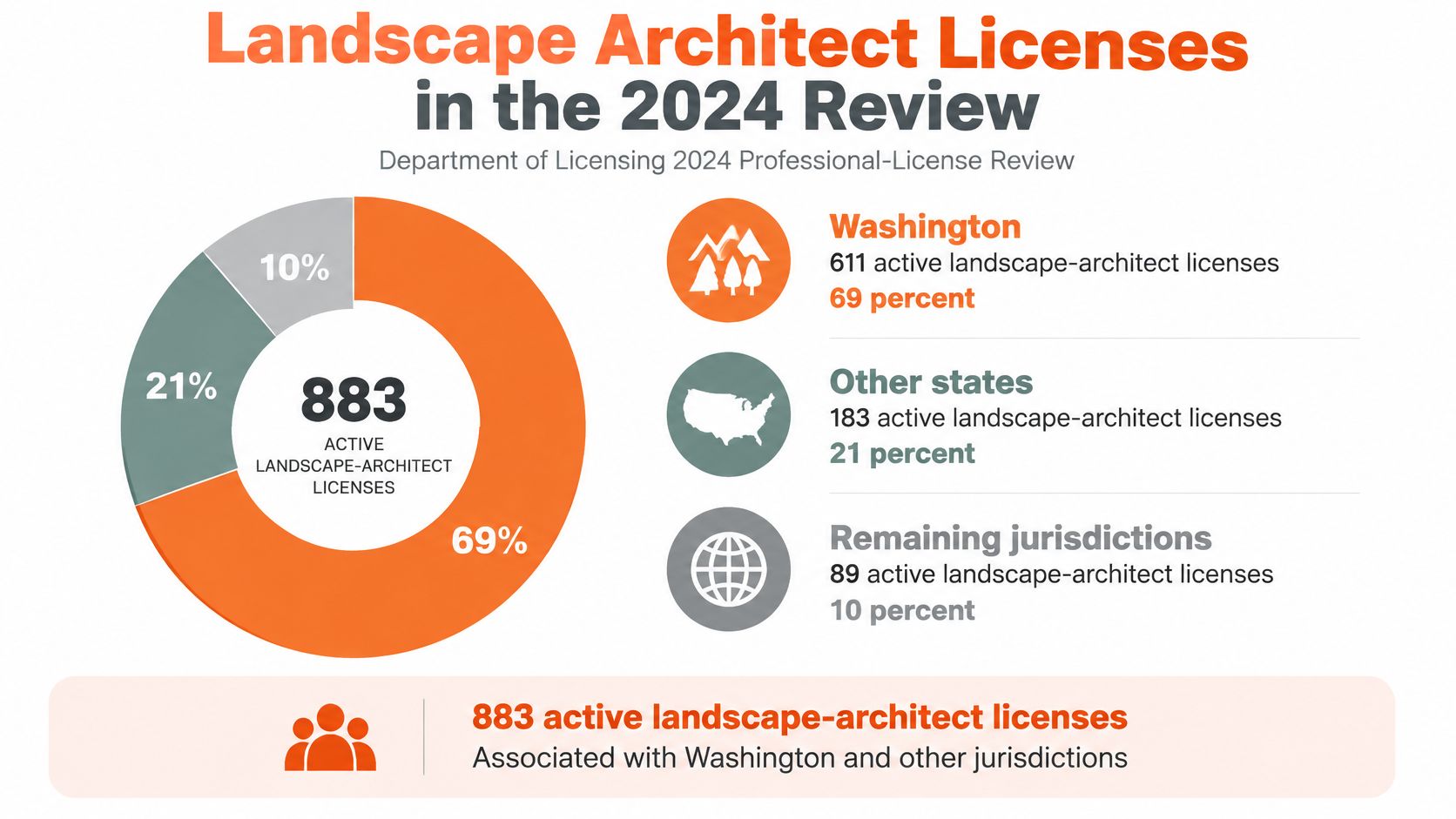
The Department of Licensing's 2024 professional-license review reported 883 active architect licenses. Of these, 611 were associated with Washington, 183 with Oregon, 83 with Canada, and 6 with other international locations. The reported shares were 69%, 21%, 9%, and about 1%, respectively. These are Washington-issued credentials grouped by geography, not a direct count of workers living in the state.
The chart summarizes the geographic distribution of the 883 active architect licenses.
Architect licenses by geography, 2024 review
| Measure | Count | Share of 883 |
|---|---|---|
| Washington | 611 | 69% |
| Oregon | 183 | 21% |
| Canada | 83 | 9% |
| Other international | 6 | About 1% |
An older license population isn't a retirement forecast
The review's age counts do not reconcile with the reported total of 883 active licenses, so they cannot support a reliable age distribution. Even a consistent age profile would not establish when licensees might retire, whether they work full time, or whether they currently practice.
Workforce planning requires comparable snapshots or linked administrative histories to examine retention and exits. License status alone does not show whether a holder is working.
The geographic profile raises a separate question: what does the location field represent? Mailing geography, residence, employer location, and project location are different measures. A location count should not stand in for local service capacity unless the underlying field supports that interpretation.
Copy the reporting fields, not an assumed workforce
The review also covered court reporters, employment agencies, and whitewater outfitters. For each profession, a worksheet can preserve the active count, address geography, available age bands, and review period. Missing demographic information should remain missing, and employment should remain unmeasured when the file does not identify it.
That produces a narrower, more defensible account of what the administrative record establishes. Questions about residence, working hours, and service delivery require other evidence.
Renewal Rules Under WAC 246-12
Under WAC 246-12, credentials must be renewed, expiration generally falls on the practitioner's birthday, and renewal requires the applicable fee, any profession-specific substance-use-disorder monitoring surcharge, and required declarations or documentation. These are credential-specific conditions, not a universal renewal interval for every Washington professional.
The rule also distinguishes continuing education from renewal in general. Education is mandatory when the profession's governing law or rules authorize it; where required, the licensee attests to compliance and retains completion records for audit. Don't infer an identical education obligation from the mere presence of an expiration date.
Read status as an administrative finding
An unexpired credential establishes something about the credential record. It doesn't establish that the holder saw a patient, worked for an employer, accepted new clients, or maintained a particular workload. Even the word current needs a definition: current in the agency file is not the same as currently practicing.
Use separate fields for these separate questions:
- Credential status: Preserve the authority's exact status label rather than replacing it with a homemade employed flag.
- Expiration basis: Identify whether the profession uses a birthday-linked expiration or another rule.
- Verification date: Store when you inspected the record, not just when you downloaded your analysis.
- Practice evidence: Leave this field unknown unless an appropriate source independently establishes practice.
A saved record is also not a permanent determination. A researcher should describe what the authority showed at verification, without promising that the credential remains unchanged afterward.
An administrative permission to practice is not a measurement of work performed.
Use renewal timing carefully
Birthday-linked expiration makes calendar-quarter analysis easy to misread. A concentration of renewal events in a period can reflect the timing of credential expirations rather than a sudden change in demand for care. Researchers should compare renewal events against the applicable expiration schedule before describing an increase as workforce growth.
For interstate work, use a separate state-specific reference, such as the Wisconsin professional-license guide, rather than carrying Washington's renewal assumptions into another jurisdiction. Match the profession and governing authority before comparing statuses.
The useful dataset is therefore more detailed than a list of names and expiration dates. Store profession, credential type, expiration basis, status, and last-verified date as distinct variables. If your research question concerns actual practice, build a separate method for that question rather than recoding credential validity as employment.
Continuing Education Hours by Profession
Continuing-education requirements depend on the credential, reporting period, and approved subject areas. A raw hours total cannot show whether a professional met all three.
Washington counselors must complete 32 hours every two years under the state counselor rules. The table compares that requirement with the CPA and land-surveyor benchmarks.
Washington continuing-education benchmarks
| Credential | Hours | Cycle | Topic or floor rules |
|---|---|---|---|
| Licensed counselors | 32 | Every 2 years | At least 6 hours ethics and law, 2 hours roles and boundaries, and 2 hours health equity every 4 years |
| CPAs | 120 CPE | 3-year reporting period | 4-hour board-approved ethics course, at least 20 hours each calendar year, no more than 60 hours nontechnical |
| Professional land surveyors | 30 PDH, or 15 if the first cycle is under 2 years | Prior 2-year renewal cycle | Shorter initial cycle uses the 15-hour rule |
A counselor who completes fewer than 32 hours falls short of the counselor benchmark, even if those hours would meet another profession's total. Full compliance also depends on eligible activities, topic requirements, and the applicable reporting period.
Compare obligations, not raw hours
The CPA requirements illustrate why annual minimums and reporting-period totals belong in separate fields. Meeting an annual floor does not establish that a holder completed the full three-year total. A large total alone also does not show whether the ethics requirement was met or the nontechnical-hour limit was observed.
For an audit-ready worksheet, record the required total, cycle dates, topic floors, and eligible activity classifications separately. Note whether compliance is self-attested, independently documented, or unavailable in the public file. A public status label does not establish that each course was independently checked.
Ranking professions by required hours per year can obscure course eligibility, subject restrictions, initial-cycle exceptions, and review procedures. The calculation describes an arithmetic average, not the full regulatory obligation.
Preserve the fields needed for aggregation
Before producing a cross-profession count, retain these core fields:
- Profession: Keep the regulated occupation identifiable.
- Renewal cycle: Attach compliance to its actual reporting period.
- Active or inactive status: Use the agency definition rather than assuming every record is equivalent.
- Last-verified date: Make the observation reproducible.
These benchmarks do not cover every Washington profession. An unlisted profession needs its own governing rule, and a credential subtype may require a more specific check. When a public roll lacks education details, report the credential status it supplies rather than assigning a compliance score.
Reciprocity and Military Portability Routes
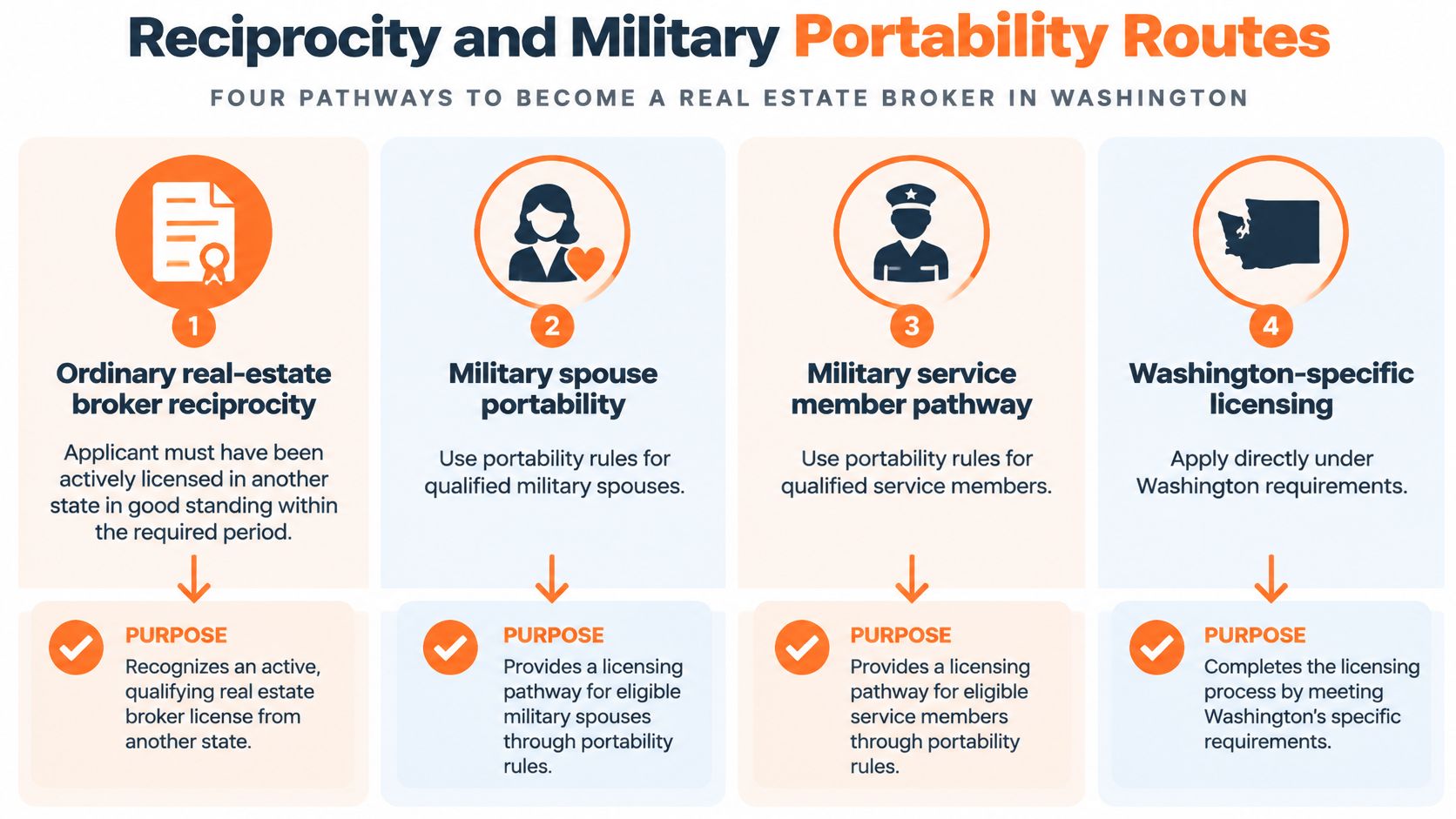
Washington does not have one reciprocity rule for every profession. The route depends on the credential and the applicant's circumstances. For real estate brokers, the Department of Licensing's reciprocity guide requires an active out-of-state license in good standing within the prior six months, license history, and completion within a six-month approval window. Other pathways have different eligibility criteria and evidence requirements.
The visual distinguishes ordinary reciprocity from military-related and direct Washington licensing pathways.
Washington portability routes by applicant
| Situation | Route | What must be true | Time limit |
|---|---|---|---|
| Real estate broker from another state | Ordinary reciprocity | Actively licensed elsewhere in good standing within the prior 6 months, plus license history | Finish within a 6-month approval window |
| Servicemember or spouse relocating on orders | SCRA military portability | Valid out-of-state license, military-order relocation, recent use, good standing; background check possible | Tied to the military relocation facts |
| Marriage and family therapist | Temporary probationary license | Substantial equivalency | Not specified here |
| Associate counselor | Annual continuing education, not the MFT temporary license | Profession-specific CE each year | Annual |
For marriage and family therapists, the temporary license route is based on substantial equivalency. Associate counselors have annual continuing-education obligations under their own credential framework. Neither route should be treated as a real estate broker reciprocity pathway, and annual education alone does not grant portability.
Select by applicant facts
Start with the profession and applicant category. Military relocation may make a portability pathway relevant, but the applicant still needs to meet the applicable requirements for the out-of-state credential, qualifying use, and good standing. Holding a current license alone does not establish eligibility.
Then obtain license history and the intended work timeline. The last date of active status and the last date of practice can answer different eligibility questions.
A broker whose license history falls outside the reciprocity recency requirement should not be assigned to that route solely because they held a license in the past. A military spouse may need to be assessed under a military portability process rather than only under the ordinary broker route.
Separate permission stages in the dataset
For workforce research, record the application route separately from the credential stage. Permission to proceed, a temporary credential, and an issued active license are distinct administrative outcomes. Combining them can make applicants appear to be fully licensed before the agency has reached that determination.
Use separate fields for application route, evidence reviewed, approval stage, and credential issued. If a public file does not identify the route, leave it unknown rather than inferring it from an out-of-state address.
The defensible conclusion is specific: the documented facts may match a pathway, subject to the authority's determination. That is more informative than saying Washington has reciprocity across professions.
Lookup Groups and Misreading Checks
A professional-license lookup should begin with a routing index, not a statewide search assumption. Assign the profession to the relevant public system before opening a file, then preserve the terminology that system uses.
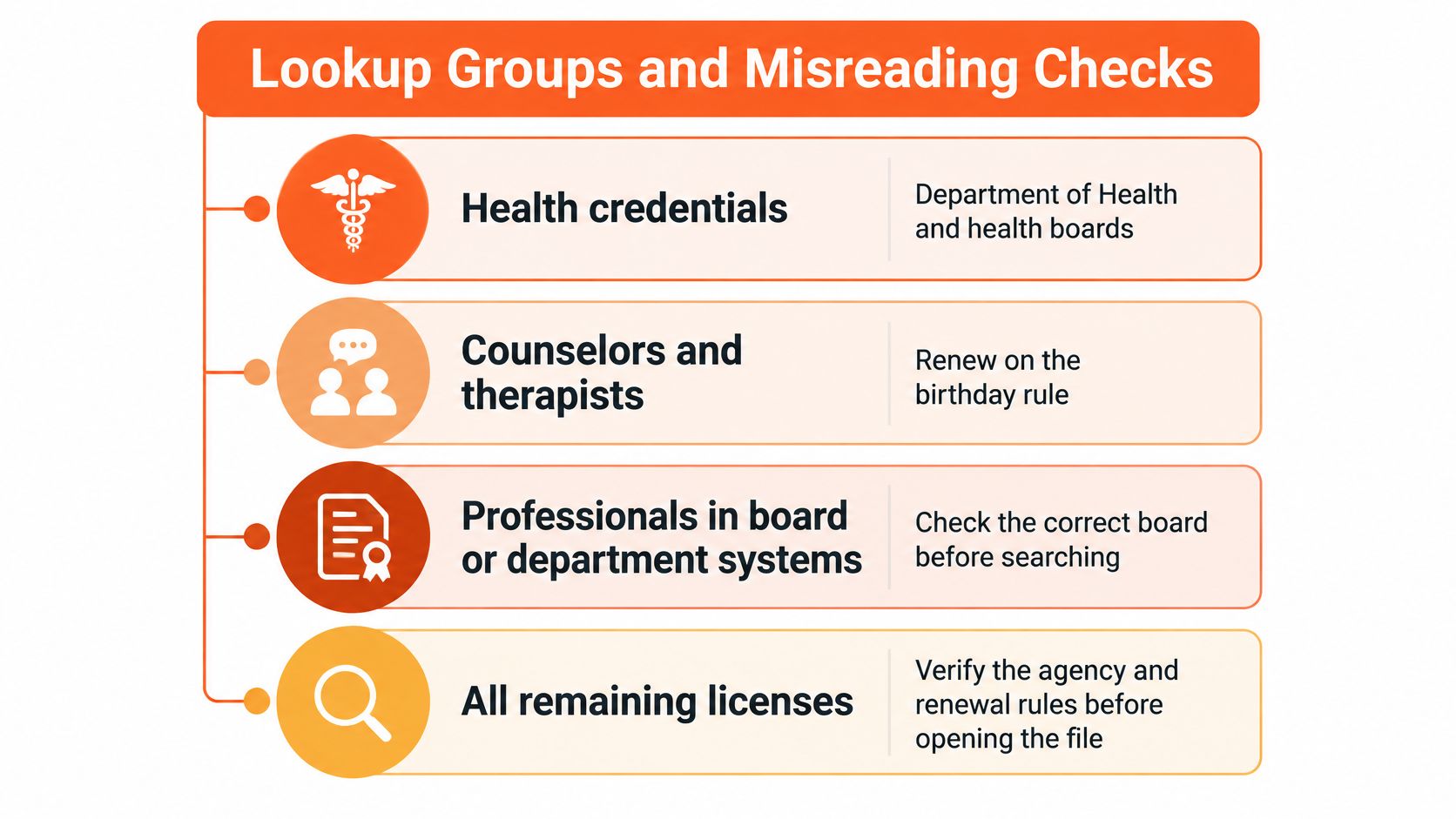
Route the lookup
- Health credentials: Start with the Department of Health and relevant health boards or commissions. Keep the profession and credential subtype intact.
- DOL business and professional licenses: Locate the specific professional program, such as architecture or real estate, before selecting a count file.
- Contractor and workplace credentials: Start with Labor and Industries and identify whether the record is a license, registration, or another credential.
- Educator certificates: Use the Office of Superintendent of Public Instruction system and retain its certificate terminology.
Engineering research needs the same jurisdiction check. The licensed professional engineer reference provides context for distinguishing a professional designation from the specific state record needed to support a count.
For every lookup group, collect profession name, credential type, status, address geography when present, and pull date. Keep a data dictionary beside the working file so another analyst can interpret the columns without reconstructing your decisions.
Apply the misreading checks
Before publication, test the proposed claim against the record:
- Stock versus events: Does the chart describe credentials at an observation date or administrative actions over a period?
- Jurisdiction versus residence: Does the location filter establish residence, or only an address associated with the credential?
- Permission versus practice: Is there independent evidence for the employment language used in the headline?
- Comparable obligations: Have profession-specific renewal and education rules survived the merge?
- Approval versus issuance: Have temporary and application-stage records been kept distinct from the credential category being counted?
These checks should change the wording of a result when necessary. A narrower caption is preferable to a broader claim that the file can't support.
Inspect the complete file without publishing identities
At ProfessionLens, we compute licensing counts from full public files, never samples. Our counts use public licensing rolls and federal files as pulled on the count date, and a roll can contain errors, duplicates, or lapsed licenses. Reading the entire file removes sampling uncertainty, but it doesn't make the source error-free.
Our count pages carry no individual names, only counts by profession, state, county, and employer. That separation lets readers examine workforce distributions without turning a statistical reference into an individual directory.
Document rows retained, exclusions, duplicate handling, and unresolved categories. A transparent count needs both a defined population and a record of how the original file became the published table.
Verify an Individual License Step by Step
Individual verification answers a different question from a workforce total. Use the live authority record to establish the credential's displayed condition, and preserve enough context for another person to repeat the check.
Identify the profession and authority. Route health credentials to the Department of Health system, DOL professions to their professional program, contractor or workplace credentials to Labor and Industries, and educator certificates to OSPI. Don't select an agency merely because its search screen looks familiar.
Match the credential carefully. Use the credential identifier when available and confirm the profession. A name match alone can select the wrong person or the wrong credential subtype.
Record the displayed status. Save the authority's wording and the verification date. Do not translate inactive, expired, pending, or another category into active.
Inspect expiration and geography. Note the applicable expiration basis and what the address field represents. Avoid describing the holder as a resident unless the source establishes residence.
Resolve the decision-specific question
Check any portability conditions. For an applicant relying on an out-of-state credential, compare applicant category, license history, and intended work timing against the appropriate pathway. An existing credential and eligibility for a new one are separate findings.
Save the provenance. Record the agency, record or file title, credential identifier, status definition, and pull date. For mortgage-specific verification, 24hourEDU's guide to verifying MLO credentials provides a focused reference rather than assuming a general professional lookup covers that workflow.
Recheck before acting. Return to the live agency record before a hiring or regulatory decision. A saved extraction establishes what you observed then, not what the authority displays now.
Verification note: Keep the individual decision record separate from the aggregate research file. They serve different purposes and require different evidence.
Choose the File Before You Cite
Choose a source that matches the claim. A total from one licensing system cannot stand in for Washington's full professional workforce.
For health credentials, use the Department of Health or the relevant health board record and its credential rules. For a DOL profession, use the appropriate active-license file and state how out-of-state addresses are handled. For licensing activity, use transaction records and identify the event categories: a renewal is not a new hire, and issuance does not establish employment. Contractor counts and workplace credentials require their own definitions. Educator counts should come from OSPI certificate records, not another agency's category.
Attorneys require a separate source strategy. ProfessionLens does not count attorneys because it found no open person-level attorney roll in the states it probed. That limitation does not establish that attorney records do not exist.
Decide whether the populations can be combined
When a claim spans systems, cite each one separately before combining figures. Confirm that the units match and check whether a person or business could appear in more than one population. If overlap cannot be resolved, publish separate counts.
ProfessionLens publishes state-level counts for Texas, California, Florida, Illinois, and Washington, including contractor counts for Washington. Its public licensing rolls were pulled on 15 September 2026. Keep that collection date visible when reusing the figures.
For a reproducible handoff, organize the analysis file with documented fields, not just presentation labels. The CSV examples guide shows how to structure rows for inspection. Preserve source categories alongside cleaned categories so another analyst can trace each transformation.
Put the definition under the chart
State the administrative population before readers interpret a chart as a measure of labor supply. Identify the agency, file title, status definition, geography rule, and actual pull date. If the source does not measure employment, say so.
Use a source line that identifies the file's measure and limits:
Source line: Agency and file title. Measure: stated credential status. Geography: stated address field and inclusion rule. Pulled: actual extraction date. Unit: licenses, people, businesses, certificates, registrations, or events.
For published workforce research, readers should be able to inspect the file, filters, and meaning of each figure. ProfessionLens publishes aggregate counts by profession, geography, and employer, with no individual names on its count pages. Visit ProfessionLens to find a relevant count page, inspect its source and count date, and cite the defined population rather than treating a partial licensing file as Washington's full workforce.