Home / Blog / Professional License Wisconsin Workforce Counts
Professional License Wisconsin Workforce Counts
ProfessionLens, 2026-10-28
A professional license in Wisconsin sits inside a system of 415,861 active credentials as of 30 June 2023, and that figure counts credentials across professions, not the workforce of any one occupation. It also doesn't tell you who can practise today.
That distinction drives every useful count in this state. A credential can be active, renewal-pending, lapsed, or searchable in an old file. A teacher sits outside the main state credential total entirely. A dentist may hold a Wisconsin credential without holding a compact privilege to work elsewhere.
Readers who mix those rows get a large number and a wrong conclusion. Recruiters overstate supply. Planners add staff from different regulators and different years. Journalists cite an employer headcount as if it were a statewide profession total.
The fix is dated, labelled counting. Name the publisher, the period, and the unit before you use any figure. Then check status before you treat a person as available labour.
Table of Contents
- Wisconsin Credential Totals Readers Can Cite
- Business Health and Trades Categories
- Published Workforce Counts by Profession
- Active Credentials versus License Records
- Renewal Hours and Audit Rules
- Boards outside DSPS and Compact Privileges
- Fields to Check before You Count Someone
- Choose the Count That Matches the Question
Wisconsin Credential Totals Readers Can Cite
Flow shows the system's workload before stock shows its size. The DSPS 2021-23 biennial report says the Department of Safety and Professional Services received about 119,997 initial applications between July 2021 and June 2023 and renewed more than 400,000 credentials during an average biennium.
The same report dated the system's stock at 415,861 active credentials as of June 30, 2023. That figure is a system-wide credential count. It does not identify how many people can practise a named occupation on that date.
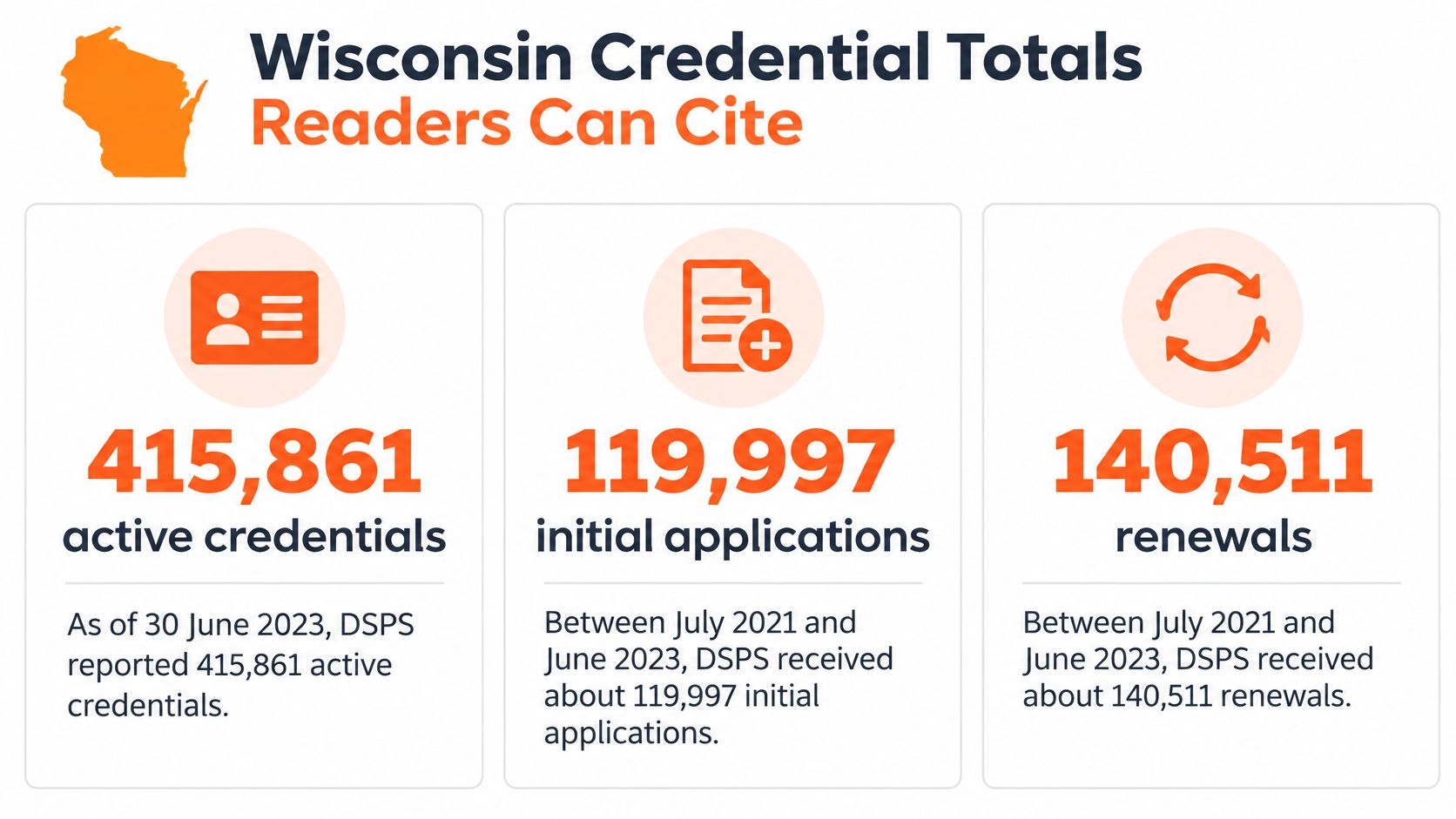
How the Three Totals Differ
The 415,861 figure is a point-in-time count of active credentials. The about 119,997 applications represent intake over two fiscal years, not credentials issued. The more than 400,000 renewals describe normal biennial volume across the DSPS system.
Each number answers a different question. Use active credentials for system scale, initial applications for incoming demand, and renewals for administrative turnover. None is a profession-level workforce count.
Wisconsin Licensing Scale
| Measure | Figure | Period | Publisher |
|---|---|---|---|
| Active credentials | 415,861 | As of 30 June 2023 | DSPS biennial report |
| Initial applications received | about 119,997 | July 2021 to June 2023 | DSPS biennial report |
| Credentials renewed in an average biennium | more than 400,000 | Typical biennium | DSPS biennial report |
Citation rule: Write the number, the date, and the publisher together. A credential total without all three invites misuse.
Two limits apply to every row. A credential is not always one currently available worker because the unit is the credential, not a person in a named job. Public school teachers also sit outside the DSPS total, so these figures cannot answer a school staffing question.
Use the table for system scale, intake, and renewal volume. Separately published occupation counts are needed before drawing a conclusion about nurses, engineers, teachers, or any other workforce.
Business Health and Trades Categories
Start with the area, then the job title. The Wisconsin Legislature occupational licensing study material states that DSPS and its attached credentialing boards administer more than 200 licenses across business professions, health professions, and trades professions. That first sort sets the renewal clock, verification form, and audit exposure a reader should expect before any profession is named.
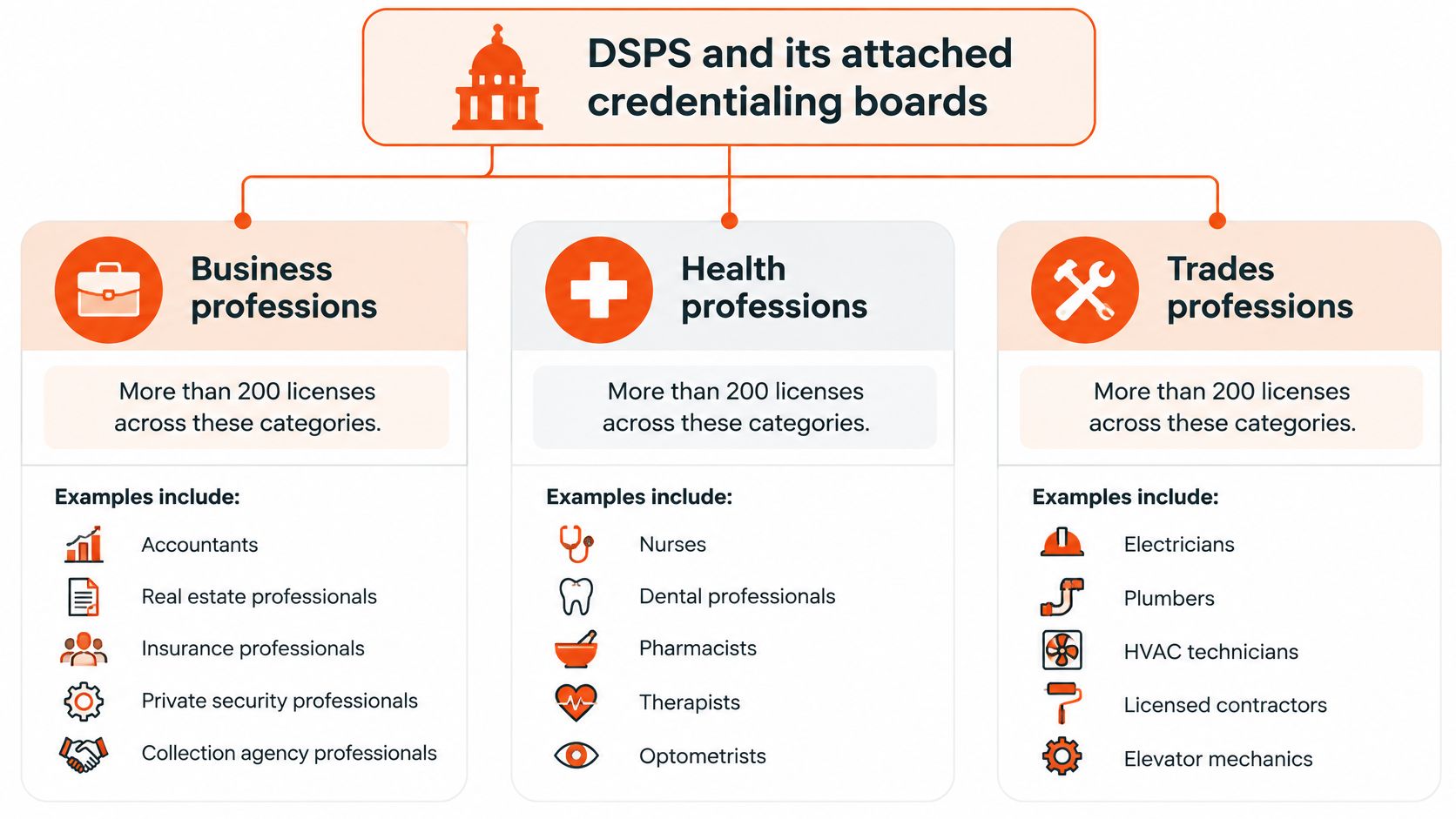
What Sits in Each Area
- Business professions: The professional engineer is the clearest example here, with a biennial continuing-education standard tied to the credential. Readers comparing engineering supply should start with the guide to the licensed professional engineer credential and then confirm the Wisconsin cycle.
- Health professions: Physician, dentist, and dental hygienist each carry a different renewal evidence pattern, from audit submission to compact privilege steps.
- Trades professions: Building and construction trades appear in state materials as occupational licenses, a narrower label than the broader credentials used for health and business professions.
The label has counting consequences. A file that strips area labels and merges trades rows with health rows can make unlike credentials look comparable. It can also overstate immediately usable labour when inactive records, renewal-pending credentials and compact privileges sit in the same total as people who can practise today.
Why the Counts Differ by Source
Two scope phrases need their publisher attached. The Legislature study material is the basis for the more than 200 licenses figure above. DSPS biennial reporting uses a wider description of regulatory authority over professions and industries, so keep licenses administered separate from the broader field under authority.
Choose business, health, or trades before you look up any renewal rule, because cycles, verification forms, and audit exposure differ by area.
That sequence prevents the most common lookup error. A reader who searches by job title alone may land on the wrong board, the wrong renewal clock, or the wrong verification path. Area first, profession second, rule third.
Published Workforce Counts by Profession
Most DSPS professions don't have a current public person-count broken out in the material available here. Say that plainly before you quote anything. Then use only the counts with a named publisher, a period, and a clear unit.
Teachers come first because their publisher is different. The Wisconsin Department of Public Instruction licensing data published 63,681 teachers and 4,824 administrators in the 2024-25 school year. Those are DPI staff counts. They aren't inside the DSPS credential total dated 30 June 2023.
Published Wisconsin Workforce Counts
| Group | Count | Unit | Period | Publisher |
|---|---|---|---|---|
| Public school teachers | 63,681 | Staff in DPI licensing data | 2024-25 school year | Wisconsin DPI |
| School administrators | 4,824 | Administrators in DPI licensing data | 2024-25 school year | Wisconsin DPI |
| Professional engineers at MSA Professional Services | 115 | Employees of one Wisconsin firm, not a statewide total | 2025, published June 2025 | MSA Professional Services |
| All DSPS credential types | 415,861 | Active credentials across professions | As of 30 June 2023 | DSPS |
For engineers, don't invent a statewide licensee total. The MSA Professional Services firm ranking announcement states that MSA employed 115 licensed professional engineers in Wisconsin in 2025, published in June 2025. Label it exactly that way. It's one firm's employees, useful for employer scale, useless as a state profession total.
Two Misuses to Avoid
Say a health-system planner adds 63,681 teachers to 415,861 DSPS credentials to size the licensed workforce. She hasn't double-counted the same people, but she has mixed two agencies, two units, and two periods into one headline. The result can't support a hiring or capacity decision.
Say a recruiter treats 115 as all Wisconsin professional engineers. He's taken an employer press figure and understated the profession, because the unit was employees at one firm. The error is in the label, not the arithmetic.
Cross-state health comparisons need the same discipline. A reader using physicians per capita by state still has to keep the Wisconsin numerator limited to physicians, not all health credentials. Per-capita math doesn't fix a mixed numerator.
Apply one rule to any new row you add. Name the population, the year, and whether the unit is a person, a credential, or a firm's employees. If you can't fill all three fields, don't publish the row as a workforce count.
That restraint is the point. A short table with honest units beats a long table that blends staff, credentials, and company headcounts. Readers can cite the short table without caveats carrying the argument.
Active Credentials versus License Records
A searchable licence record isn't an active credential. That gap is where Wisconsin supply counts go wrong, because a name in a lookup or an old export only proves a record exists.
The renewal-pending rule defines one important middle state. The DSPS credential verification guidance indicates that a complete renewal application, including payment, received by the expiration date allows the credential holder to practice while renewal is evaluated. The applicant must still respond to information requests, so pending doesn't mean finished.
Verification Paths Split by Area
Verification isn't one workflow. Business and health-profession credentials use a verification request form, while trades credentials use a LicensE support ticket containing the licensee's name and license number. Using the wrong path can leave you with no dated confirmation, even if the person is properly credentialed.
Keep five fields on every dataset row:
- Status: Record active, expired, or renewal-pending as shown, don't infer it from a search result.
- Expiration date: Store the exact date so a later count can drop lapsed rows.
- Renewal-pending flag: Mark yes only when the complete application and payment arrived by expiration.
- Profession: Use the credential name as printed, not a generic job title.
- Verification date: Date the check, because status can change after you pull the file.
Worked Examples
Say a nurse submits a complete renewal and fee before expiration, and DSPS is still reviewing it. Treat her as able to practise during evaluation, and flag the row renewal-pending. Removing her would understate current supply.
Say a trades credential appears only in an old search, with no current status or expiration date attached. Don't add that person to a supply count. You have a historical record, not evidence of current authority.
Counting standard: No status, no expiration date, and no verification date means no inclusion in a current workforce count.
Our counts are computed from public licensing rolls and federal files as pulled on the count date, and a roll can carry errors, duplicates or lapsed licences. That's why a full-file count still needs a status filter. File size alone doesn't equal deployable labour.
Renewal Hours and Audit Rules
A renewal timestamp marks a processed application. The evidence file behind it can still be open, short on a sub-requirement, or tied to the wrong cycle. Three credentials show three distinct problems: engineers an hours split, physicians a post-renewal audit, dentists and dental hygienists a state-line question.
The DSPS professional engineer profession page sets a biennial standard of 30 approved Professional Development Hours (PDHs), including at least 2 PDHs in professional conduct and ethics. At least 13 PDHs must come from real-time instruction, such as a traditional classroom, live computer conferencing, or interactive video conferencing where participants can communicate directly with the instructor.
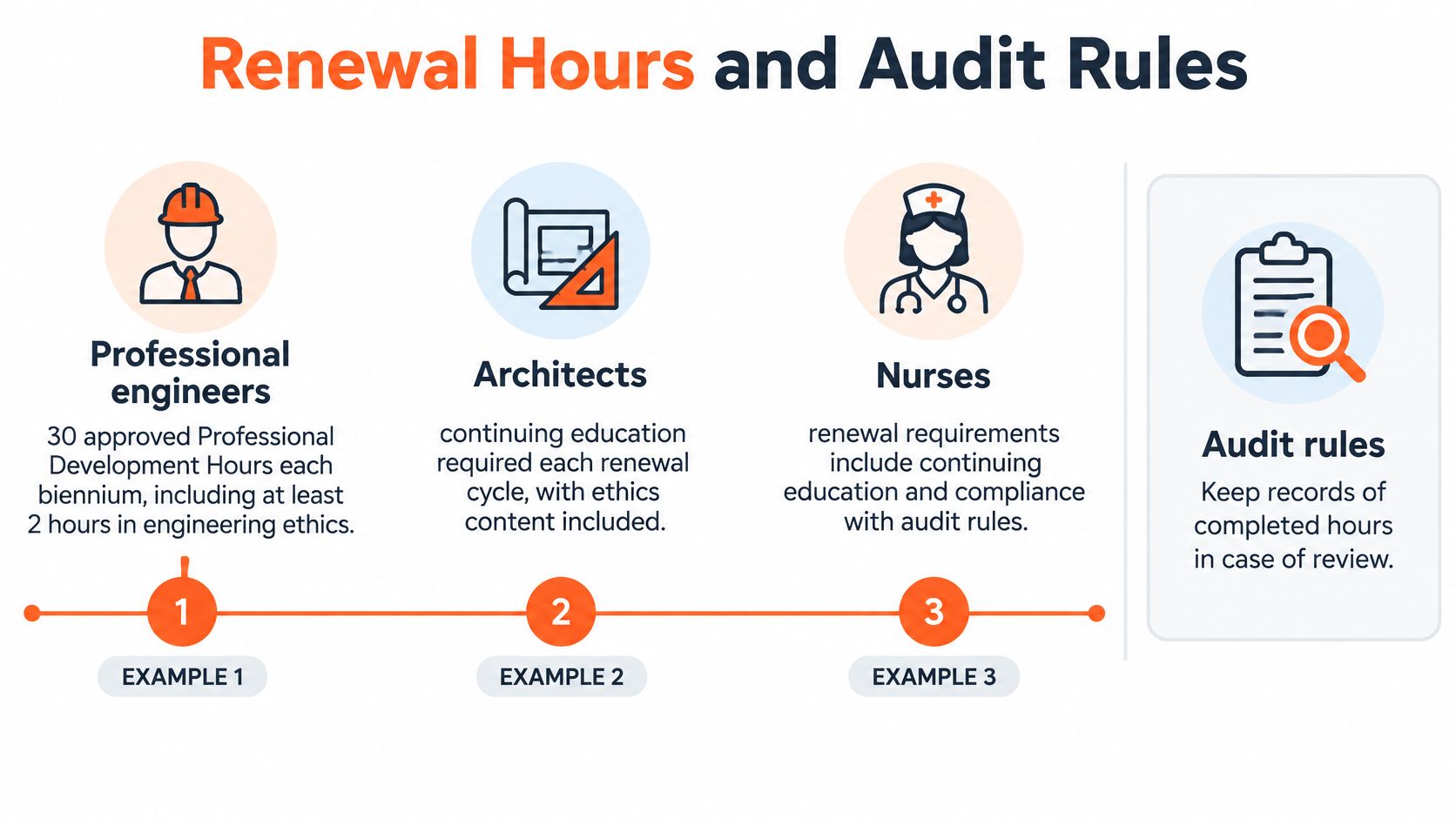
The Engineer Clock
The reporting cycle runs from August 1 of an even-numbered year through July 31 of the next even-numbered year. Two fields decide whether an engineer clears the standard: current status and the biennium the hours belong to. Hours logged in the wrong biennium do not cure a shortfall in the current one.
The edge case is a total that passes and a split that fails. An engineer logs 30 PDHs, all on-demand with no direct instructor contact. The sum meets the standard. The 13 PDH real-time minimum does not. The credential still falls short.
Record total PDHs, ethics PDHs, and real-time PDHs as three fields. One hours column hides the exact failure mode the rule creates.
Different Evidence Problems
Physicians face a second gate after renewal. A randomly selected physician can face a CE Broker audit and must submit CME information by a specified deadline, so renewal day ends one obligation and can open another. A credential renewed on time can sit inside an open audit file. That row reads "active" in a status field while the evidence behind it stays unclosed.
Dentists and dental hygienists raise a boundary question. Their compact rule is listed as scheduled to take effect 1 November 2026, and a compact privilege requires its own steps on top of the Wisconsin credential. Until the rule is in force, a Wisconsin licence and multistate practice authority are separate facts. Readers who need cross-state authority, rather than in-state hours, should treat it as its own check.
Renewal Evidence for Three Wisconsin Credentials
| Credential | Cycle or date | Evidence required | What a count can miss |
|---|---|---|---|
| Professional engineer | 1 August of an even year through 31 July of the next even year | 30 PDHs, at least 2 in ethics, at least 13 real-time | Hours logged but not real-time |
| Physician | Renewal plus a later CME audit if selected | CE Broker submission by the audit deadline | A renewal checkbox with an open audit file |
| Dentist or dental hygienist | Compact rule scheduled to take effect 1 November 2026 | Wisconsin credential plus any compact privilege steps | A Wisconsin licence with no multistate privilege attached |
The lesson for counting is narrow. Renewal status tells you a credential was processed. A headcount that treats every renewed credential as fully usable mixes open audit files and in-state-only authority into the same total as clean renewals.
Boards outside DSPS and Compact Privileges
A workforce file often mixes three populations that don't belong in one total. DSPS credentials are one. DPI-licensed school staff are another. Compact privileges held for practice in another state are a third. Each answers a different question, and each carries its own status field.
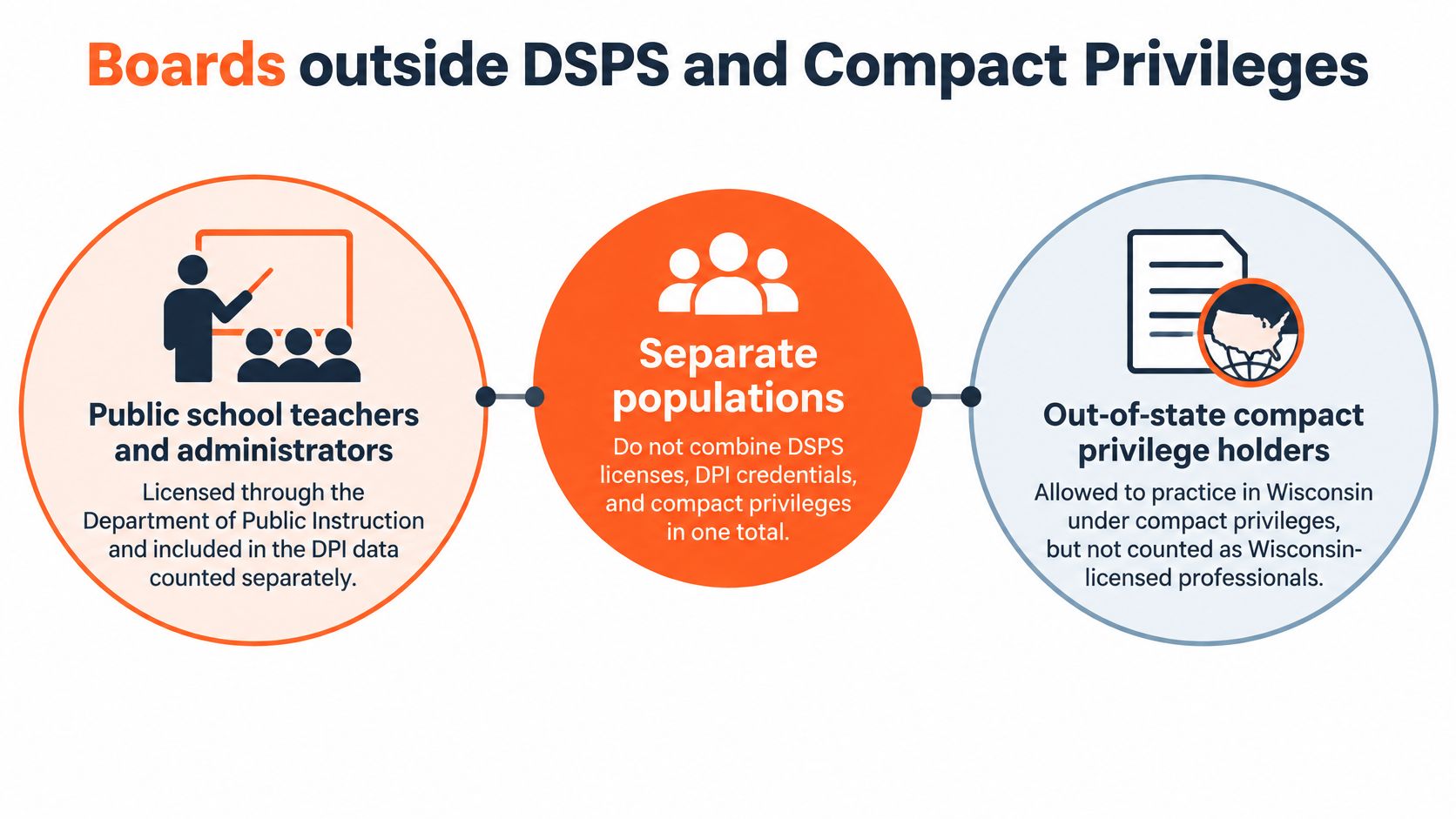
Public school teachers and administrators are licensed through the Department of Public Instruction and appear in DPI data, not in the DSPS credential total. Pair each figure with the population it describes. If your question is school staffing, use DPI. If your question is DSPS system size, use DSPS. A combined headline hides which regulator vouches for which worker.
Attorneys sit outside the three-area DSPS split, and no published Wisconsin attorney count appears in the material available here. ProfessionLens does not count attorneys or financial advisers because no open person-level roll of attorneys was found in any state probed, and the SEC and FINRA systems answer name queries only. Where no public roll exists, the issuing authority still has to be identified before anyone enters a count.
Compact Privileges as a Counting Step
Multistate practice creates the second mixing risk. The Wisconsin physician license renewal FAQ on CE Broker audits shows the same split inside a single board: a randomly selected physician owes CME documentation after renewal, so the licence record and its evidence file are two separate facts. Wisconsin's dentist and dental-hygienist compact rule is still pending, so a supply count must keep a Wisconsin dental credential apart from any compact privilege it may one day support.
Say a dentist is licensed in Wisconsin but hasn't completed a required compact step. She counts as Wisconsin-credentialed. She is not immediately deployable in another compact state.
A headcount that skips that step overstates cross-state supply.
Digitization can improve oversight while adding friction for professionals who work across state lines, because evidence, privilege, and renewal date now move on separate tracks.
ProfessionLens counts health professions nationally, so the same separation decides whether a state comparison measures usable labour or paper credentials. A row from outside DSPS keeps its own regulator name, date, and unit, and it isn't added to a DSPS row without that note attached.
Fields to Check before You Count Someone
Apply this sequence to one person or to a full file. Each step adds one field, and the completed row is what you count. The review of best licensed professional data sources is useful background, but the official Wisconsin lookup decides status.
- Confirm the regulator: Use DSPS for business, health, and trades, DPI for teachers and administrators, and a different authority for attorneys.
- Record the profession as printed: Copy the credential label exactly, including a new APRN label if the file has changed, don't substitute a job title.
- Record status and expiration: Flag renewal-pending only when the complete application and payment arrived by the expiration date.
- Choose the verification path: Use a verification request form for business and health, or a LicensE ticket with name and licence number for trades.
- Check the engineer biennium: Note whether 30 PDHs include 2 ethics hours and 13 real-time hours in the current cycle.
- Check physician audit status: Note whether a CE Broker audit notice is outstanding after renewal.
- Check compact privilege separately: For dentists and dental hygienists after 1 November 2026, record privilege apart from the Wisconsin credential.
- Store the verification date: Place it next to your count date so a later reader knows when status was true.
One Completed Example Row
- Profession: Professional engineer
- Status: Active
- Expiration: Recorded from the official lookup
- Renewal-pending: No
- Verification path: Business and health verification request form route, as applicable to the credential area
- Verification date: Recorded on the day checked
Don't fill missing fields from memory or from a prior export. If expiration or status is blank, hold the row out of a current supply count and verify again. A smaller dated count is defensible. A larger undated one isn't.
Keep the sequence in this order. Regulator first prevents most downstream errors, because the wrong regulator gives you the wrong form, the wrong cycle, and the wrong evidence standard. Verification date last locks the row to a point in time.
Choose the Count That Matches the Question
Match each question to one dated number. Don't let a convenient figure answer a question it wasn't built for.
- How large is the DSPS system: Use 415,861 active DSPS credentials as of 30 June 2023, and don't describe it as nurses or engineers.
- How many school staff are there: Use 63,681 teachers and 4,824 administrators for the 2024-25 school year, and don't add them to DSPS totals.
- How large is one engineering employer: Use 115 only as the Wisconsin professional engineers MSA Professional Services employed in 2025, not as a statewide engineer total.
- Who can practise now: Use a status-filtered, date-stamped row confirmed on the official DSPS or DPI lookup.
Say a recruiter asks how many engineers can start in Wisconsin next month. She needs the status check, profession, expiration, and verification date for each candidate. The system total and the employer count answer different questions, and neither proves a person can start.
Every licensing count we publish is computed from a full public file, never a sample, and every ProfessionLens count is free to read and to cite, with no account and no paywall. Full-file counting removes sampling error, but it doesn't remove roll errors. Public rolls can still contain duplicates or lapsed records, so cite the number, date, and publisher every time.
Reuse the credential totals for system scale, the profession table for named workforce counts, and the field checklist for current practice authority. That's the whole method.
For dated counts of licensed professionals by profession, state, county, and employer, and for research that separates active credentials from mere licence records, visit ProfessionLens and start with the Wisconsin figures you need to cite. Bring the number, date, and publisher into your own work, then verify current status before you treat any professional as available to practise.