Home / Blog / Professional License PA Counts and How to Read Them
Professional License PA Counts and How to Read Them
ProfessionLens, 2026-11-01
Pennsylvania reported more than 900,000 licensed professionals, with licensee totals current as of March 2021, in the Department of State's comparison report. That's a measure of the licensing system, not a count of people available to start work. For anyone researching “professional license PA,” the key distinction is between a credential on a roll, the time needed to process a completed application, and a person providing services.
Table of Contents
- Pennsylvania Professional License Counts at a Glance
- Boards and License Families under BPOA
- Days to Issue a Complete Application
- Active Inactive and Expired Are Different Stocks
- Clocks That Start Only After a Complete File
- County Licensee Counts Are Not Local Workforce
- Verify One Pennsylvania License in PALS
- Match Fields and Cite a Dated Count
Pennsylvania Professional License Counts at a Glance
The Department of State comparison gives the statewide baseline its proper context: more than 900,000 licensed professionals, with more than 67 percent of licensees in health-care occupations. The same report found that 24.71 percent of Pennsylvania's workforce was professionally licensed or certified, ranking the state 30th nationally, while 19.13 percent held a professional license, approximately equal to the national average.
Those measures don't share a denominator. The licensee population describes the composition of the regulated population, while the workforce percentages describe the prevalence of credentials among workers. Treating them as interchangeable would confuse the size of an administrative system with the share of workers subject to licensing.
Pennsylvania professional-license baseline
| Measure | Figure | Basis and date |
|---|---|---|
| Licensed professionals | More than 900,000 | Licensee totals as of March 2021 |
| Share of licensees in health care | More than 67 percent | Same comparison report |
| Workforce licensed or certified | 24.71 percent, 30th nationally | Comparison report |
| Workforce holding a professional license | 19.13 percent | About the national average |
What the baseline supports
The strongest conclusion is about composition. Pennsylvania's licensing population is primarily a health-care population, rather than an evenly distributed collection of regulated occupations. A statewide licensing total therefore isn't a neutral indicator of conditions in real estate, personal services, or another smaller license family.
The headline also needs careful labeling. The report calls its subjects licensed professionals, but an analyst using the figure as a credential-stock baseline shouldn't upgrade it into a deduplicated count of working people. Preserve the source's terminology, attach its date, and explain the limits of the intended use.
The figures support different statements:
- Statewide scale: The headline establishes the breadth of Pennsylvania's licensing system, not a current employment total.
- Occupational concentration: The health-care share establishes dominance within the licensee population, not the number of physicians, nurses, or pharmacists.
- Broad workforce coverage: The licensed-or-certified measure includes a wider category than professional licenses alone.
- License-only coverage: The narrower workforce measure shouldn't be substituted for the broader measure when comparing jurisdictions.
What a newer file changes
A later county-by-occupation release provides a geographic view, but a more recent file isn't automatically a replacement for this statewide comparison. Before substituting totals, an analyst would need to reconcile covered professions, status filters, geographic assignments, and the unit counted.
Baseline rule: Cite the historical licensing population as a dated administrative measure. Don't relabel it as today's employed workforce.
Keep the resulting measures in separate columns. Boards describe administrative organization. License records describe credential holdings. Processing days describe a duration. Status categories describe the condition of a credential, while county rows describe its geographic classification. Only a separate employment or practice measure can establish whether someone fills a job.
Boards and License Families under BPOA
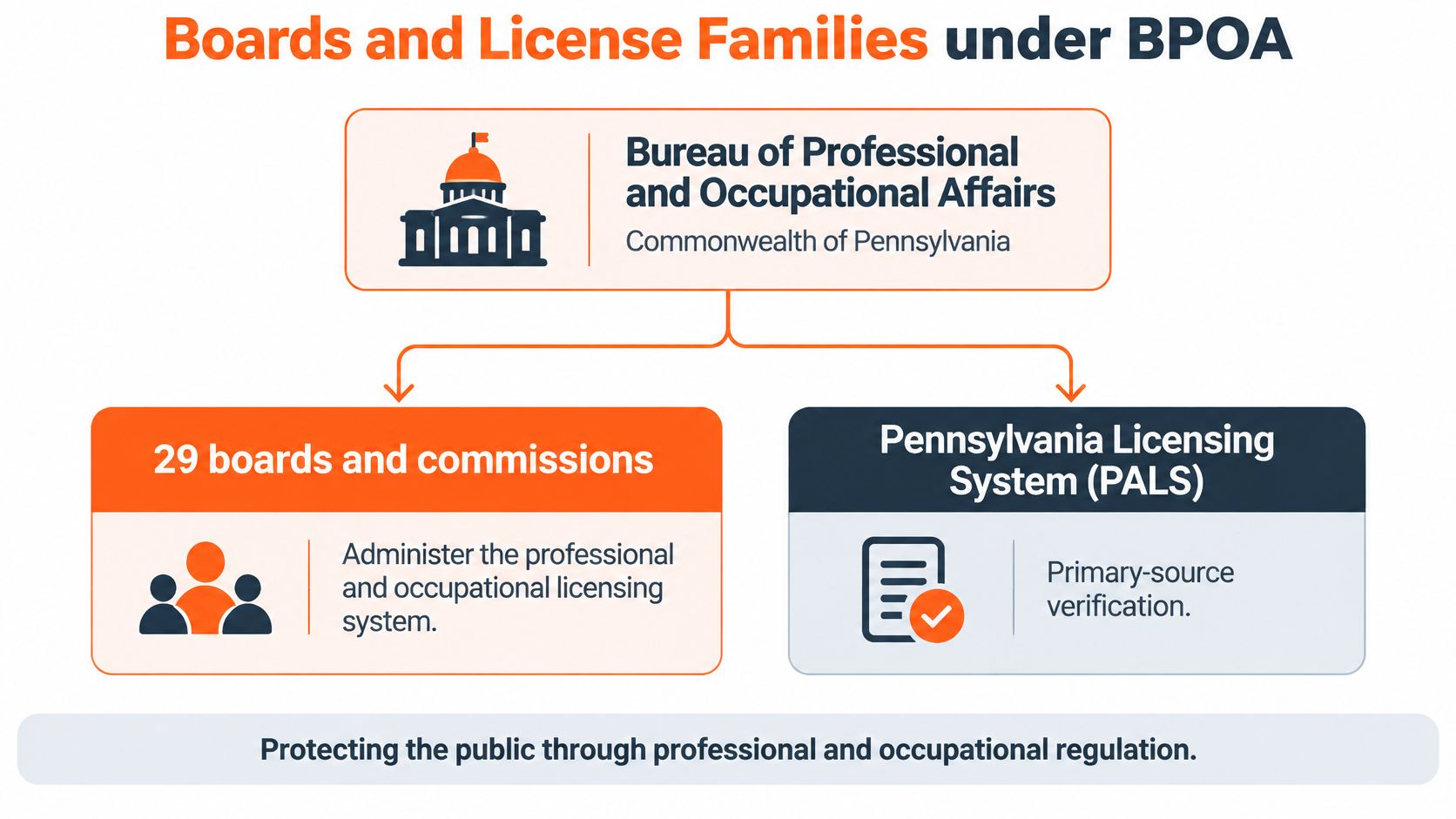
Pennsylvania administers its professional-licensing infrastructure through 29 boards and commissions under the Bureau of Professional and Occupational Affairs, and identifies the Pennsylvania Licensing System, PALS, as its primary-source verification system in the Department of State's license-verification guidance. That guidance says PALS updates daily, although submitted changes may take up to 48 hours to appear.
The first classification decision is whether a record represents a person credential or a business or premises credential. Both belong in an account of licensing administration. They don't belong in the same headcount.
Classify the credential before counting it
Consider a pharmacist lookup. The useful analytical record isn't just a name and a profession. It's a person credential with an identifiable license type, a current status, and any displayed disciplinary information.
For a real estate salesperson, the same discipline applies differently. A salesperson credential doesn't establish that person's current brokerage affiliation or prove that the person works full time. Don't turn the result into a brokerage employee count without employer evidence.
A cosmetology salon, barber shop, or vehicle dealership calls for a different unit altogether. Treat the record as a business or premises credential for counting purposes, rather than another licensed person. A premises authorization can't tell you how many practitioners work inside it.
| Lookup example | Appropriate counting unit | Unsupported inference |
|---|---|---|
| Pharmacist | Person credential by license type and status | Current employment |
| Real estate salesperson | Individual salesperson credential | Brokerage headcount |
| Salon, barber shop, or dealership | Business or premises credential | Number of workers |
Preserve the fields that explain the result
PALS supports searches using license number and status and can expose disciplinary actions, including suspension, fines, or other penalties. A record with an adverse action needs a review of the actual action, not an assumption that every disciplinary flag has the same consequence.
For a published extract, document both the as-of date and a refresh-lag rule. If a recently submitted change may still be pending, mark the record for rechecking instead of treating the apparent discrepancy as a confirmed error.
The same classification problem matters in interstate work. A Washington professional-license comparison should be approached by matching credential families and record units, not by assuming that another state's broad licensing label has identical coverage.
Before treating a row as an active-practitioner candidate, retain board or commission, profession, license type, unique license number, status, and disciplinary indicator. Those fields establish what the credential is and what the state currently reports about it. They don't, by themselves, establish employment.
Days to Issue a Complete Application
The Department of State's processing-time announcement compares average processing days for complete applications between January 2023 and September 2024, following the executive order directing agencies to examine application delays.
Complete-application processing days, 2023 to 2024
| Application | January 2023 | September 2024 |
|---|---|---|
| Real estate salesperson | 13 days | 1 day |
| Pharmacist by examination | 26 days | 1 day |
| U.S.-educated medical doctor | 43 days | 2 days |
| Physical therapist | 31 days | 2 days |
| Cosmetology salon, initial | 15 days | Same day |
| Barber shop, initial | 12 days | Same day |
| Vehicle dealership | 10 days | 1 day |
These are average processing times for finished files. They aren't the number of licenses issued, the number of active licensees, or the elapsed time experienced by someone whose application still lacks required documentation.
Read the improvement as an administrative result
The comparison supports a clear conclusion: the state reported substantially faster handling of completed applications across the listed categories. It doesn't establish an equivalent increase in labor supply.
A processing average has no application-volume denominator attached to it here. Faster handling could occur alongside more applications, fewer applications, or a different mix of applicants. Without issuance volumes and exits from the licensed population, an analyst can't calculate net credential growth from this table.
The distinction also matters across application families. A pharmacist application by examination is a defined pathway, not a stand-in for every pharmacist application. Likewise, the medical-doctor row identifies an educational group, while the salon and barber-shop rows identify initial business applications.
A faster licensing decision is an administrative outcome. A filled position requires evidence about a person, an employer, and work actually performed.
The Department of State also reported a 25-place rise in the 2024 State Occupational Licensing Index, moving from near the bottom in 2023 to the top 10 in 2024, in the announcement cited above. That's a licensing-process ranking, not a workforce-availability ranking.
Choose the question before using the table
Use these averages when the question is how quickly the department handled a completed application of the specified type during the comparison periods. Keep the application label intact when quoting the result.
Don't use them to answer these different questions:
- Credential prevalence: How many people hold the license?
- Application experience: How long does an applicant wait from initial submission?
- Recruitment supply: How many credential holders are seeking work?
- Local capacity: How many practitioners serve a particular county?
For workforce planning, request separate measures of application receipts, completed files, decisions, and active credentials. Those measures describe different stages and should remain separate even when the same applicant appears in each.
An employer can use the published averages as context for a candidate whose file is already complete. It shouldn't promise a start date by adding the table's duration to an initial submission date. That calculation assumes away the part of the process the table doesn't measure.
Active Inactive and Expired Are Different Stocks
Status is an analytical field, not a note to add after publishing a total. An issued credential establishes that an authorization exists or existed. Its current status determines how that row should enter a present-day licensing count.
The Pennsylvania regulation governing the cited inactive-status pathway allows covered licensees to request inactive status and suspend renewal-fee obligations while inactive; return to active status requires at least 30 hours of approved continuing professional education during the preceding biennium, plus applicable fees. That's a profession-specific rule, not a universal reactivation standard for every Pennsylvania board.
Build mutually understandable categories
Start with the status labels in the source file. Preserve the original value, then create any analytical grouping in a separate field so another researcher can reverse the transformation.
- Active: Include in an active-credential stock, without asserting that the holder is employed.
- Inactive: Keep separate from active authorizations and inspect the relevant board's return requirements.
- Expired: Retain as a distinct administrative category rather than assuming the holder remains eligible to practice.
- Suspended: Flag for substantive review instead of treating the record as an unrestricted active credential.
- Other or unresolved: Publish the category or explain its exclusion. Don't assign it to active.
A status table should reconcile to the extract's retained records. If a total labeled licensed includes historical or non-active records, say so explicitly.
Test the arithmetic without overstating it
In a hypothetical file of 100 licenses, removing 20 inactive records leaves 80 records. That remainder is an active-license proxy only if inactive is the sole excluded status and every remaining row meets the chosen active definition.
It becomes a person-count proxy only under another assumption: each person holds a single credential of the relevant type. Even then, no employment measure has been introduced. Subtraction can change the credential denominator, but it can't manufacture evidence of practice.
For reproducibility, preserve the available list-request fields: license number, name, city, county, certification date, and expiration date. Use certification and expiration fields to define cohorts, while retaining status as its own variable rather than inferring it solely from dates.
A Wisconsin professional-license comparison raises the same methodological question: are the compared totals based on equivalent status categories? Match the definitions before comparing the size of the populations.
Publish licensed, active, inactive, expired, and other categories with the extract's as-of date. If the source doesn't support a category, report that limitation rather than estimating it. Historical credentials ever issued are not a current workforce.
Clocks That Start Only After a Complete File
A single statewide average would hide the distinction between waiting to become complete and waiting for a decision. Pennsylvania's licensure processing guides and timelines describe a completed-file process requiring examination results, training-hour confirmation, and background-check results before the final issuance-or-denial clock begins; its 2025 account reported the pharmacist and doctor comparisons below.
Which Pennsylvania license clock a figure belongs to
| Clock | Starts when | Published figure |
|---|---|---|
| Pharmacist, 2025 report | Official clock after a complete file | 20 business days in 2023 to 4 days |
| Doctor, 2025 report | Official clock after a complete file | 43 days to 5 days |
| Before the file is complete | Applicant awaits exam results, training-hour confirmation, or background check | Share of applicants delayed not stated in the cited account |
| Complete file to active license | Complete-file date, followed through issuance and activation | Stage-specific median not stated in the cited account |
| License to filled job | Active status followed by entry into a job | Not measured by processing days |
The process diagram makes the completeness boundary explicit.
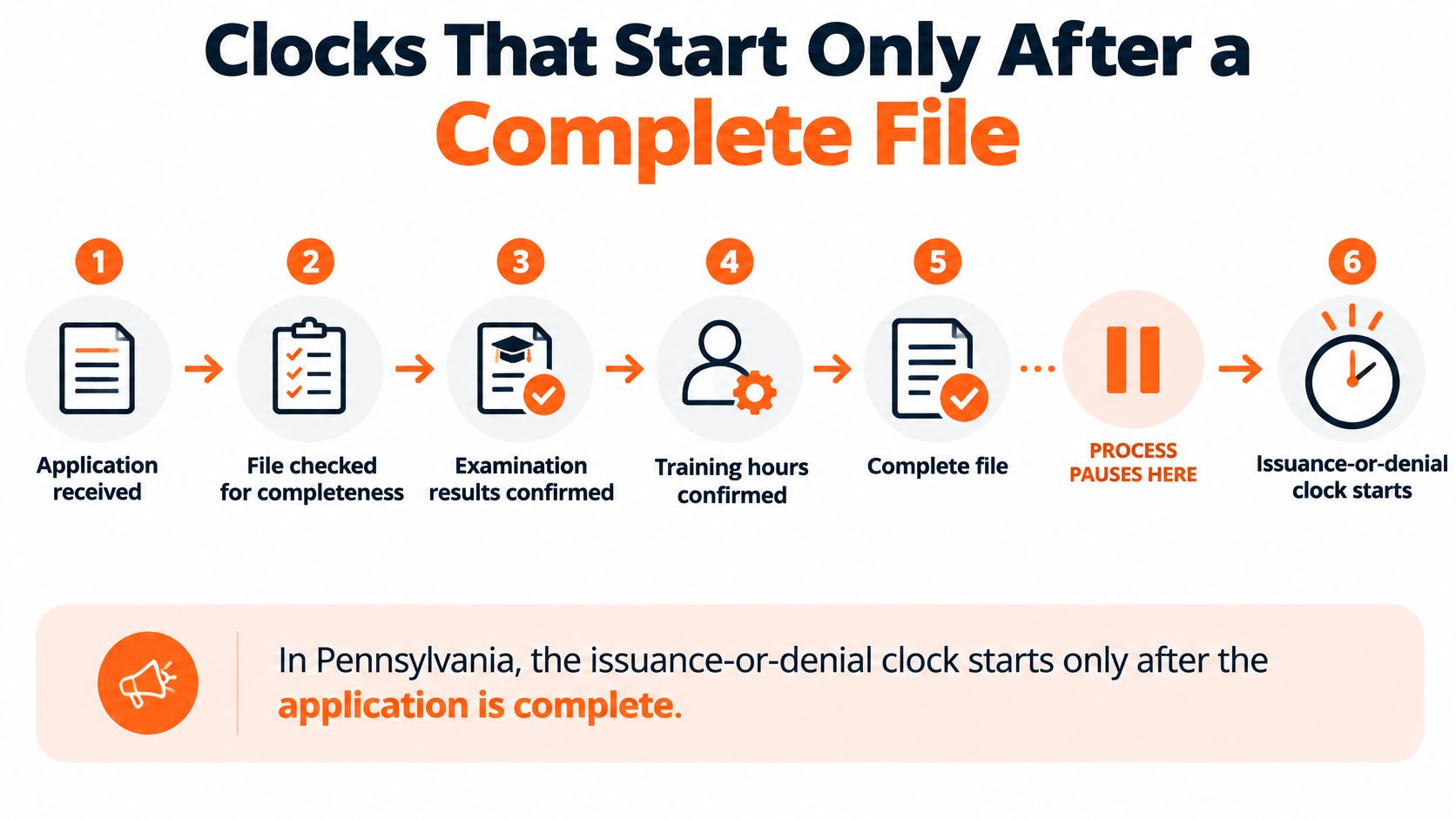
Keep first-time, endorsement, renewal, temporary-permit, examination, and foreign-trained pathways separate. Request median intervals from receipt to completeness and completeness to activation, plus the share delayed before completeness.
Faster decisions on finished files can enlarge the credential stock without shortening waits for examinations, transcripts, background checks, jurisdictional verification, or entry into practice.
County Licensee Counts Are Not Local Workforce
Pennsylvania's county-by-occupation professional-licensee dataset publishes active-licensee counts by geography, with a listed update of July 1, 2025. Its unit is an active licensing record assigned to a county, not a verified person working at a local service site.
Consider a hypothetical rural county with 40 active licenses and a city county with 400. The larger raw total doesn't establish greater per-capita availability. First reconcile duplicate people and license types, then divide comparable person counts by the respective county populations.
Separate address from service location
A county field needs a definition before it becomes a map of service supply. A mailing address may identify where a license holder receives correspondence rather than where that person treats patients, sells property, or provides another regulated service.
The diagram separates the administrative row from the labor-market interpretation.
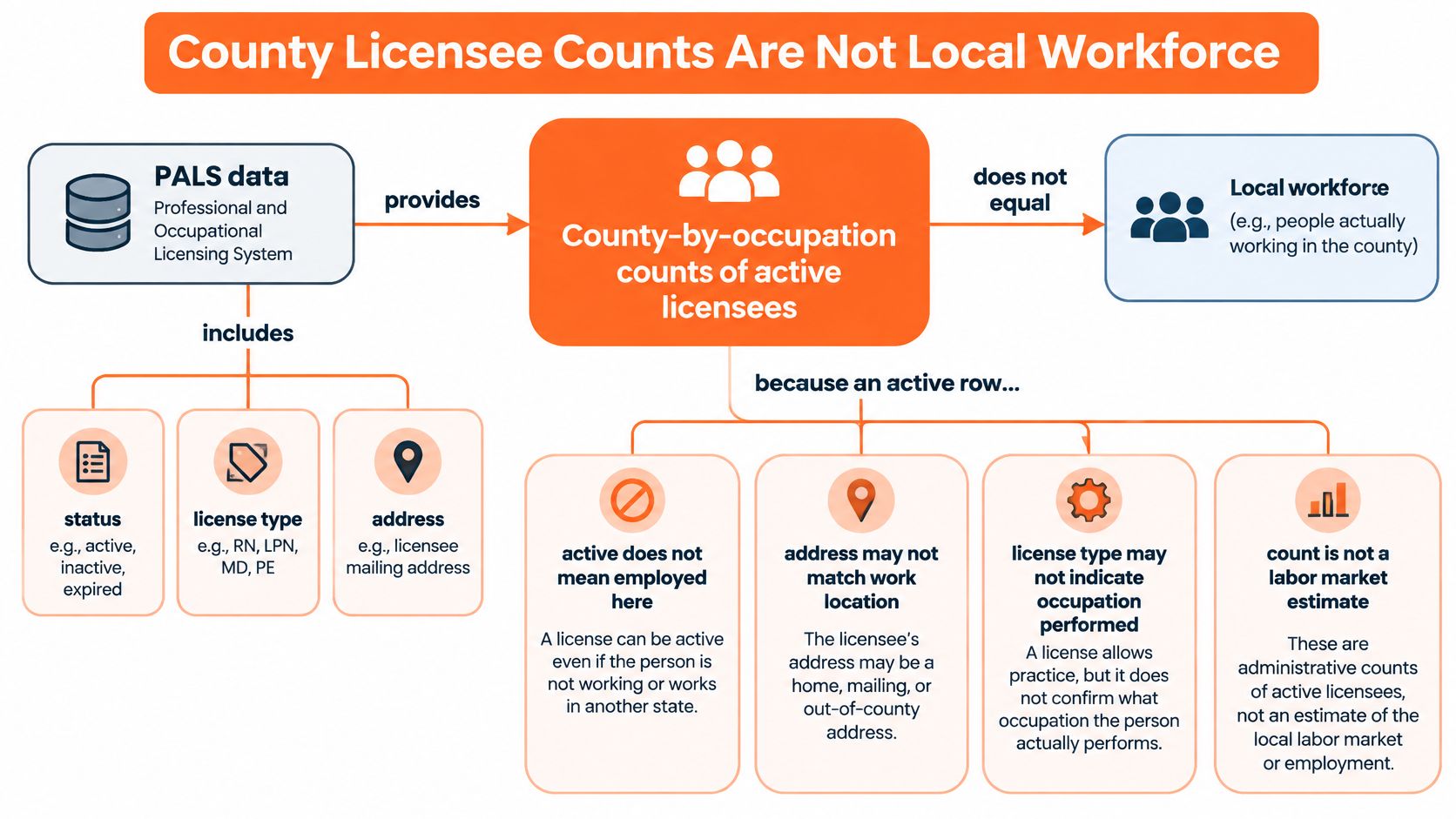
An active credential can belong to someone retired from practice, working outside the recorded county, holding another license type, or maintaining Pennsylvania authorization for portability. None of those situations necessarily makes the licensing record wrong. They make it unsuitable as unqualified evidence of local employment.
Population adjustment doesn't fix that mismatch. A precisely calculated rate remains misleading if its numerator counts mailing-address credentials while the interpretation concerns practitioners serving residents.
- Credential density: Active licenses divided by county population.
- Person density: Deduplicated credential holders divided by county population.
- Practice density: Practitioners assigned to verified work locations divided by county population.
- Service capacity: Requires additional evidence about work performed, not only authorization.
Modernization can widen the interpretive gap
Pennsylvania's modernization effort included a catalog covering more than 2,400 licenses, permits, and certificates, alongside date-certain deadlines for completed applications and fee refunds when agencies miss them, as described in the state material associated with the county dataset cited above. Those are administrative improvements, not direct observations of service delivery.
Faster issuance can increase the stock of active credentials before any corresponding change in local employment. A county planner who treats that increase as newly available capacity could mistake administrative throughput for a change in access.
Small absolute differences also matter more to rates in smaller populations. That makes consistent deduplication and geographic assignment especially important when ranking rural counties against urban counties.
Publish active licenses, deduplicated people, status mix, and county population side by side when the underlying sources allow. Put employment and practice-location evidence in separately labeled columns, with their own reference dates. If a practice-site field isn't available, call the result license density rather than workforce availability.
Verify One Pennsylvania License in PALS
A useful PALS check produces an attributable record, not merely a recollection that a name appeared in search results. Define the purpose first: confirming a candidate's credential, checking a referral, and reviewing a supplier may require different follow-up evidence.
Follow the record rather than the name
Open PALS and identify the credential. Search by license number when available. If you begin with a name, resolve the match using the profession and other displayed details before attributing the result to a person.
Record the board or commission, profession, license type, unique license number, status, and disciplinary indicator together. Keep the source wording intact. A normalized spreadsheet label should supplement the original value, not replace it.
Read the status as a category. Don't interpret the existence of a record as confirmation that the person currently practices. If the displayed status is unexpected, preserve it and investigate rather than substituting what the applicant or employer anticipated.
For an inactive credential, check the applicable board's reactivation requirements. Don't apply another profession's continuing-education rule merely because both records appear in PALS.
Preserve the decision trail
Check freshness. Record when you performed the lookup and any as-of information shown. When a submitted change may still be pending, schedule a follow-up and keep both results instead of overwriting the earlier observation.
Inspect any displayed suspension, fine, or other penalty before making a hiring, referral, or procurement decision. Read the underlying action where available. A brief disciplinary flag may not explain the action's scope or current consequences.
Store the evidence together. Keep the lookup date, identifying fields, displayed result, and relevant action reference in the same verification record. Separate what PALS displays from statements supplied by the credential holder.
If a result can't be confidently matched, mark it unresolved. A similarly named person is not a defensible substitute, and the absence of an immediately recognizable match isn't enough to declare that someone lacks a license.
Verification boundary: A successful lookup establishes what the state's record says about a particular credential at the time checked. It doesn't establish the holder's employer, work schedule, or local availability.
For an employment decision, collect the missing employment evidence separately. For a county study, obtain the appropriate file rather than aggregating casual name searches. Individual verification and population estimation need different workflows because they answer different questions.
Match Fields and Cite a Dated Count
Reliable counting starts with the join keys, not the headline total. Match board or commission, license type, and occupation title before combining extracts. A loose profession name can conceal different authorizations, business records, or categories that shouldn't share a denominator.
Deduplicate exact license records before attempting to identify unique people. A license number is a credential key, not necessarily a person key. Use a person-level match only when names and supporting fields provide enough evidence, and retain an unresolved category for ambiguous matches.
Keep the extract reproducible
Maintain a short processing ledger:
- Source identity: Record the file title, issuing authority, and original filename.
- Timing: Preserve the pull date and the source's own as-of date separately.
- Row accounting: Record rows read, retained, dropped, and left unresolved.
- Filters: Save the status, profession, license-type, and geographic rules.
- Unit checks: Keep premises authorizations out of person totals and document any person-level consolidation.
A reviewable CSV makes these decisions easier to inspect. Our CSV examples provide a useful starting point for thinking about row structure and fields to preserve.
At ProfessionLens, every licensing count is computed from a full public file, never a sample. Our counts use public licensing rolls and federal files as pulled on the count date, and a roll can still contain errors, duplicates, or lapsed licenses. Full-file coverage removes sampling uncertainty, not administrative error.
Our state-roll coverage includes real estate agents in California and Texas, insurance producers in Florida and Texas, professional engineers in Texas, contractors in Washington, and 13 license board types in Illinois. Those coverage boundaries shouldn't be stretched into a claim that we maintain an equivalent Pennsylvania roll.
Match each source to its question
| Question | Appropriate evidence | Boundary |
|---|---|---|
| How large was the statewide licensing population? | Dated Department of State comparison | Historical baseline, not current employment |
| What does the state report about a credential? | PALS verification result | Credential-specific status and discipline |
| Where are active licensees assigned? | County-by-occupation file | Administrative geography, not verified service location |
| How quickly did completed files move? | Application-processing comparison | Duration, not credential volume |
Before citing an outside total, confirm that it names its unit, basis, and date. IamVera.AI's discussion of scrutinizing AI figures in legal filings is relevant here: a numerical assertion needs traceable support, not just plausible wording.
Write the citation so the jurisdiction, profession, status filter, counting unit, and reference date travel with the figure. Then state what the figure cannot show. That prevents a Pennsylvania credential count from becoming an unsupported claim about Pennsylvania jobs.
ProfessionLens publishes professional counts with named sources and count dates so researchers can inspect what each figure measures. Visit ProfessionLens to compare available profession, geography, and employer counts, and use the documented basis to distinguish licensing populations from employment claims.