Home / Blog / Professional License NY: Counts, Rules and Timelines
Professional License NY: Counts, Rules and Timelines
ProfessionLens, 2026-11-17
New York counted 1,198,374 registered professional licensees as of April 1, 2025, according to the state Office of the Professions. Read the wording closely, because three parts of it do the heavy lifting. Registered, not licensed. Licensees, not workers. April 1, not today.
That gap between a credential sitting in a state file and a person doing the job is where most workforce analysis falls apart. A professional license NY search returns a status line, and the status line is what decides whether someone can practise this month. Counts quoted in policy papers, recruiting decks and news stories routinely skip that line.
Three different things get called "licensed" in New York: credentials that exist in a state file, credentials currently registered, and people working. The difference between them is measurable, and it's measurable without double counting.
Table of Contents
- New York Licensed Professional Counts by Profession
- Which Agency Licenses Each Profession in New York
- How to Apply for a New York Professional License
- Application and Renewal Timelines You Can Expect
- Renewal Cycles and Continuing Education Rules
- Counting People Who Can Practise
- Where to Look Up and Read a New York License Record
- Confirm a New York License Status Before You Act
New York Licensed Professional Counts by Profession
New York keeps one of the largest public registers of professional credentials in the country, and the headline figure is easy to misread. The state's numbers of registered licensees report counts 1,198,374 registered professional licensees as of April 1, 2025 across a broad set of regulated occupations. Every one of them must be currently registered to practise or to use a professional title in New York. None of that means they worked in the state that day.
What the register actually measures
Each row is a registration count, not an employment measure. A licensee can hold a New York credential and work in another state, work part time, or carry more than one credential at once. The total works well as a denominator for share-of-profession questions. It works badly as a numerator for headcount questions, and the two uses get confused constantly.
Registered professional licensees in New York by profession, April 1, 2025
| Profession | Registered licensees | Note |
|---|---|---|
| Registered professional nurses | 463,030 | Largest group; includes the RN registration held by nurse practitioners |
| Medicine | 115,029 | Second largest group on the register |
| Certified public accounting | 67,350 | No separate note published |
| Nurse practitioners | 46,278 | Also registered as RNs; do not add to the nursing total |
| Social work | 45,337 | No separate note published |
| Professional engineering | 33,835 | No separate note published |
| Pharmacy | 31,801 | No separate note published |
| Architecture | 21,781 | No separate note published |
| Dentistry | 20,286 | No separate note published |
| All professions combined | 1,198,374 | Registrations, not unique people; overlaps exist |
Why the nursing rows don't add up
Nursing is the register's centre of gravity, and the arithmetic around it is where most summaries go wrong. New York notes that nurse practitioners must be registered as registered professional nurses, so the 46,278 nurse practitioner registrations sit inside the 463,030 nursing figure. Add those two rows together and you've counted the same people twice.
Counting rule: overlapping categories get reconciled, never summed. A unique-person total needs a de-duplicated file, and the published table doesn't hand you one.
Use the April 1 date as a fixed reference point
The April 1 date is what makes the register comparable year over year. Pull every figure you quote from the same date, and state that date whenever you cite the number. For county-level detail and licence issuance volumes, the profession-specific pages on the Office of the Professions site carry more than the aggregate table does. Use the table to size one profession against the total, and go to the detailed pages when geography or issuance volume is the question being asked.
Which Agency Licenses Each Profession in New York
The application form, the fee, the renewal date and the exact wording of the public status record all come from the regulator. Not from the profession, not from the exam board, not from the accrediting body. Two people who both describe themselves as working in health care in the same building can answer to different agencies with different paperwork, and a question about a licence is really a question about which body holds the file.
New York licensing bodies by profession category
| Category | Professions | Regulating body |
|---|---|---|
| Health care | Medicine, registered professional nursing, nurse practitioners, pharmacy, dentistry | NYSED Office of the Professions |
| Accounting, engineering and architecture | Certified public accounting, professional engineering, architecture | NYSED Office of the Professions |
| Social work | Social work | NYSED Office of the Professions |
| Insurance | Insurance agents, brokers and producers | NY Department of Financial Services |
| Real estate | Real estate brokers and salespersons | NY Department of State, Division of Licensing Services |
Why the split runs where it does
The NYSED Office of the Professions administers the education-law titles, which is why physicians, nurses, pharmacists, dentists, accountants, engineers, architects and social workers all sit under one roof despite having almost nothing else in common. Insurance agents, brokers and producers sit with the Department of Financial Services, an agency that supervises market conduct as well as entry. Real estate brokers and salespersons sit with the Department of State's Division of Licensing Services, which handles the transactional side of that industry.
Practical move: find the profession in the table, open that body's site, and confirm the licence pathway there before trusting anyone else's summary of it. The regulator publishes the form, the fee schedule and the renewal date, and it wins any disagreement with a third-party guide.
The details that don't transfer
A renewal notice, a continuing-education requirement and a status record are all generated by the system the agency runs. That means a lookup habit learned on one profession's site often won't carry to another's, and a records request about a licensee has to go to the custodian of that particular file.
This map covers the professions in the register above. New York licenses other occupations that sit with other boards or other state agencies, so confirm the body rather than assuming the nearest match is right.
How to Apply for a New York Professional License
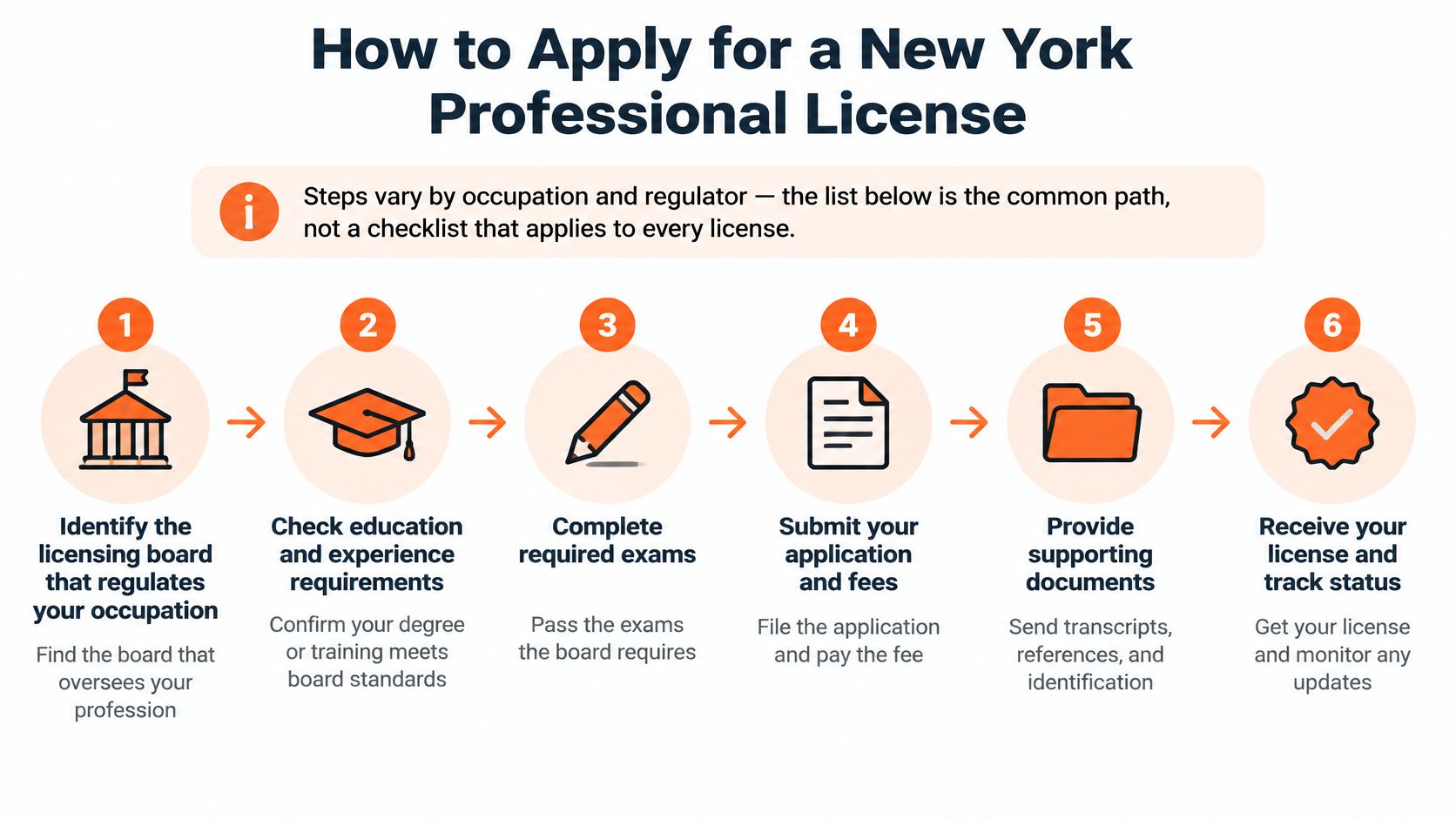
New York's licensure framework is consistent enough to plan around and specific enough that no single checklist covers every occupation. The state's guide to applying for a professional license lists the common ingredients: an approved course of study, a written or practical examination, health certification signed by a physician or nurse practitioner, proof of identity, and educational documentation such as a school certificate and a transcript showing completed subjects and hours. Treat it as the shape of the process. Each regulator layers its own requirements on top.
This is also where the count of licensed people begins to overstate the count of people who can practise. An approved application produces a licence; registration, renewal and good standing determine who can legally work. Some applicants finish every step below and still cannot practise until a later registration takes effect.
The common path, step by step
- Identify the regulator and the exact pathway. One agency can host several licences with different requirements, and the wrong pathway means a wasted application fee. Confirm the title you're applying for matches the work you intend to do.
- Complete an approved course of study. The regulator publishes which programmes satisfy this, and a programme that isn't on the list won't be fixed later by extra coursework. Check the approval status before you enrol, not after.
- Pass the examination the regulator requires. Some professions use a written exam, some a practical one, some both. The common slip here is sitting an exam for the wrong jurisdiction and assuming the score transfers.
- Get the health certification signed by the right clinician. A physician or nurse practitioner has to sign it. A form signed by a different type of practitioner can stall a file for weeks while you get it redone.
- Assemble proof of identity. This is the step applicants treat as trivial and then discover it needs a specific document type or a certified copy.
- Order the school certificate and transcript. The transcript has to show completed subjects and hours. A transcript that lists courses without hours, or hours without subjects, is a frequent reason an education review goes back to the applicant.
- File the complete application and record the date. Note the day the last document went in, because that date, rather than the day you started, is the one status timelines get measured from.
Two mistakes account for most of the delay in this sequence. Enrolling in an unapproved programme costs months, and an incomplete transcript costs weeks.
If the credential you're chasing turns out to be a certificate rather than a licence, the rules on issuance, renewal and revocation are different. The ProfessionLens comparison of professional licenses or certificates sets out where the two diverge.
Applicants heading into medicine face a longer runway than anyone else on the register, because the licensing step sits on top of years of education. The Medical School Programs doctor pathway guide maps the undergraduate, pre-med and medical-school stages that come before a licence application is even possible.
Application and Renewal Timelines You Can Expect
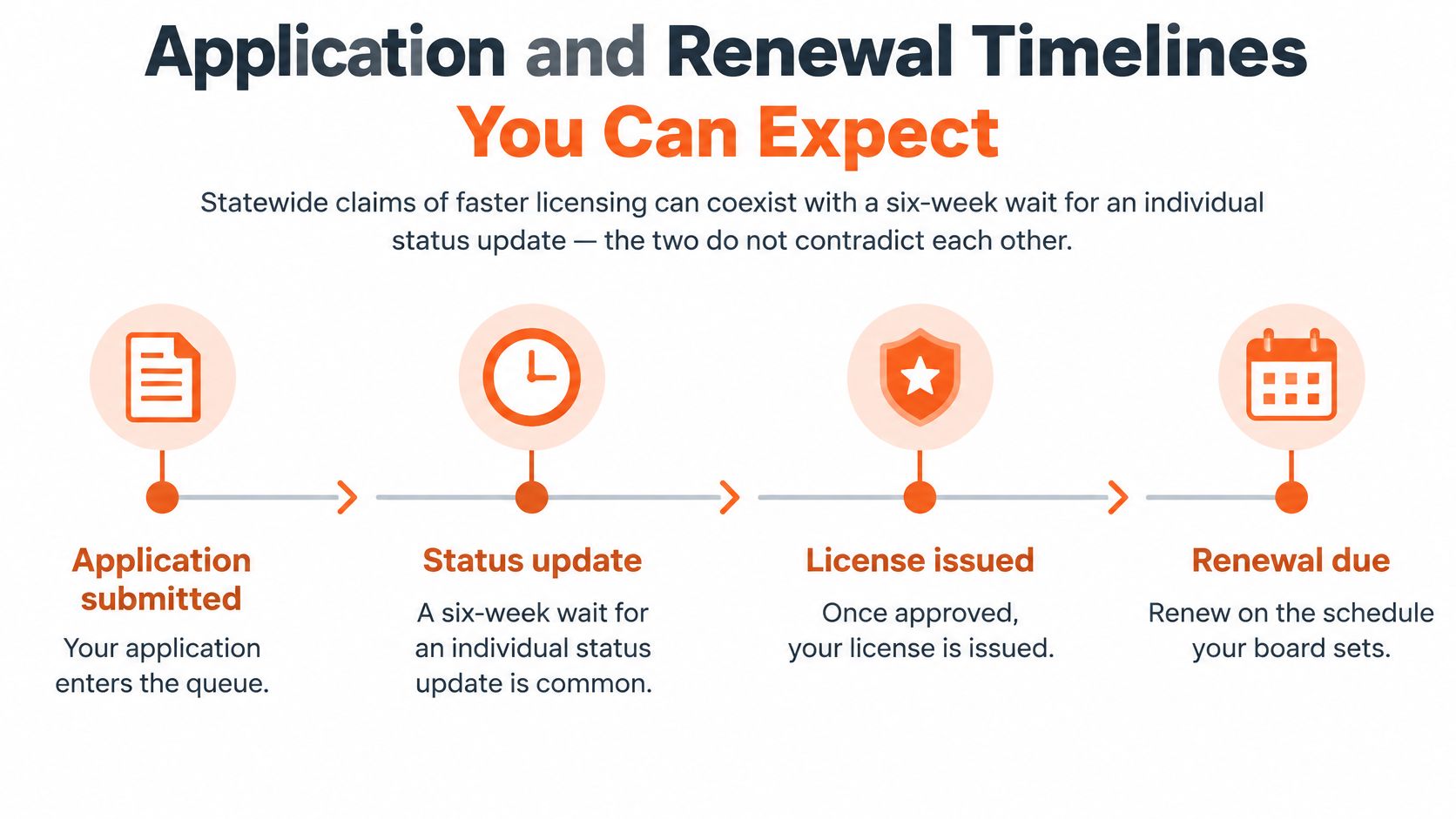
New York can report a genuine improvement in licensing speed and still leave an individual applicant waiting six weeks for an answer. Both facts come from the same state government, and neither one is wrong. The New York State Education Department's contact and status guidance advises applicants to wait six weeks after submitting all documentation before requesting an application-status update, and warns that busy periods can extend that window. Complete online renewal applications, by contrast, may take up to three business days to process.
The statewide picture reads better. New York has reported faster licensing processing in recent years, with the Division of Licensing Services citing shorter average turnaround across the licence types it administers.
A filed application enters a queue, and the queue moves on document completeness rather than on the date you mailed it.
What the averages leave out
A statewide turnaround figure is an agency-wide metric. It doesn't tell you which professions or application types it covers, and it doesn't say whether the clock starts when an application is filed or when the last document lands. Foreign education reviews, examination scheduling, background checks and missing documents each change the timeline in ways an average flattens out. NYSED professions may also run on different service levels than Department of State licences, since they're separate agencies with separate systems.
None of these turnaround numbers measures the practising population either. A licence can be issued and then lapse at the next registration, so even an accurate count of licences granted in a fast month overstates how many people can lawfully practise today.
A statewide average and an individual service standard answer different questions. Quote the first, plan around the second.
Ask for the right numbers
When you're planning around a credential, ask the agency for the median and percentile figures for your profession and application type instead of a single advertised average. Ask whether the measure counts complete files only. If you're the one publishing timeline claims, report the measure, the population and the completeness rule alongside it, because a fast average built on easy files tells a hospital recruiter nothing about a foreign-trained nurse's application.
Renewal Cycles and Continuing Education Rules
A registration that is not renewed on time stops being permission to practise, even when the underlying licence stays in the file. Physicians renew on a shorter cycle than most other NYSED professions, which renew less often. Insurance sits on a separate biennial clock, and continuing education is built into the renewal itself.
Renewal and continuing education rules by license group
| License group | Renewal cycle | Key requirement |
|---|---|---|
| Physicians | Shorter NYSED registration cycle | Registration renewed with the state before the period ends |
| Most other NYSED professions | Longer NYSED registration cycle | Registration renewed on that profession's cycle |
| Insurance licensees (licence in effect over two years) | Each full biennial licensing period | 15 approved CE credits, completed before the renewal application is filed |
| Property/casualty insurance licensees | Each full biennial licensing period | Includes at least one hour of flood-insurance instruction |
| National Flood Insurance Program sellers | Each full biennial licensing period | At least three enhanced flood-insurance hours |
The insurance curriculum in detail
For many New York insurance licensees, continuing education is a condition of renewal. The Department of Financial Services continuing education rules require 15 approved credits during each full biennial licensing period, once the licence has been in effect for more than two years. Those 15 hours are not free-form. At least one hour each in insurance law, ethics and professionalism, and diversity, inclusion and elimination of bias has to sit inside the total.
Property/casualty licensees add flood-insurance instruction. Anyone selling National Flood Insurance Program policies needs at least three enhanced flood-insurance hours. Take a property/casualty producer renewing after a full biennial period. The 15 credits have to cover the three mandated subjects and the flood hour, and every hour has to come from a New York-approved provider or course.
Timing and the lapsed record
Finish the credits before you submit the renewal or relicensing application. Hours from a provider outside New York's approval list do not count, however relevant the topic.
Renewal check: list your credits by subject before you file. A 15-credit total that skips the diversity, inclusion and elimination of bias hour fails the curriculum test even when the hours add up.
Boards outside these groups set their own cycles and subject rules. A licensed professional geologist follows a registration path of its own. Miss the renewal and the credential remains on file, but registration lapses. The file still counts a licence. It does not count someone who can practise in the current period.
Counting People Who Can Practise
The rule that resolves most confusion is simple and widely ignored. New York requires professionals to be both licensed and currently registered to practise or to use a professional title in the state, as the Office of the Professions FAQ sets out. A credential that exists in a file is not the same thing as permission to work this month.
Registration status and practice rights in New York records
| Status | What it means | Can practise in the current period? |
|---|---|---|
| Registered | Licence is on file and registration is current | Yes |
| Inactive | Licensee told the state they will not practise in the next registration period | No, for that period |
| Not Registered | Registration has generally lapsed | No, until registration is renewed |
| Licensed (any status) | The credential exists in the record | Only if also currently registered |
Three layers a count can measure
A count of licences on file is the widest layer. It includes people who told the state they won't practise, people whose registration lapsed, and people who moved away years ago. A count of currently registered licences is narrower and is the layer that matches the legal right to practise. A count of people working is narrower still, and no licensing file contains it, because part-time work, out-of-state employment and multiple credentials all sit outside the register's view.
Take a physician who files as inactive. The name stays in the licence file, the credential still exists, and that person drops out of the currently registered group for the period. A table published without a status filter counts them as a practising physician.
The three errors that inflate a total
- Summing overlapping categories. Nursing and nurse practitioner rows share people, and any total built by addition inherits the double count.
- Keeping inactive and lapsed records. A snapshot of the whole file is not a snapshot of who can work.
- Reading a registration decline as an exodus. Fewer registrations can mean nonrenewal or a temporary pause rather than people leaving the occupation.
A dated counting method
Fix one reference date, such as April 1, 2025, and hold every comparison to it. Filter to currently registered status before you count anything. Remove duplicates across overlapping categories and write down which ones overlapped. State which categories you excluded and why. Record the source you pulled and the date you pulled it, because the next snapshot will differ.
ProfessionLens builds its own counts from public licensing rolls and federal files as they stood on the count date, and it treats a roll as capable of carrying errors, duplicates or lapsed licences, which is why the count date travels with every published figure. The same caution applies to anyone assembling health workforce numbers; the ProfessionLens breakdown of licensed healthcare professionals shows how much a total moves once you decide which credentials and which statuses belong inside it.
Where to Look Up and Read a New York License Record
Start with the regulator from the category map, because the lookup happens on that body's public records rather than through a general web search. Then read the record in a fixed order so you don't stop at the first line that looks reassuring.
- Open the right agency's public licence search. A real estate record lives with the Department of State, an insurance appointment with the Department of Financial Services, and a nursing or medical record with NYSED. Searching the wrong body returns nothing, and nothing is not evidence of no licence.
- Search by name and profession, then confirm identity with a second detail. A city or a licence number separates the record you want from a namesake, which matters before you put a name in a published list.
- Read the status line. Registered, inactive or not registered. This one line decides whether the person can practise in the current period.
- Compare the date of last registration with the renewal period for that profession. A date that sits comfortably inside the cycle is normal; one that predates it points to a lapsed registration.
- For an insurance licensee, check that the continuing education was completed before the last renewal was filed. The credits are a condition of the renewal, so a completed renewal implies they were satisfied at filing.
- Save or print the record with its date and source. A licence record is a snapshot, and it changes at the next renewal.
A record showing registered status proves registration for the current period only. A missing record can mean a different profession, a different board or a different agency, so confirm the category before concluding that someone holds no New York licence at all.
Confirm a New York License Status Before You Act
A licence on file and a licence in force are two different things. New York issues the credential once; registration is the current permission to use it, and it expires. Every error worth preventing sits in that gap, so before you rely on a New York licence for a hire, a contract or a published figure, run this check in order.
- Confirm registered status for the current period. Inactive or not registered means the person can't practise in that period, whatever the file says about the credential.
- Confirm the last registration falls inside the cycle for that profession. A stale date is the earliest warning that a renewal was missed.
- For insurance, confirm the 15 credits and the three mandated subject hours were completed before the renewal was filed. A renewal that cleared the agency implies the curriculum was met.
- For a new application, wait six weeks after complete submission before asking for a status update. Busy periods push that window out, and calling sooner rarely produces information the file doesn't yet hold.
- When you cite a count, state its reference date and source. Counts taken on different dates aren't comparable, and a figure without a date can't be defended later.
Those five steps prevent the two errors that matter most. The first is treating a credential on file as permission to practise now; a count built on licences issued will always overstate the number of people who can work today. The second is combining two totals pulled on different dates, which can count the same workforce twice. The waiting that comes with a stalled application is its own kind of strain, and if the pressure is spilling into daily life, finding ERP therapy for OCD nearby is a practical place to look for local support. Counts you republish should carry their attribution as well; ProfessionLens publishes its tables under CC BY 4.0 and asks that they be credited to ProfessionLens.
Treat the regulator's own records as the authority for licence status, and confirm with that regulator before you act on anything that affects employment, a contract or a published claim.
ProfessionLens counts licensed professionals across the United States by profession, state, county and employer, so you can cite a dated figure instead of an undated one. Its count pages cover physicians, nurse practitioners, pharmacists, dentists, professional engineers, real estate agents and insurance producers, and every count is free to read and cite, with no account and no paywall. Visit ProfessionLens to compare a New York figure against the national picture before you publish it.