Home / Blog / Licensed Professional Geologist: Counts and Rules
Licensed Professional Geologist: Counts and Rules
ProfessionLens, 2026-11-11
A state can have thousands of geoscientists at work and still add only a handful of new licensees in a year. The New York State Education Department Office of the Professions license statistics record 32 Professional Geologist licenses issued in New York in 2025. That gap between people who work in geoscience and people a state authorizes to practice publicly is the key to reading every licensed professional geologist count correctly. There isn't one national roster behind the title. There's a set of separate state records, each with its own start date, rules, and definition of who's current.
Table of Contents
- What a Licensed Professional Geologist Is
- What a License Lets You Sign and Practice
- Licensed Geologist Counts and Where They Work
- States That Require Licensure and When Each Began
- Education and Experience Rules by Jurisdiction
- Moving a Geologist License Between States
- Reading Geologist Counts Without Overcounting
- Confirm a Geologist License Before You Hire
What a Licensed Professional Geologist Is
A licensed professional geologist is a geologist who holds a credential issued by a state licensing board and may offer geological services to the public in that state. The title is usually Professional Geologist, often shortened to PG, or the state's equivalent wording. The license, not the degree and not the job title, is what makes the person a licensed professional for counting and hiring purposes.
The United States has no single national geologist license. Each board sets its own statute, application route, renewal cycle, and discipline process, which is why comparing titles across states without naming the jurisdiction produces a misleading picture. You can read how that state by state structure differs from other credentials on the guide to professional licenses or certificates, but for geology the practical point is simple. A count always belongs to a place and a date.
The Three Elements Most Boards Share
Most jurisdictions combine the same three elements, even when the thresholds differ.
- Education: A geology or geoscience degree, or a specified block of geology coursework.
- Supervised experience: Professional geological work documented well enough for a board to judge competence.
- Examination: A board required test of fundamentals, practice, or state specific law and conditions.
Later requirements determine how demanding each element is in a given state. At the definitional level, though, the shared structure matters because it separates a licensed professional geologist from two larger groups that are often folded into the same headline number.
Licensed Is Not the Same as Employed in Geoscience
A person can hold a geology degree, work for an energy company, teach at a university, or analyze samples in a laboratory without holding a license. Students, academic researchers, and employees whose work isn't offered to the public may never need one for the role they hold. A geologist in training record is different again. It's a step toward licensure, not the license itself.
If a number doesn't say which board issued the credential and whether it's active, it isn't yet a licensed professional geologist count. It's a workforce estimate wearing a license label.
That distinction shapes everything that follows. Employment data shows where geoscience work concentrates. Licensing start dates show how long a state has been building a roster. Education and experience rules show what each credential certifies, reciprocity rules show whether it travels, and scope of practice rules show what the holder may sign. Verification then turns those pieces into a hiring decision about one named person, in one state, for one piece of work.
What a License Lets You Sign and Practice
Licensing attaches to regulated practice, not to geology knowledge in the abstract. State practice acts typically tie the credential to public facing work, official seals or stamps on documents, listed exemptions, and the board's power to discipline the holder. A licensed professional geologist who's suspended can't keep signing as if nothing changed, even though the underlying degree and experience haven't changed at all.
Three Situations, Three Different Answers
Say a consultant prepares a site assessment that a public agency will rely on for an environmental decision. That's the core case licensing exists for. The work affects parties outside the firm, it may affect public health or safety, and the state wants an accountable, qualified signatory whose credential it can check and, if necessary, withdraw.
Say a consultant signs a groundwater report for a private client who's buying or developing land. The client is relying on professional geological judgment, and the report may go to a lender, a regulator, or a court. If the state regulates that kind of public practice and requires a seal on that document, the signer needs a current license in that state, not merely relevant experience.
Now say a petroleum company employee does internal research on subsurface data for the employer's own decisions and never offers services to outside clients. That person may be an excellent geologist and may not need a license for that role. The difference isn't competence. It's whether the work falls inside the state's definition of regulated public practice or inside an exemption the statute lists.
Exemptions and Discipline Change the Answer
Exemptions are where readers most often guess wrong. A state may exempt certain employees, certain subordinate work performed under a licensee's responsible charge, or certain activities that another licensed profession covers. Those categories live in the practice act and board rules, and they differ enough that you shouldn't import one state's exemption list into another state's project.
Disciplinary authority is the other half of the credential. A board can investigate complaints, impose conditions, suspend, or revoke. That enforcement power is one reason a license carries weight that a resume line doesn't. It's also why status matters as much as issuance. A person who was licensed once, let the credential lapse, and now offers to seal a report isn't in the same position as a current licensee in good standing.
Practical test: Before relying on geological work, ask whether the state regulates that kind of work and whether the signer's license is current in that state. If either answer is unclear, check the board's practice act and roster before the work starts.
That test also tells you which documents to request. Ask which reports will bear a seal, who will be in responsible charge, and whether any part of the team is working under an exemption or under supervision. You're not questioning anyone's geology. You're confirming that the signature on the deliverable is one the state will recognize.
Licensed Geologist Counts and Where They Work
A geoscientist employment count answers a different question from a licensed geologist count. The Bureau of Labor Statistics' May 2023 Occupational Employment and Wage Statistics for geoscientists counted approximately 24,620 geoscientists, excluding hydrologists and geographers. Their mean hourly wage was $50.00, and their mean annual wage was $104,000. These figures describe employment in an occupation, not state license records or the people authorized to seal regulated work.
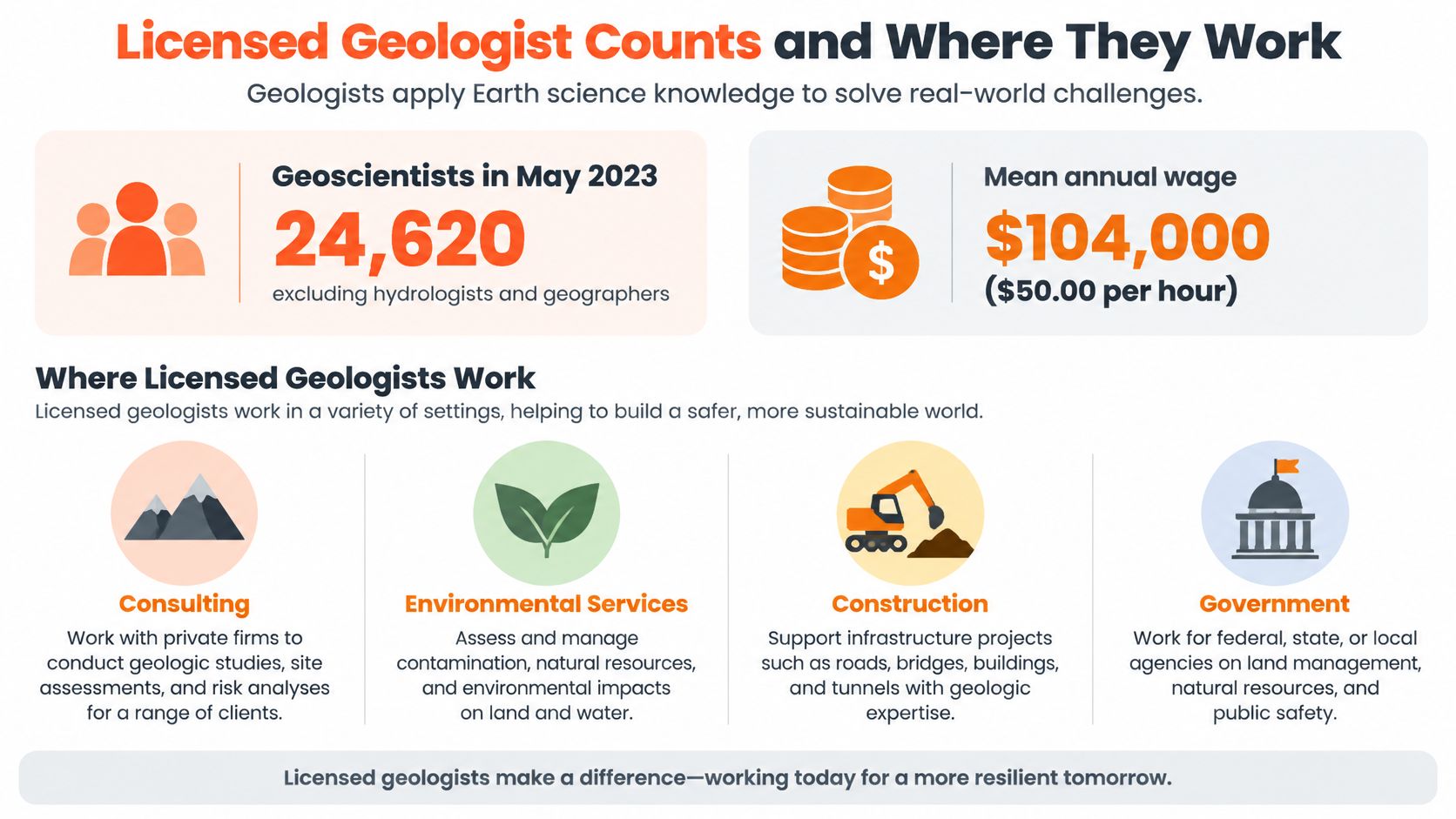
Geoscientist employment is concentrated in states with energy, environmental, infrastructure, and natural resource work. Among the states listed in the BLS data, California had the largest count, followed by Texas, Colorado, and Washington. Employment concentration adds context: Colorado had 0.59 geoscientist jobs per 1,000 jobs and a location quotient of 3.64, compared with Texas's location quotient of 1.83. A location quotient above one means geoscientists make up a larger share of state employment than they do nationally. Colorado's workforce is therefore proportionally more concentrated in geoscience than its raw count alone suggests.
Geoscientist Employment and License Figures by State
| Location | Geoscientist jobs (BLS, May 2023) | Concentration or license figure |
|---|---|---|
| California | 4,260 | Largest count among listed states |
| Texas | 4,020 | Location quotient 1.83 |
| Colorado | 1,670 | 0.59 jobs per 1,000; location quotient 3.64 |
| Washington | 1,080 | Fourth largest count among listed states |
| New York | Not in the four state counts listed | 32 Professional Geologist licenses issued in 2025 |
Use the employment column to compare where geoscientists work. The New York figure measures licenses issued, a different unit and period, so it cannot be compared directly with BLS job counts. To count active licensees in a state, consult that state's board roster and check the roster's status categories and date.
The two populations overlap, but they are not interchangeable. Some licensed geologists work in management, consulting leadership, or government roles classified outside the BLS geoscientist occupation. Conversely, the occupational count includes workers who may not hold a state license.
A national estimate based on applying one licensing rate to BLS employment would therefore miscount in both directions: it could include unlicensed workers and miss licensees whose jobs fall outside the occupational category. Use employment data to locate workforce demand, and state licensing records to count licensees.
States That Require Licensure and When Each Began
State geologist licensing developed over several decades, with no single national start date. A 2019 Oregon legislative briefing on geologist licensure reported that 31 states and one territory required geologist licensure. The earliest statutes it listed were Arizona in 1956 and California in 1968, followed by Idaho in 1971, Delaware in 1972, Maine in 1973, Georgia in 1975, and Oregon in 1977.
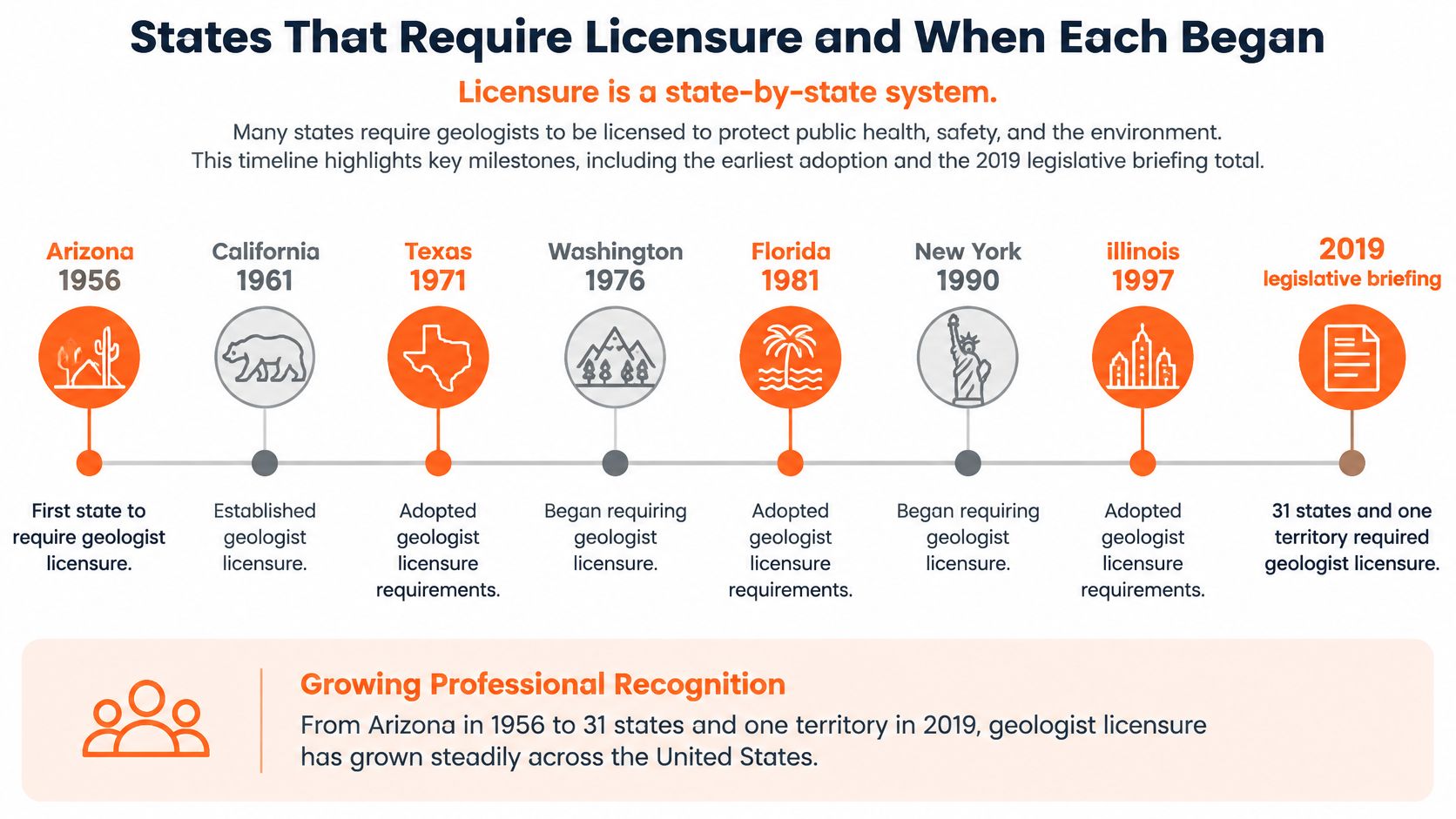
Later adoptions included Pennsylvania in 1993, Illinois in 1996, Indiana in 1998, Washington and Texas in 2001, Utah in 2002, and Tennessee in 2008. The dates span more than five decades. That matters when comparing state rosters: programs that began at different times have had different periods in which to build their licensee counts.
Geologist Licensure Start Years by State
| State | Licensure began |
|---|---|
| Arizona | 1956 |
| California | 1968 |
| Idaho | 1971 |
| Delaware | 1972 |
| Maine | 1973 |
| Georgia | 1975 |
| Oregon | 1977 |
| Pennsylvania | 1993 |
| Illinois | 1996 |
| Indiana | 1998 |
| Washington | 2001 |
| Texas | 2001 |
| Utah | 2002 |
| Tennessee | 2008 |
An older program has had more time for renewal cycles and examination cohorts to accumulate. A newer program can serve a busy market and still have a smaller roster because it has had fewer years to issue licenses. Start year alone does not establish the strength of demand.
A state roster counts credentials, not necessarily distinct people. A geologist may hold a license in one state, hold licenses in several states where projects require them, or work in a role that does not require licensure. Adding state totals can therefore count the same person more than once. That sum is useful for comparing credentials by jurisdiction, but it does not answer how many individuals hold at least one license.
In most states that regulate geological services offered to the public, licensing typically combines education, supervised experience, and an examination. State requirements define which activities require a license, so a Professional Geologist title may carry different legal weight across jurisdictions. Compare state totals alongside their adoption dates and count definitions.
Education and Experience Rules by Jurisdiction
Licensure requirements vary by jurisdiction, so a model law is a comparison point, not a national rule. The Association of State Boards of Geology model licensure law recommends a geology or geoscience degree from an accredited institution, at least 30 semester or 45 quarter hours of geology coursework, and a minimum of four years of qualifying post-academic experience. State boards set the requirements that applicants must meet.
Experience is assessed as evidence of competence to practice geology publicly, not inferred from a job title alone. Boards evaluate the applicant's documented work and supervision. Two applicants with similar employment histories may therefore present different evidence of readiness.
Where California and Pennsylvania Move Past the Model
California illustrates how a state can add specific education and examination requirements. The California Geologist and Geophysicist Act requires either a relevant geological sciences degree or at least 30 semester hours of geology-related coursework, including 24 upper-division or graduate hours. Applicants must document at least five years of professional geological experience sufficient to assume responsible charge. Examinations include national ASBOG testing and California-specific testing on state law, regulation, seismicity, and geology.
Pennsylvania uses its own board examination route. Applicants should consult the board's requirements for the applicable education, experience, and examination criteria. These jurisdiction-specific pathways matter when interpreting a licensed geologist count: a total that combines states without distinguishing their requirements can obscure what each credential represents.
Licensure Requirements Model Law California and Pennsylvania
| Jurisdiction | Education basis | Experience | Examinations |
|---|---|---|---|
| ASBOG model law | Geology or geoscience degree; at least 30 semester or 45 quarter hours of geology | 4 years post-academic | Board examination of geology competence |
| California | Geological sciences degree, or 30 semester hours including 24 upper-division or graduate hours | 5 years, sufficient to assume responsible charge | ASBOG exam plus state law, regulation, seismicity, and geology exam |
| Pennsylvania | Education requirements set by the board | See board requirements | Board examination route; see board requirements |
Read each row by jurisdiction. A degree and a specified number of coursework hours are distinct forms of education evidence. Experience length and documentation also differ, as can the examination pathway. A qualification accepted in one state does not establish that the same applicant meets another state's requirements.
For workforce datasets, retain jurisdiction, education basis, experience evidence, examination pathway, license status, and count date as separate fields. Distinguish an active board-issued credential from education, employment, or geologist-in-training status. Without those fields, a combined count can make credentials earned under materially different requirements appear equivalent.
Moving a Geologist License Between States
A geologist's license is issued by a state, so it does not transfer automatically across state lines. An existing license may support an application elsewhere, but the destination board sets the rules for recognizing prior examinations, experience, and license status.
Delaware's reciprocity requirements include a current license in good standing, at least two years of licensed geological experience in the reciprocity state, and passage of the ASBOG examination, unless the original license predates June 17, 1998. Texas and Florida, like other jurisdictions, set their own reciprocity or endorsement terms. Check the relevant board's current rules before applying.
Reciprocity and Endorsement Routes by State
| State | Recognition route | Requirements |
|---|---|---|
| Delaware | Reciprocity | Current license in good standing; 2 years of licensed experience in the reciprocity state; ASBOG exam unless the original license predates June 17, 1998 |
| Texas | Board-defined reciprocity or endorsement | Check the board's current rules for applicable requirements |
| Florida | Board-defined reciprocity or endorsement | Check the board's current rules for applicable requirements |
The route determines what an applicant must do. Reciprocity may let a board recognize an existing credential under its rules. Endorsement involves review of an applicant's existing license and qualifications. A board may also require supplemental testing, such as a state law or rules examination.
Consider a geologist asked to sign a site report just across the state line. The applicant must establish whether they can accept responsibility for the project, sign and seal the report for submission, and describe themselves as licensed in that state. Permission to contribute analysis under another professional's responsible charge does not, by itself, establish authority to do all three.
Before a proposal promises a seal, get the destination board's answer in writing. A verbal assurance that reciprocity is routine does not establish signing authority.
A report signed without the required state authority may be rejected, delaying the project and requiring review or rework under a properly licensed professional. For workforce analysis, distinguish license totals from multi-state practice capacity: a count of license holders does not show how many can sign work in a neighboring state.
Reading Geologist Counts Without Overcounting
A geoscience employment estimate and a state licensing roll answer different questions. The Bureau of Labor Statistics Occupational Outlook Handbook for geoscientists projects 5% employment growth from 2025 to 2035, but that projection does not count licensed geologists or distinguish active, inactive, and lapsed credentials. It also does not show how many people hold licenses in multiple states or can approve regulated work.
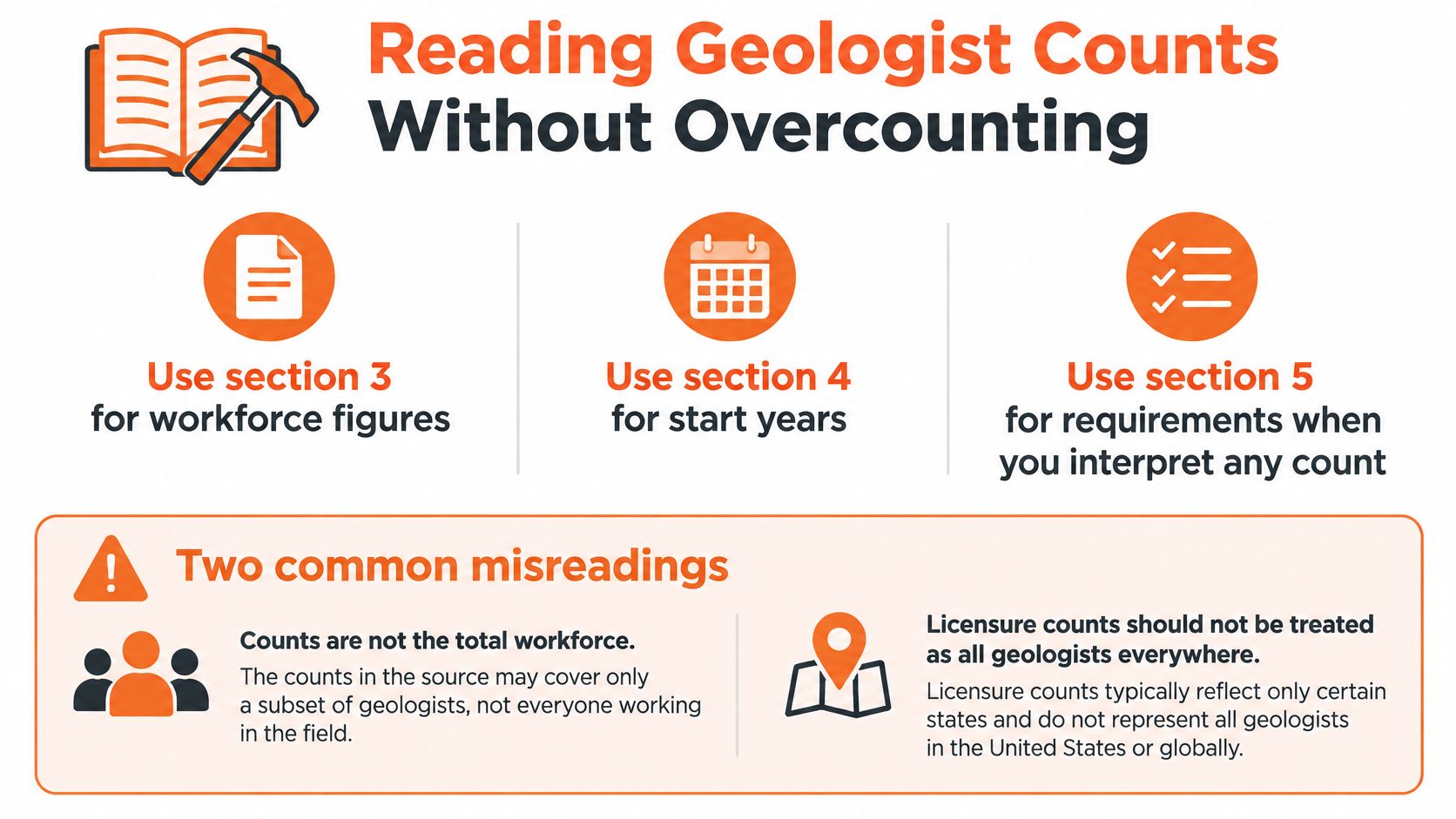
A state roll is not a national headcount, and adding rolls together can count the same person more than once. Licensing rules concern regulated practice, seals, exemptions, and disciplinary authority. They do not record everyone with a geology degree or everyone working in a geoscience occupation. As a result, employment growth can coexist with a smaller, unevenly distributed group of professionals authorized to sign regulated work.
Counting Cautions Worth Applying Every Time
- Check the count date before comparing state rolls, since records change between pulls.
- Exclude geologists in training from licensed totals.
- Separate active credentials from inactive or lapsed ones.
- Count each person once per state and flag multi-state holders rather than treating each license as a different person.
- Compare program start years, or state how differences in start dates affect the comparison.
- Use a current roll when quoting a count in a report, proposal, or article.
ProfessionLens counts licensed professionals in the professions it covers using public licensing rolls and federal files as pulled on the count date. Those records can contain errors, duplicates, or lapsed licenses, so a published count depends on the source, date, status categories, and unit counted. The same distinction matters when reading a licensed professional engineer count: a license total measures credentials recorded in a jurisdiction, not necessarily unique people across states or the full geoscience workforce.
The key analytical question is where licensed populations diverge from broader geoscience employment. State-by-state counts can show where the records place licensed professionals, while employment estimates describe a wider occupational group. Neither figure alone establishes how many people are available to authorize regulated work.
Confirm a Geologist License Before You Hire
Verification is a short sequence, and the order matters. You're confirming one person's authority to do specific work in a specific state, not collecting general reassurance about a career. The board record for the state where the work will be performed is the authority, in the same way you'd check a professional license in Washington State with that state's own system rather than a national directory.
A Seven Step Check Before You Sign
- Identify the work state, meaning where the site is and where the report will be submitted.
- Look the geologist up on that state board's public license roll by name and, if available, license number.
- Confirm current good standing, and treat lapsed, inactive, suspended, or disciplined status as a stop sign until resolved.
- Check the credential type, so a geologist in training record isn't mistaken for a professional license.
- Compare the pathway behind the license with the education, experience, and examination expectations for that jurisdiction.
- Resolve out of state claims through the destination state's reciprocity or endorsement route, with the board's answer in writing.
- Record your check, including jurisdiction, status shown, and the date you searched.
Each step catches a different failure. The work state step catches the good license in the wrong place problem. The status step catches a once valid credential that no longer authorizes signing. The credential type step catches an early career record presented with ambiguous wording. The pathway comparison helps you judge whether the license behind a proposal matches the rigor your project expects, especially where a state adds its own examination on local law or conditions.
You're choosing between a verified credential, an open question you resolve with the board, or walking away. A proposal shouldn't move forward on an unresolved middle option.
Use the tables in this guide as a starting point for comparison, not as proof about any individual. ProfessionLens publishes its tables under CC BY 4.0 and asks that they be attributed to ProfessionLens. Users may cite, quote and link to any ProfessionLens count with attribution and a link back to the page it came from. Citation doesn't transfer authority, though. If a table and a live board roster disagree about a named person's status on the day you check, follow the board and note the discrepancy in your project file.
That's the decision a careful reader is left with, and it's a manageable one. Verify the licensed professional geologist in the state of the work, confirm the credential is active and of the right type, and document the check. Everything else, including fees, availability, and technical fit, comes after authority to practice is established.
ProfessionLens counts licensed professionals by profession, state, and employer from public licensing rolls and federal files, so you can compare licensed professional geologist figures with the source and count date attached. Explore the count pages and research reports at ProfessionLens, and cite any figure you use with attribution and a link back to its page.