Home / Blog / Licensed Healthcare Professionals and How Counts Differ
Licensed Healthcare Professionals and How Counts Differ
ProfessionLens, 2026-11-07
Licensed healthcare professionals aren't one population in public files. They're several overlapping populations, each counted for a different purpose, on a different date, with different rules for who's included. Quote the wrong one and you'll answer a question nobody asked.
Table of Contents
- Three Labels for One Clinician
- How a Licence File Becomes a Larger Number
- Job Counts for the Largest Licensed Groups
- Why an NPI Is Not a Licence
- What Interstate Compacts Do and Do Not Count
- Which Source Answers Which Count
- Check the Denominator Before You Cite
Three Labels for One Clinician
Start with physicians, because the split is documented cleanly. The U.S. Health Resources and Services Administration 2024 State of the U.S. Health Care Workforce report counted 933,788 professionally active physicians in the United States in 2024, including 800,355 physicians reported as practicing in patient-care roles. Patient-care physicians were about 85.7% of the professionally active total. Roughly one in seven professionally active physicians was therefore outside direct care.
Add a third file and you get a third honest number. The U.S. Bureau of Labor Statistics page for physicians and surgeons put physicians and surgeons at approximately 862,800 jobs in 2025. That payroll count sits between the two 2024 HRSA totals, and it shouldn't match either one. It's counting jobs in an occupation, not people with a credential and not people delivering care this week.
Four ways to count the same clinician
| Status | Who is included | Question it answers | Error if used alone |
|---|---|---|---|
| Licensed to practice | Registered and legally entitled, practicing or not | How large is the credentialed stock? | Overstates care available today |
| Professionally active | Jobs that require the credential, including non-patient roles | How many use the education at work? | Mixes bedside care with admin and research |
| Practicing, patient care | Direct services to individual patients | How many are delivering care? | Undercounts people who could return to practice |
| Employed, BLS jobs | Payroll jobs in the occupation | How many jobs does the occupation hold? | A person can hold more than one job, and a licensee can hold none |
Two details in the HRSA split show why the row matters more than the headline. Internists and family-medicine physicians together accounted for almost one-quarter of patient-care physicians, so two broad categories carry a large share of delivered care. Women represented 38.9% of patient-care practicing physicians. Both shares describe the patient-care row only. Neither describes everyone who holds a licence.
Pick the row before the number
A licence count is a permission stock. It tells you who's legally entitled to practise. A BLS count is a payroll stock. It tells you how many jobs an occupation holds. A patient-care count is a delivery stock. It tells you who's providing services to individual patients.
Those aren't three estimates of one thing with different levels of precision. They're answers to three different questions, and swapping them produces a specific, predictable error each time. Pick the row that matches your question first. Only then quote a total from a file that counts that row.
How a Licence File Becomes a Larger Number
Picture the count as a funnel. The wide top holds everyone a licensing board still lists as entitled to practise, whether or not they've seen a patient this year. The middle narrows to people whose current job requires that education, including teaching, research and administration. The narrow bottom holds people delivering care to an individual patient.
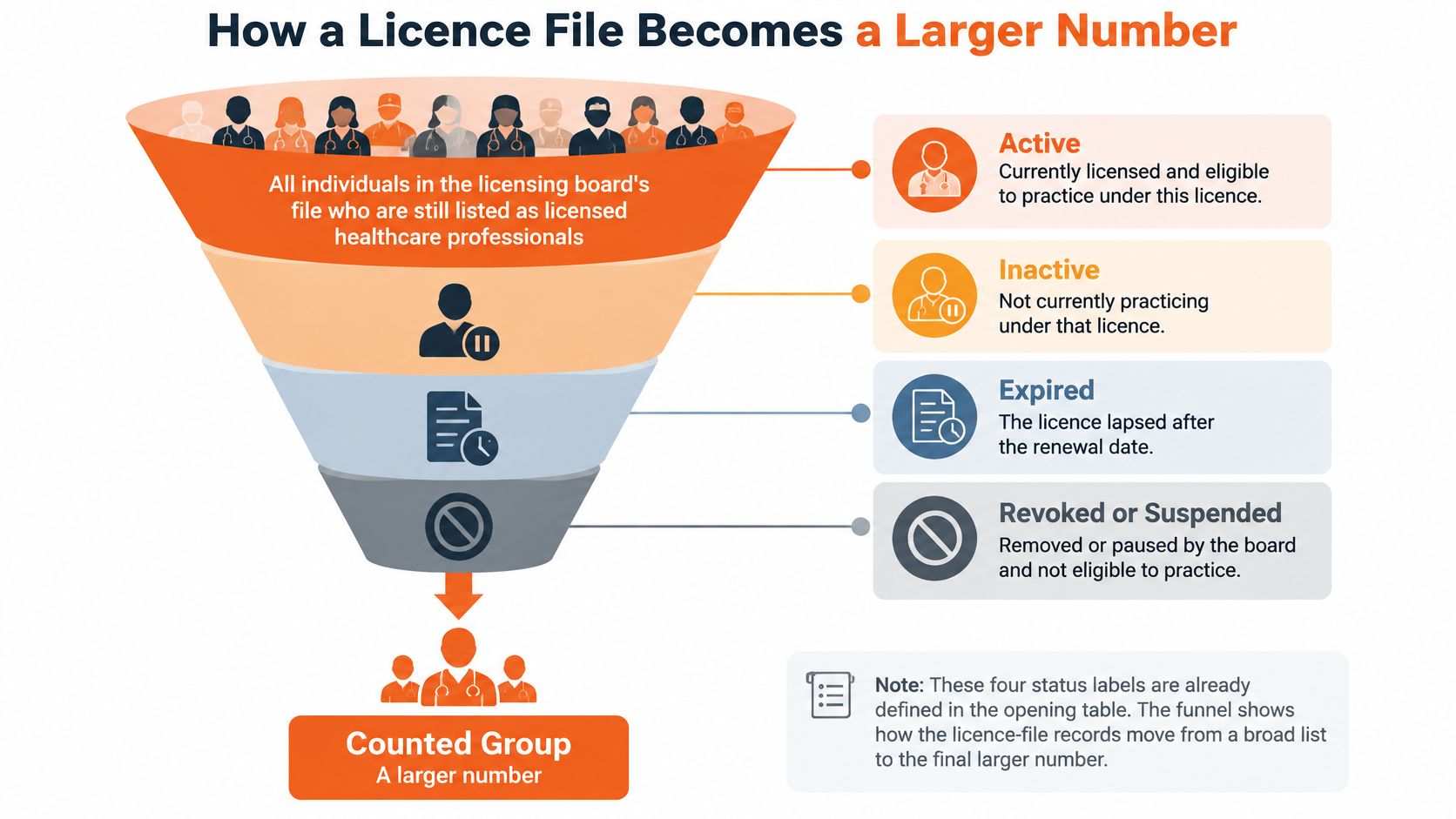
The OECD data explorer definitions for physician measurement state that physicians licensed to practice include both practicing and non-practicing physicians who remain registered and legally entitled to practice, while practicing physicians provide individual patient services. Professionally active physicians also include doctors whose medical education is required for their jobs.
Licence records include non-practicing registrants who remain legally entitled, while practicing counts leave out credentialed people who aren't seeing patients.
That gap isn't noise. It's built into what each file is for. A licensing board regulates permission, so its file keeps people who hold permission. A workforce survey that asks about patient services drops anyone not currently providing them. The licence number is larger because it's supposed to be larger.
One physician, three years, three rows
Say a physician works full time in a clinic in year one. She sits in every row at once, licensed, professionally active, practicing and employed. In year two she becomes a medical director. The job still requires her medical education, so she's professionally active and employed, but she no longer provides individual patient services. She's left the practicing row without leaving medicine.
In year three she takes a career break and keeps her licence current. Now she's only in the top row. No new diploma, no lost credential, no fraud in any file. She moved between rows while each source recorded exactly what it's designed to record.
Edge cases that move people between rows
- Retirement with the licence kept: The person stays in the permission stock and leaves the delivery stock.
- A lapsed licence dropped from a public file: One board deletes the row, another retains it, so two state files disagree about the same person.
- A locum working in two states: Two licensing rolls list one clinician, and a naive state sum counts her twice.
- Telehealth as the only current work: The clinician is delivering care, but not necessarily in the county printed on the record.
Each case is routine. Together they explain why a licence denominator inflates immediately available clinical labour, while a practicing denominator shrinks the stock that matters for re-entry, regulatory capacity or future supply.
Keep the three denominators apart in your own files. The sources were built for different purposes and pulled on different dates, so merging them into one number doesn't average out the differences. It hides them.
Job Counts for the Largest Licensed Groups
Employment size is the question the Bureau of Labor Statistics can answer, and the table below is the lookup. Read each row as payroll jobs in 2025, not as people holding a licence.
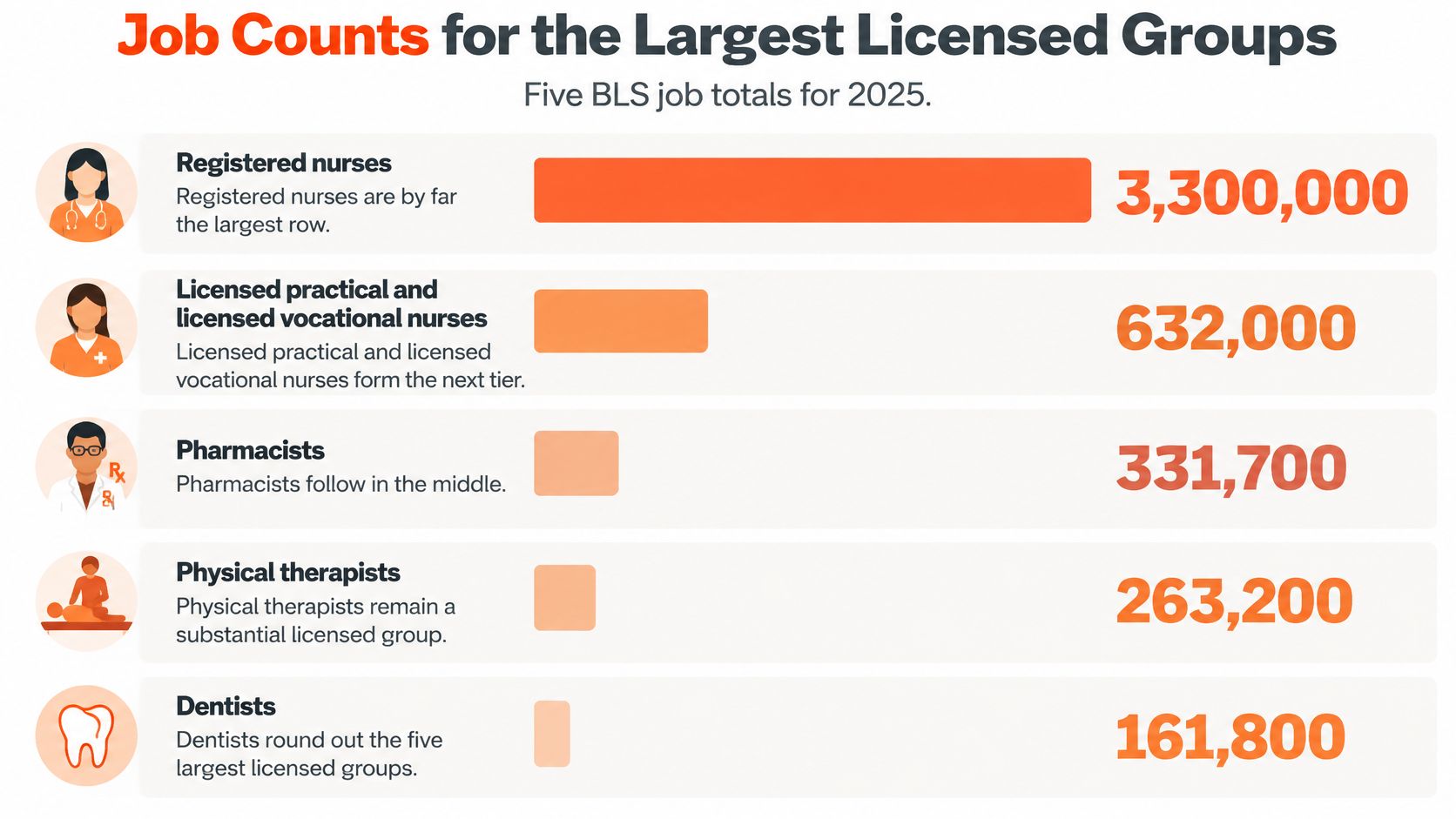
| Occupation | Jobs in 2025 | What this row is | What it leaves out |
|---|---|---|---|
| Registered nurses | 3,465,400 | Payroll jobs | Licensed nurses not employed, and LPNs |
| Physicians and surgeons | 862,800 | Payroll jobs | Licensed or active physicians without a counted job |
| Pharmacists | 325,200 | Payroll jobs | Licensed pharmacists not in a pharmacist job |
| Nurse practitioners, nurse anesthetists and nurse midwives | 399,000 | Three occupations combined | A nurse-practitioner-only total |
| Licensed practical and licensed vocational nurses | 666,900 | Payroll jobs | Registered nurses |
Reading the rows one at a time
Registered nurses are by far the largest row. The U.S. Bureau of Labor Statistics page for registered nurses put registered nurses at approximately 3,465,400 jobs in 2025. Nothing else in the table is close, which is why small percentage changes in nursing move national workforce totals more than large changes in smaller occupations.
Licensed practical and licensed vocational nurses are a separate licence and a separate row. The U.S. Bureau of Labor Statistics page for licensed practical and licensed vocational nurses counted approximately 666,900 jobs in 2025. Folding them into registered nurses by mistake is one of the more common errors in secondary reporting, because both groups get called nurses in ordinary speech.
The advanced practice row is a combined occupation group, not a nurse practitioner total. The U.S. Bureau of Labor Statistics page for nurse practitioners, nurse anesthetists and nurse midwives counted approximately 399,000 jobs in 2025 across all three occupations together. Anyone quoting that figure as a nurse-practitioner-only count has misread the row label.
Pharmacists are smaller but still a major licensed group. The U.S. Bureau of Labor Statistics page for pharmacists counted approximately 325,200 jobs in 2025. As context for the whole table, the U.S. Bureau of Labor Statistics healthcare occupations overview put the median annual wage for healthcare practitioners and technical occupations at $86,530 in May 2025, which marks these as practitioner occupations rather than aides or support staff.
Two counting rules for every BLS row
BLS counts jobs, so one person holding two jobs can appear twice. A person holding a licence with no job doesn't appear at all. Those two rules explain most gaps between a BLS total and a licensing roll for the same occupation.
Job counts also say nothing about why someone leaves a job, which is a separate measurement problem. If your question is about keeping employed clinicians in post rather than counting them, Turn On Work's healthcare retention insights covers that side of the workforce. Cite this table for employment size. Go back to the status table when your question is permission to practise.
Why an NPI Is Not a Licence
The CMS rule is plain. The CMS NPPES help documentation states that issuance of a National Provider Identifier does not ensure that a healthcare provider is licensed or credentialed, because NPPES primarily assigns a standardized identifier for administrative transactions. An NPI is an identifier. It isn't permission to practise.
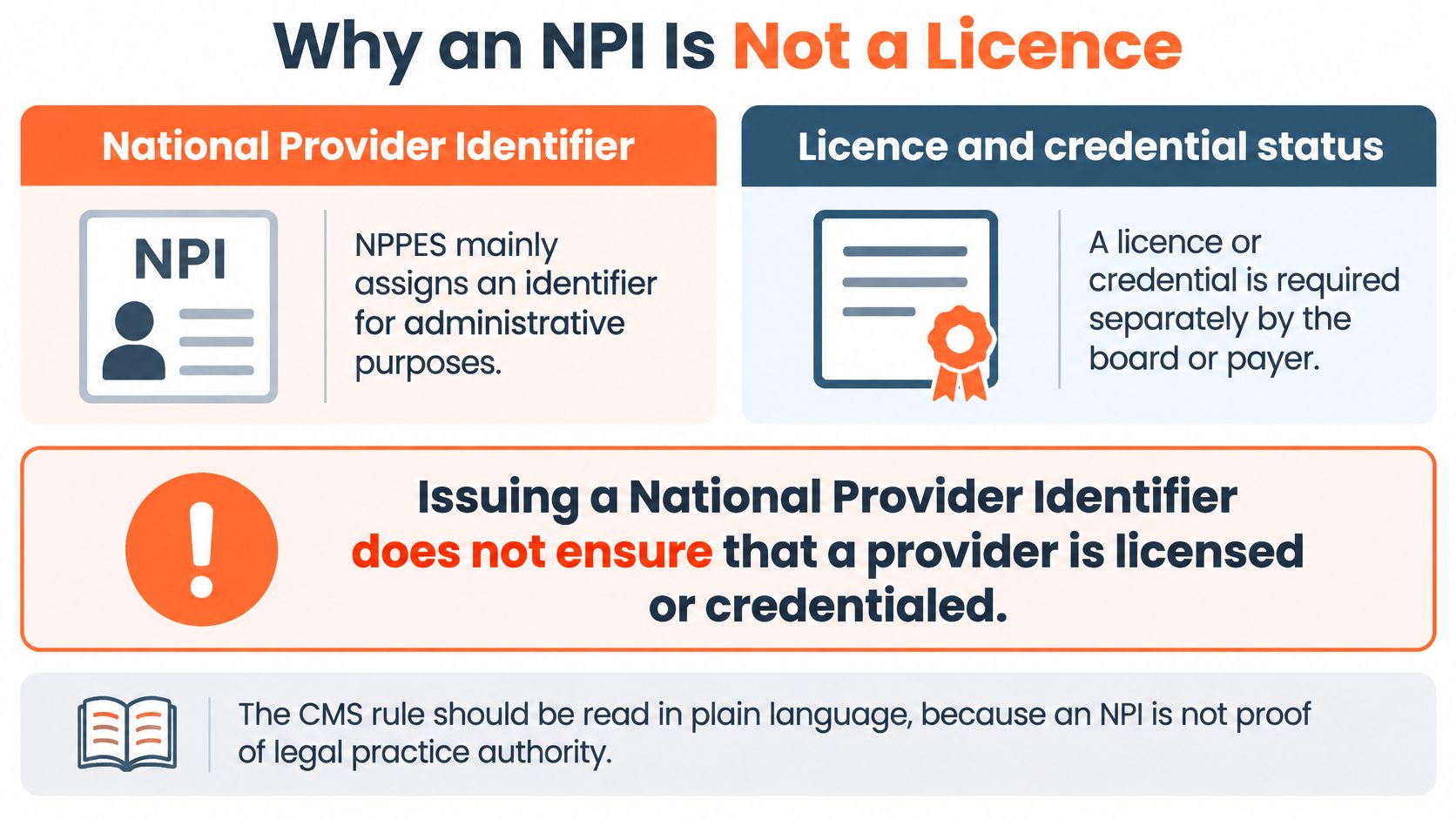
An NPPES row can contain provider status, taxonomy, state and reported license information. Two weaknesses matter for counting. Taxonomy selections aren't independently verified against trusted sources, and a provider may report multiple taxonomy codes while designating one as primary. One record can therefore look like a specialist in more than one field or place.
What the mismatch looks like in real files
Our count of physicians in the US is 1,272,256 on NPPES, dated 15 September 2026. Our count of physicians on the CMS clinician file is 730,327, dated 15 September 2026, and the CMS Doctors and Clinicians national file was released on 10 September 2026. Those two federal files disagree by hundreds of thousands because they enumerate different things. Neither one is a licensing roll.
Say a deactivated identifier still sits in an old extract your team downloaded last year. Or say a multi-taxonomy record gets counted as an active specialist in a county where the clinician only holds a secondary taxonomy. Both produce a false positive that no amount of averaging will fix. Readers who work with organizational identifiers face the same trap, and managing Type 2 NPIs in 2026 walks through the entity side of it.
A safe counting pipeline
- Resolve identity in NPPES: Use the file for identity resolution and reported classification only.
- Keep the primary taxonomy: Where your question needs one specialty per person, drop secondary codes before counting.
- Confirm licensure elsewhere: Check each person against a state licensing roll or another authoritative credential file.
- Date and clean the snapshot: Record the pull date and remove deactivated rows before you publish a total.
Enumeration answers "does this person have an identifier?" Licensure answers "may this person practise?" A pipeline that treats the first as the second will invent clinicians.
Other health occupations run into the same identity problem in different record systems, and our explainer on the dental counting system shows how classification choices shape a count before any arithmetic happens. Separate the identifier step from the licence check and the false positives mostly disappear.
What Interstate Compacts Do and Do Not Count
The Physician Assistant Licensure Compact had been enacted in 17 states by May 29, 2025, according to a Kansas Legislative Research Department summary of interstate healthcare compacts. The same summary reported that the Nurse Licensure Compact covered 43 jurisdictions and the Interstate Medical Licensure Compact covered 42. These figures count jurisdictions, not clinicians, visits or filled vacancies.
What a privilege actually is
A compact lets a clinician with a qualifying home-state licence practise in another member state without repeating the full application. It removes an administrative step for someone who is already licensed. It does not add a licence holder to the workforce, assign a clinician to an underserved area or establish that the clinician is employed.
Whether easier licensing results in more care is a separate question. Research measures clinician movement, practice locations and user satisfaction, but those measures do not establish how many patients received care.
What the evidence measures
- Out-of-state physician practice: Research examines whether physicians practise across state lines and how practice locations change.
- Nursing mobility: Studies examine whether compact membership is associated with greater movement between states.
- User experience and telehealth: Surveys examine clinicians' views of the medical compact process and whether they use it for telehealth.
These measures describe mobility, locations or satisfaction. They do not show how many clinicians are professionally active, employed, working in shortage areas or seeing patients. A licence holder may be counted in a state without using the compact privilege there.
Three lines, reported separately
Compact membership describes policy reach. Privilege use shows that clinicians have acted on that option. Care delivered is a different measure, and compact membership alone cannot establish it.
Keep all three denominators separate: licensed, professionally active and employed. Even a compact record or an NPI does not establish that a clinician can see a patient today. Report membership as a jurisdiction count, use as a measure of activity under the privilege, and care only when a source directly measures patient care. A map of member states is a policy fact, not a workforce or access count.
Which Source Answers Which Count
Match the source to the question before you cite anything. Each file below is good at one job and blind to the rest.
| Source | Counts | Best use | Blind spot |
|---|---|---|---|
| BLS occupational counts | Payroll jobs by occupation, 2025 | Employment size | No licence or practice data |
| HRSA 2024 workforce report | Professionally active and patient-care physicians | Physician benchmark | Physician-focused only |
| NPPES | Identifier records with status and taxonomy | Identity resolution | Not a licence check |
| State licensing roll | Licensed individuals and status | Permission to practise | Duplicates and lapsed rows possible |
| Compact membership lists | Member jurisdictions | Mobility policy | Not a headcount |
Order of operations
First, decide whether your question concerns permission, employment, activity or care. Second, pick the source whose row matches that question. Third, check its snapshot date, because a public roll can contain duplicates and lapsed licences and needs its own date. Fourth, cite the count alongside its exclusions.
Say a claim states that a state has more nurses because it joined a compact. The BLS jobs row and the compact row together still don't confirm more practice, because one counts payroll jobs and the other counts jurisdictions. Neither one observes a nurse seeing a patient. Our count page on how many pharmacists are in the US shows the same discipline applied to a single occupation, with the source and date attached to the figure.
There's also a step downstream of counting that these files don't cover. A clinician can be licensed, identified and employed and still not be billable until a payer enrolls them, which is the practical problem behind getting providers approved so claims pay. Keep that layer out of workforce totals. It's a revenue process, not a population count.
Check the Denominator Before You Cite
Arizona's method is a good model because it states its own limit. Arizona's 2025 workforce methodology document includes professionals with an active license but explicitly warns that maintaining an active license does not prove the individual is delivering care. Licensing systems generally regulate authorization to practice, not actual hours worked or current clinical activity.
That means a licence file won't tell you hours, panel size, retirement in place, or whether this week's work happens in the county printed on the record. The question most public pages never answer is how many licensed professionals are available to provide care in a specific place today. Most pages answer an easier question instead, which is how many licenses exist.
Four measures a research note should carry
Report licensed, active, employed and clinically practicing as separate measures, each with a dated snapshot and transparent exclusions. Recognisable exclusions include a licence kept after retirement, a dual-state licensee counted twice, an administrative role, a deactivated NPI left in an old extract, and a lapsed row that one board deletes while another retains it. State-level licence rules shape several of those exclusions, as our page on a professional license in PA illustrates for one state.
Our own counts are computed from public licensing rolls and federal files as pulled on the count date, and a roll can carry errors, duplicates or lapsed licences. Every ProfessionLens count is free to read and to cite, and the service has no account and no paywall. Users may cite, quote and link to any ProfessionLens count with attribution and a link back to the page it came from.
Global figures set a boundary, not a denominator for a local claim. The World Health Organization health workforce programme page reported that the global health workforce exceeded 70 million workers based on information from 194 Member States through September 2024, with approximately 52 million in dentists, medical doctors, midwifery personnel, nursing personnel and pharmacists. WHO also projected a worldwide shortage of 11.1 million health workers by 2030. That's a needs gap against demand, not a count of unused licences sitting in a file.
The five-point check
- Name the status: Licensed, active, employed or practicing.
- Name the file date: Use the snapshot date, not the article year.
- Name the source type: Licensing roll, identifier file, payroll survey or membership list.
- State the duplication rule: Say whether one person can appear twice.
- Note roll quality: Record that a public roll can contain errors, duplicates or lapsed licences.
A number without its denominator is a claim about a file, dressed up as a claim about care.
Watch the rewrite. "The state has 40,000 nurses" says nothing checkable. "The state licensing roll listed 40,000 active nursing licences on the pull date, which doesn't show how many holders were employed or delivering care" says exactly what the file supports. Run the five points, rewrite the sentence so its denominator is visible, and cite only the row that matches your question.
If you need a count you can cite, visit ProfessionLens for dated counts of licensed healthcare professionals by profession, state, county and employer, each computed from public licensing rolls and federal files with the source and count date on the page. Every count is free to read and cite with attribution, so you can check the denominator yourself before the number goes into your report.