Home / Blog / Dental Counting System: How Dentists Are Counted
Dental Counting System: How Dentists Are Counted
ProfessionLens, 2026-11-06
Tooth 8 and tooth 11 can identify the same tooth: the permanent upper-right central incisor is 8 in Universal notation and 11 in FDI notation, according to the American Dental Association's tooth designation document. A number without its counting system can therefore mislead before anyone makes an arithmetic error.
A search for dental counting system also raises a different question: how many dentists are there? Here, the ambiguity concerns people rather than teeth. A dentist can appear in an identifier file, a licensing roll and a clinician file, but those records don't necessarily establish the same professional status.
For researchers, journalists and workforce planners, the essential distinction is what the record identifies versus what the headline claims to count.
Table of Contents
- Tooth Numbering Systems Side by Side
- Which System Applies Where
- Dentist Count and the Records Behind It
- How Licence Status Changes Who Gets Counted
- Why Counts From Different Files Disagree
- Reading State and National Dentist Ratios
- Build and Check the Count Before You Cite It
Tooth Numbering Systems Side by Side
The FDI two-digit system and the American Universal system identify the same teeth using different codes. Neither code should be interpreted without knowing the notation used in the record.
Under ISO 3950 notation, permanent teeth use quadrant digits 1 through 4 and position digits 1 through 8, while primary teeth use quadrant digits 5 through 8 and position digits 1 through 5. The quadrant identifies the arch and side; the position identifies the tooth's location from the facial midline.
For permanent teeth, the quadrant sequence is upper right, upper left, lower left and lower right. Universal notation instead follows a continuous path around the arches rather than encoding the quadrant within each identifier.
Common teeth in FDI and Universal notation
The following crosswalk applies those numbering rules. Right and left refer to the patient, not the person looking at the chart.
| Tooth | FDI (ISO 3950) | Universal (ADA) |
|---|---|---|
| Upper-right central incisor | 11 | 8 |
| Upper-left central incisor | 21 | 9 |
| Lower-left central incisor | 31 | 24 |
| Lower-right central incisor | 41 | 25 |
| Upper-right third molar | 18 | 1 |
| Lower-right third molar | 48 | 32 |
| Primary upper-right central incisor | 51 | E |
Read each row horizontally: it represents one tooth expressed in different systems, not separate teeth. The primary example also shows why a dataset needs a dentition field or an equally clear coding convention. A primary tooth shouldn't be translated as though it belonged to the permanent series.
Record-handling rule: Preserve the original tooth code and its notation system before adding a translated code.
That approach makes the conversion auditable. If a treatment record looks wrong later, the analyst can distinguish an error in the original entry from an error introduced during translation.
For a clinical record, confirm the anatomical description alongside the code. For a database, store the notation as a field rather than leaving it buried in a document title or filename.
Which System Applies Where
Jochen Viohl of Berlin first described the FDI concept in 1966, and the Fédération Dentaire Internationale proposed worldwide adoption at its 1970 meeting in Bucharest, according to this tooth-numbering reference. Its quadrant-and-position structure suits communication between clinicians and computer systems because the code carries location information.
Universal remains the principal convention associated with U.S. dentistry. The ADA Universal Tooth Designation value set identifies the claim-system code JP and distinguishes permanent designations 1–32 from primary designations A–T.
A practical identification routine
- Read the record's declared system. Look at the claim instructions, data dictionary, export specification or chart legend before interpreting a tooth identifier.
- For a U.S. claim, check for Universal notation. The claim-system field is stronger evidence than the appearance of the tooth number alone.
- For international clinical data, check for FDI. Treat the country and clinical setting as clues, not proof. An imported record may retain its original convention.
- Translate through a crosswalk. Match the anatomical tooth, dentition and side. Don't infer equivalence just because a code has the same number of digits.
A wrong conversion can attach treatment information to the wrong tooth. That makes translation a record-integrity task, not merely a formatting preference.
Keep the original and converted fields distinct in any combined dataset. If the notation is undocumented, flag the record for clarification instead of automatically selecting the convention that seems most likely.
The governing principle is straightforward: identify the schema before interpreting the value. That principle matters just as much when the value represents a dentist rather than a tooth.
Dentist Count and the Records Behind It
Counting licensed dentists is the other meaning of a dental counting system. Readers trying to interpret a dental chart need tooth notation; readers evaluating workforce supply need a defined population and a reproducible extraction method.
Public files offer different views of that population. An identifier record, a licence record and an employment estimate aren't interchangeable evidence of a person currently practising dentistry.
Source records used to count dentists
| Source record | What it covers | Dentist count or coverage | Main limitation |
|---|---|---|---|
| NPPES, National Plan and Provider Enumeration System | National Provider Identifier holders | Extract qualifying dentist records on the stated count date | An identifier can remain after practice ends unless deactivated |
| CMS Doctors and Clinicians file | Clinicians represented through Medicare-related enrolment and reporting criteria | Count qualifying dentist records in the specific release | Not an all-dentist licensing register |
| State dental licence rolls | Individuals holding a state licence | Apply each state's published licence categories and status definitions | States maintain separate files, formats and update schedules |
| BLS OEWS | Employment estimates by occupation | Use the relevant occupational estimate and reference period | Survey-based estimates, not a list of individual dentists |
No new headline total belongs in a publication until the named file has been pulled and checked. A number copied from another page can be a reference figure, but it isn't a substitute for the extraction being described.
NPPES is useful for identifier-based matching. State rolls are the relevant place to investigate legal licence status, subject to the board's definitions and publication practices. CMS clinician records describe a narrower administrative population, while BLS Occupational Employment and Wage Statistics answer an employment-estimation question.
Before comparing totals: Match every number to a source file, a count date and a definition of the population included.
The same distinction applies outside healthcare. Our discussion of licensed professional engineers provides another setting in which the meaning of licensed must be separated from an employment claim.
A defensible dentist count begins with the question being asked. If the question concerns licence holders, an employment estimate won't answer it directly. If it concerns available clinical labour, a register alone won't establish working hours, patient availability or practice location.
How Licence Status Changes Who Gets Counted
A row in a file is not the same as a working, licensed dentist.
An active licence is the starting point for an active-licence count, but it doesn't establish that the holder is currently seeing patients. Conversely, an identifier's administrative status doesn't determine whether a state licence is valid.
The counting rule must distinguish these concepts before the analyst filters records.
| Status on the record | Meaning | Counted as licensed | Why it matters |
|---|---|---|---|
| Active licence | Current licence to practise under the board's classification | Yes under an active-licence rule | Establishes the base eligible category |
| Lapsed or expired | Licence not renewed by the applicable deadline | No under an active-only rule | The record may remain visible after eligibility ends |
| Inactive or retired | Board-designated non-active status | Include only if the published definition expressly includes it | Holding a record isn't evidence of current practice |
| Duplicate entry | Same dentist represented in multiple records or states | Once after matching for a national person count | Raw rows can exceed distinct people |
| Deactivated identifier | NPI administratively deactivated | Not in an active-identifier count; check licence separately | Older extracts can retain a previously active record |
Separate licence validity from practice activity
Say a dentist has an expired state licence but a current NPI. An identifier-based extraction can retain her record, while an active-only extraction from that state's roll excludes it. Neither result establishes whether she holds a valid licence elsewhere.
That qualification matters. Excluding someone from a state's active roll isn't necessarily evidence that the person has left the national profession.
Our counts are computed from public licensing rolls and federal files as pulled on the count date. A roll can carry errors, duplicates or lapsed licences, so the published classification must remain distinguishable from the analyst's interpretation.
A raw row count can overstate a workforce when it includes duplicate or ineligible records. A strict active-only rule can also fail to capture actual activity when administrative updates lag behind a renewal. The remedy isn't to guess which individual records are wrong; it's to document the rule and investigate exceptions.
Before quoting a total, check which status categories were included and how duplicate people were resolved. A label such as registered dentists is insufficient unless the method explains what registered means in that particular file.
Why Counts From Different Files Disagree
A guest list records people invited to an event; a room count records people inside at a particular moment. Subtracting the room count from the guest list doesn't automatically tell you how many people cancelled.
Dentist files create a similar problem. Analysts shouldn't interpret a difference between administrative totals as a workforce shortage, retirement count or missing population without reconciling the underlying records.

Diagnose the disagreement before explaining it
- Inclusion rules differ. An identifier file asks whether someone has a provider identifier. A licensing roll asks whether someone holds a particular jurisdiction's licence. Those are different eligibility tests.
- Extraction dates differ. Downloads taken at different times can contain additions, removals or corrections. A changed total doesn't establish a changed workforce.
- Geographic units differ. A dentist licensed across state lines can contribute to multiple state totals while representing a single person nationally.
- Reporting lags differ. Boards and federal systems don't necessarily receive and publish status changes together.
A state-roll total minus a national identifier total therefore has no clear substantive meaning without harmonisation. The arithmetic can be correct while the interpretation is unsupported.
For teams managing several extracts, BromeAI's discussion of combining AI models, files and workflows offers context for organising a multi-file process. Regardless of the software used, retain original releases, explicit filter rules and a record of transformations. Automated summaries shouldn't replace record-level checks.
Our page on how many pharmacists are in the U.S. addresses the same kind of source-definition question in another health profession. The transferable lesson is to compare populations, not merely profession labels.
When comparing periods, hold the source, geography, status definition and matching method constant. When that isn't possible, explain the discontinuity in a methodological footnote. Don't describe a file change as a workforce trend unless the evidence supports that conclusion.
Reading State and National Dentist Ratios
A raw total answers how many qualifying records belong to a geography. A population-adjusted rate answers a different question: how large that count is relative to the resident population.
Consider hypothetical states with equal dentist totals but different populations. The less populous state has the higher dentist-to-resident rate, even though neither state has more dentists in absolute terms.
Our dentists-per-capita ranking covers 52 U.S. states and territories, expressed as dentists per 100,000 residents. Calculate that rate by dividing the dentist count by resident population and multiplying by 100,000; state the population year alongside the result.
Read the denominator as carefully as the numerator
Small bases make rates sensitive to individual records. In a sparsely populated county, adding or removing a dentist can noticeably change the rate. That movement may reflect a corrected address or status rather than a change in service availability.
Suppressed values aren't zero. In our tables, a count under 5 prints as <5, and a share whose base is under 20 prints n/a. These displays should remain intact when a reader copies a table into a report.
Rankings depend on eligibility rules. An ordering based on active licences needn't match an ordering based on identifier records. Before describing a place as well supplied or underserved, establish what qualified a dentist for inclusion.
A dentist-to-resident ratio is a description of a defined count, not a direct measure of access to appointments.
Licence geography also needs care. A state licence establishes jurisdictional eligibility, not necessarily the dentist's principal practice address or the location of patients served. Border practices and licences held outside a dentist's main workplace can complicate local interpretation.
Use a rate to compare scale, but don't infer clinical capacity from it alone. Working hours, service mix and patient acceptance require evidence beyond a licence count.
Before quoting a ranking, answer these questions: Which file? Which status rule? Which population year?
Build and Check the Count Before You Cite It
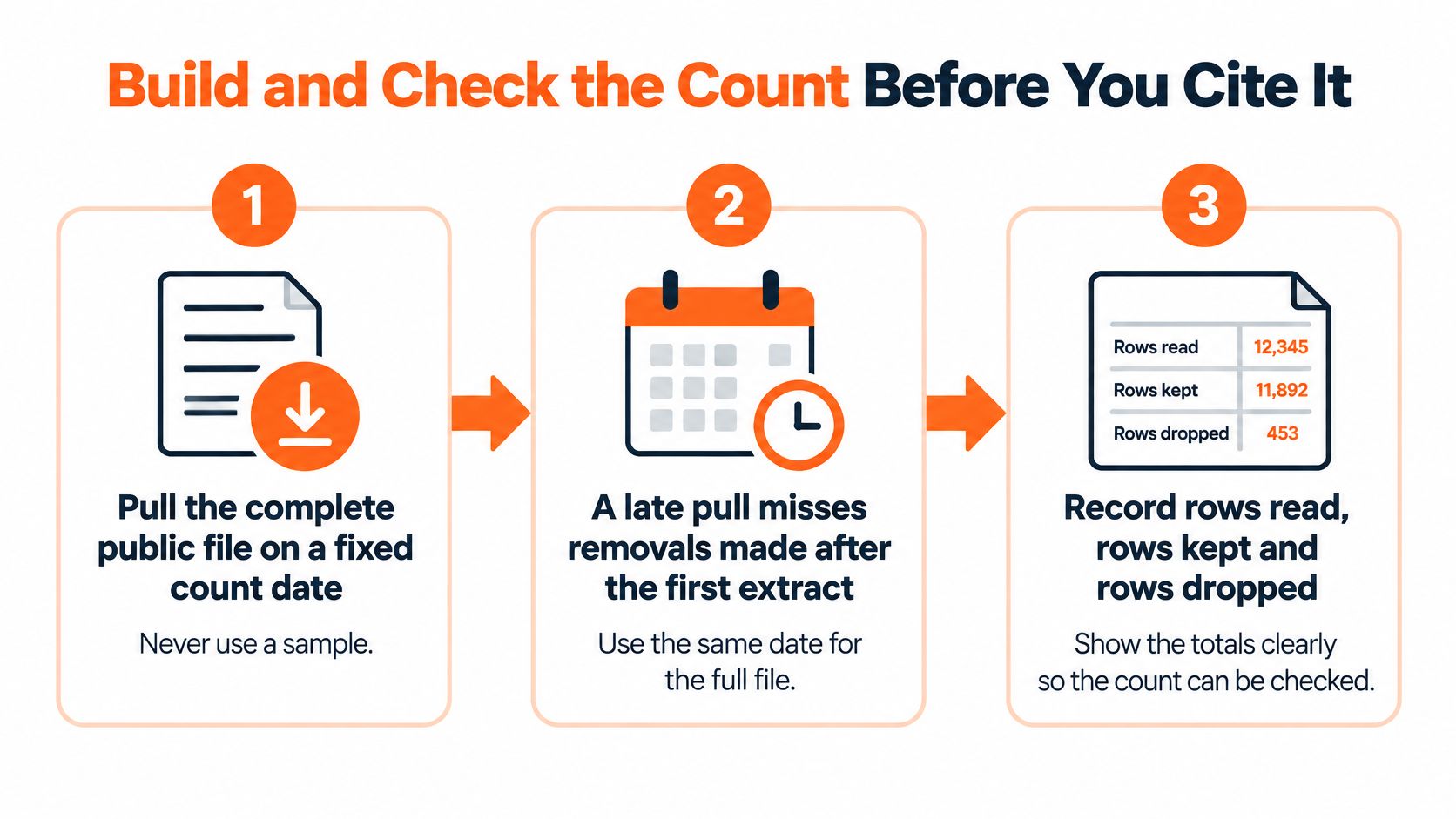
A reproducible count needs a saved input, explicit eligibility rules and an audit trail. At ProfessionLens, every licensing count is computed from a complete public file, never a sample.
Build a reproducible extraction
- Fix the extraction date and preserve the full file. Don't combine an early partial extract with a later download. A later snapshot can omit records removed since the earlier release, making the earlier state impossible to reconstruct without an archive.
- Record rows read, kept and dropped. Assign exclusions a documented reason. Totals should reconcile without unexplained adjustments.
- Match using appropriate identifiers. Use NPIs where available and jurisdiction-qualified licence numbers for board records. Names alone can merge different people; licence numbers without their issuing jurisdiction can also collide.
- Resolve duplicates at the intended unit. Retain legitimate licence relationships, but count each person once when publishing a national person total.
- Apply the declared status rule. Map each board's labels explicitly. Don't treat an unfamiliar category as active by default.
- Apply small-cell and base checks. Follow the publication's suppression policy for counts and shares. Checking only the displayed numerator can leave an apparently precise share resting on an inadequate denominator.
- Compare against reference figures. Investigate differences rather than forcing agreement. Our method page records rows read, kept and dropped, together with checks against published figures.
- Publish the source, count date and reference period. Our published reference period is September 2026, and each count page identifies its source file and count date. A reference period shouldn't be mistaken for the date every contributing file was released.
Check the citation as well as the calculation
For writing the final attribution, Statlyst's statistical citation best practices provides a useful companion to the extraction audit. Keep the population definition close to the number so readers don't mistake identifier holders for active practitioners.
Before citing, confirm the named file, extraction date, status rule, duplicate treatment and reconciliation totals. A sound result is both reproducible and accurately labelled. A technically correct extraction still produces a misleading headline if the writer describes a broader population than the file supports.
ProfessionLens publishes professional counts with named sources, count dates and documented methods so readers can assess what each total represents. Visit ProfessionLens to compare dentist figures and inspect the counting rules before using them in a workforce report, market analysis or news story.