Home / Blog / Licensed Professional Mental Health Counselor Guide 2026
Licensed Professional Mental Health Counselor Guide 2026
ProfessionLens, 2026-11-14
If a workforce report counts counselors, does it tell you how many people are legally qualified to treat clients, how many hold counseling jobs, or how many are available for appointments? Those are different questions, and treating their answers as interchangeable can mislead both prospective counselors and hiring managers.
The phrase licensed professional mental health counselor describes a state-authorized clinical credential, not a single national job classification. Understanding that distinction helps you choose a degree, evaluate an applicant, and interpret workforce figures without claiming more than the evidence supports.
Table of Contents
- What a Licensed Professional Mental Health Counselor Is
- Education, Exam and Supervised Practice Requirements
- How to Become a Licensed Professional Mental Health Counselor
- Workforce Counts and Why They Differ
- Moving Across State Lines With the Counseling Compact
- Where Licensed Counselors Are Actually Available
- How to Verify a Counselor's License and Title
- Choose the Right Credential Path for Your State
What a Licensed Professional Mental Health Counselor Is
A licensed professional mental health counselor is generally a master's-level clinician whose state board has authorized counseling and mental health treatment under a protected title. The Bureau of Labor Statistics occupational guide states that all states require mental health counselors to be licensed and identifies a master's degree plus an internship as the typical educational pathway.
Qualification generally combines a graduate counseling or closely related mental health degree, a state-recognized examination, and documented supervised clinical practice. But those elements don't produce an identical credential everywhere. State boards determine the protected title and its permitted scope.
Common counselor license titles and what they signal
| Title | Full name | What it usually signals |
|---|---|---|
| LPC | Licensed Professional Counselor | General counseling license; scope set by the state board |
| LPCC | Licensed Professional Clinical Counselor | Clinical counseling license; authority defined by the issuing state |
| LMHC | Licensed Mental Health Counselor | Mental health counseling license used in several states |
| LCMHC | Licensed Clinical Mental Health Counselor | Clinical mental health license used in some states |
Read the credential, not just the initials
Say a hiring manager receives applications from an LPC and an LMHC. Neither abbreviation alone establishes which applicant can perform every duty in the job description. The manager needs the issuing jurisdiction, exact credential, current status, and board-defined authority.
The same caution applies to students comparing programs. A university's description of a counseling career isn't a substitute for the credential requirements in the state where the graduate intends to work.
Practical rule: Use the issuing board's record to identify the license, then use that board's scope rules to establish what it authorizes.
There isn't a single national registry that replaces those state decisions. A job title describes employment; a board-issued license establishes legal authorization. Keep both fields when evaluating a counselor rather than assuming one proves the other.
Education, Exam and Supervised Practice Requirements
A qualifying degree is necessary, but it isn't the whole licensing process. Applicants also need an accepted examination, documented clinical preparation, and an approved application. Renewal creates an ongoing obligation after the initial credential is issued.
The BLS occupational requirements factsheet reports that a master's degree was required for 96.9% of mental health counselor jobs in 2025, while prior related work experience was required for 71.5% and on-the-job training for 71.9%. These are job-requirement measures, not percentages of applicants who have satisfied a licensing board.
Qualification components and where to confirm them
| Requirement | Typical standard | Where to confirm |
|---|---|---|
| Graduate degree | Graduate counseling preparation meeting the board's credit-hour, core-content, and accreditation rules | State licensing board and program accreditation listing |
| Examination | State-recognized examination; confirm whether the board accepts the NCE or NCMHCE | State board examination list |
| Supervised clinical practice | Hours, supervisor qualifications, and documentation prescribed by the board | State board supervision rules |
| Application and fees | Board forms, transcripts, examination scores, and applicable fees | State board application page |
| Renewal and continuing education | Renewal period and continuing-education requirements prescribed by the board | State board renewal schedule |
Where applicants can misread the requirements
Program approval and degree completion answer different questions. A transcript proves what you completed. The board decides whether that coursework satisfies its academic requirements. Before enrolling, compare the program's course descriptions with the board's required content and retain the written comparison.
Supervision needs the same advance checking. Don't assume that every clinical work hour counts toward licensure or that every experienced clinician qualifies as an acceptable supervisor. Confirm the supervisor's eligibility, the categories of experience that count, and the forms used to verify them before beginning the placement.
Examination planning also belongs to the board-specific checklist. Verify the accepted examination and eligibility sequence rather than selecting a test because another counselor took it.
For applicants considering Florida, Be Your Best Self & Thrive Counseling, PLLC's overview of Florida supervised hours and exam rules offers useful orientation before checking the board's current instructions. Those comparing another jurisdiction can use the Kansas licensed professional counselor guide to organize a separate state-specific review.
The decision isn't whether a program sounds clinically relevant. It's whether its education, examination pathway, and supervised experience align with the exact license you intend to obtain.
How to Become a Licensed Professional Mental Health Counselor
Build your application file before you need to submit it. A workable process connects each requirement to evidence you can retrieve, rather than leaving you to reconstruct coursework and supervision after training ends.
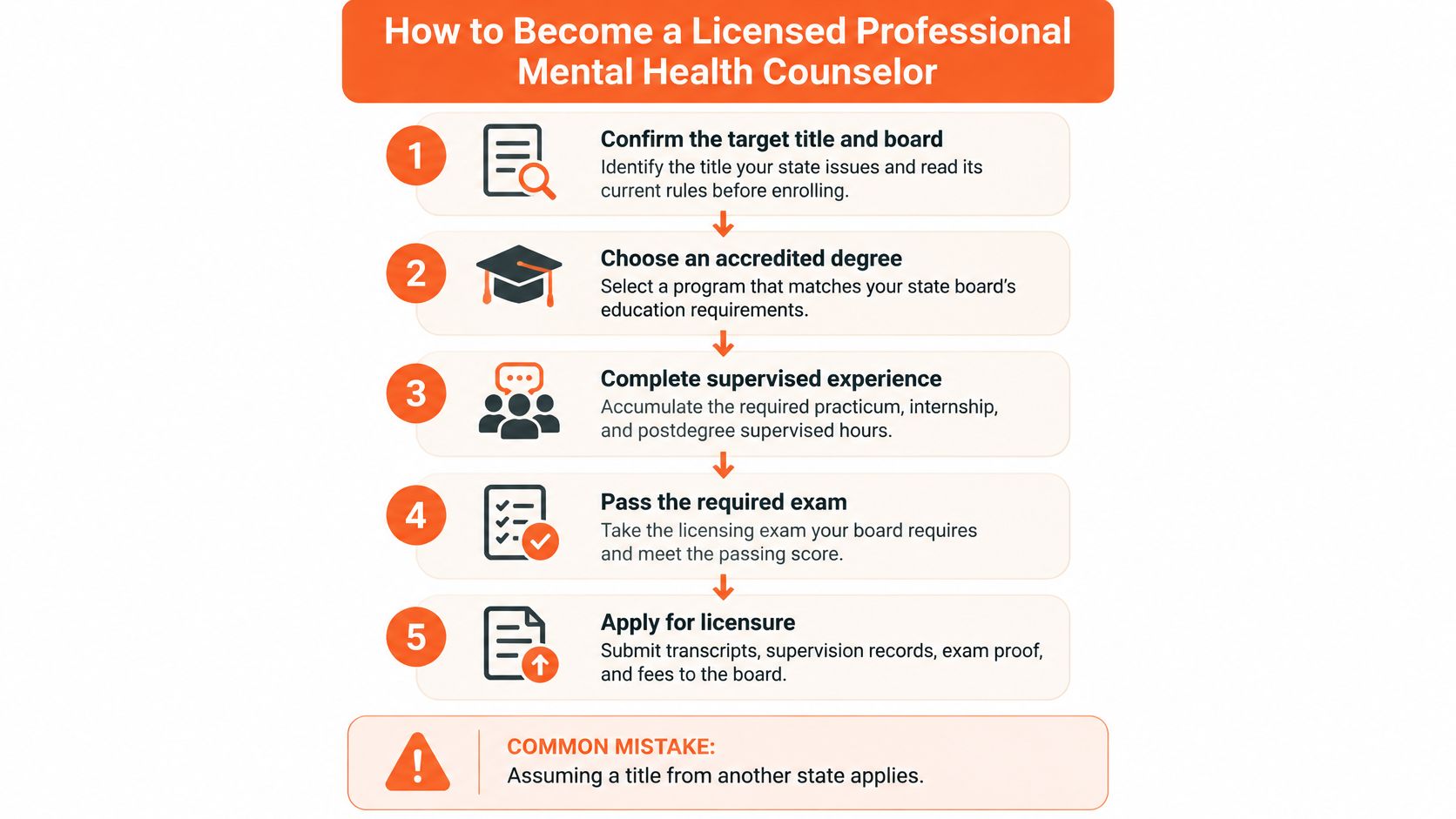
Build a documented application path
Confirm the target title and board. Identify the credential your intended state issues and save its current application instructions before enrolling. Common mistake: assuming a title used elsewhere describes the same authorization in your state.
Choose a qualifying graduate program. Consider CACREP-accredited programs and verify that your selected curriculum meets the target board's academic requirements. Common mistake: treating university admission as proof that the eventual degree will qualify for licensure.
Complete coursework and preserve the evidence. Keep transcripts, course descriptions, syllabi, and placement documentation in an organized folder. Common mistake: retaining only the diploma when the board needs details about specific courses.
Document supervised clinical experience as you complete it. Use the board's categories and forms, keep a running log, and obtain supervisor verification at appropriate intervals. Common mistake: discovering at application time that a supervisor wasn't eligible or that the records don't establish qualifying experience.
Take the accepted examination after confirming eligibility. Check the board's authorization process and how official results must reach the application file. Common mistake: scheduling a test before confirming that it fits the licensing pathway.
Submit a complete application. Reconcile transcripts, supervision verification, examination results, forms, and fees against the board's checklist. Common mistake: interpreting submission as approval before the board has reviewed and issued the credential.
Verify issuance and plan for renewal. Check the official license record, record the renewal deadline, and create a continuing-education tracking file. Common mistake: assuming the approval email is the last administrative task.
Keep an evidence folder for each licensing jurisdiction. A document accepted for one application may need different supporting information for another.
If you expect to relocate or serve clients across state lines, include that intention in your planning before choosing placements or employment. Mobility can introduce a separate authorization process, not merely a change of mailing address.
Workforce Counts and Why They Differ
The BLS occupational employment estimate reports 491,930 employed substance abuse, behavioral disorder, and mental health counselors in May 2025, with a mean annual wage of $64,440. That's a combined occupational estimate, not a census of independently licensed professional counselors.
The distinction matters before you compare that number with a licensing roll or a narrower workforce model. Similar labels don't guarantee that the underlying populations match.
Published workforce figures and what each one counts
| Source | Year | Figure | What it counts |
|---|---|---|---|
| BLS occupational figures | 2022 | 388,200 workers | Substance abuse, behavioral disorder, and mental health counselors combined |
| BLS occupational estimate described above | May 2025 | 491,930 employed | The same combined occupational category |
| HRSA supply and demand study | 2013 workforce base; 2025 demand projection | 120,010 active counselors in the base; projected baseline demand of 138,170 FTE counselors | Active workforce in the earlier model, compared with projected full-time-equivalent demand |
The HRSA demand figure is a projection, not an observed count of people working. Full-time equivalents measure a workload concept, while headcounts enumerate people. Neither should be relabeled as the number of current licenses.
Choose the count that answers your question
For occupational hiring trends, an employment estimate is useful. For credential eligibility, the licensing record is relevant. For service planning, you need information about practicing clinicians and their availability.
Even comparing employment estimates across years requires care. Check the underlying release and methods before interpreting a difference as growth among independently licensed counselors.
Our ProfessionLens counting inputs include the NPPES provider file, the CMS Doctors and Clinicians file, state license rolls from Texas, Illinois, Washington, Florida, and California, and BLS OEWS. These sources serve different purposes; their inclusion doesn't make every record a state-verified counseling license.
Our counts reflect public rolls and federal files as pulled on the count date. A roll can contain errors, duplicates, or lapsed licenses, so a defensible comparison preserves:
- Jurisdiction and date. Identify where the records originated and when they were retrieved.
- Status coverage. Separate active records from inactive or historical records.
- Counting unit. State whether the total represents records, distinct people, jobs, or full-time equivalents.
The same discipline applies when comparing licensed healthcare professionals. A larger total answers little until you know what was counted.
Moving Across State Lines With the Counseling Compact
The Counseling Compact does not create a national counseling license. According to the Counseling Compact FAQ, counselors need an unencumbered home-state license authorizing independent diagnosis, assessment, treatment, and practice, then must apply separately for a privilege in each participating state; applications opened September 30, 2025, with initial operations limited to Arizona and Minnesota.
That launch history isn't a current map of every available privilege. Check operational availability when you apply rather than assuming that compact membership means privileges are already being issued.
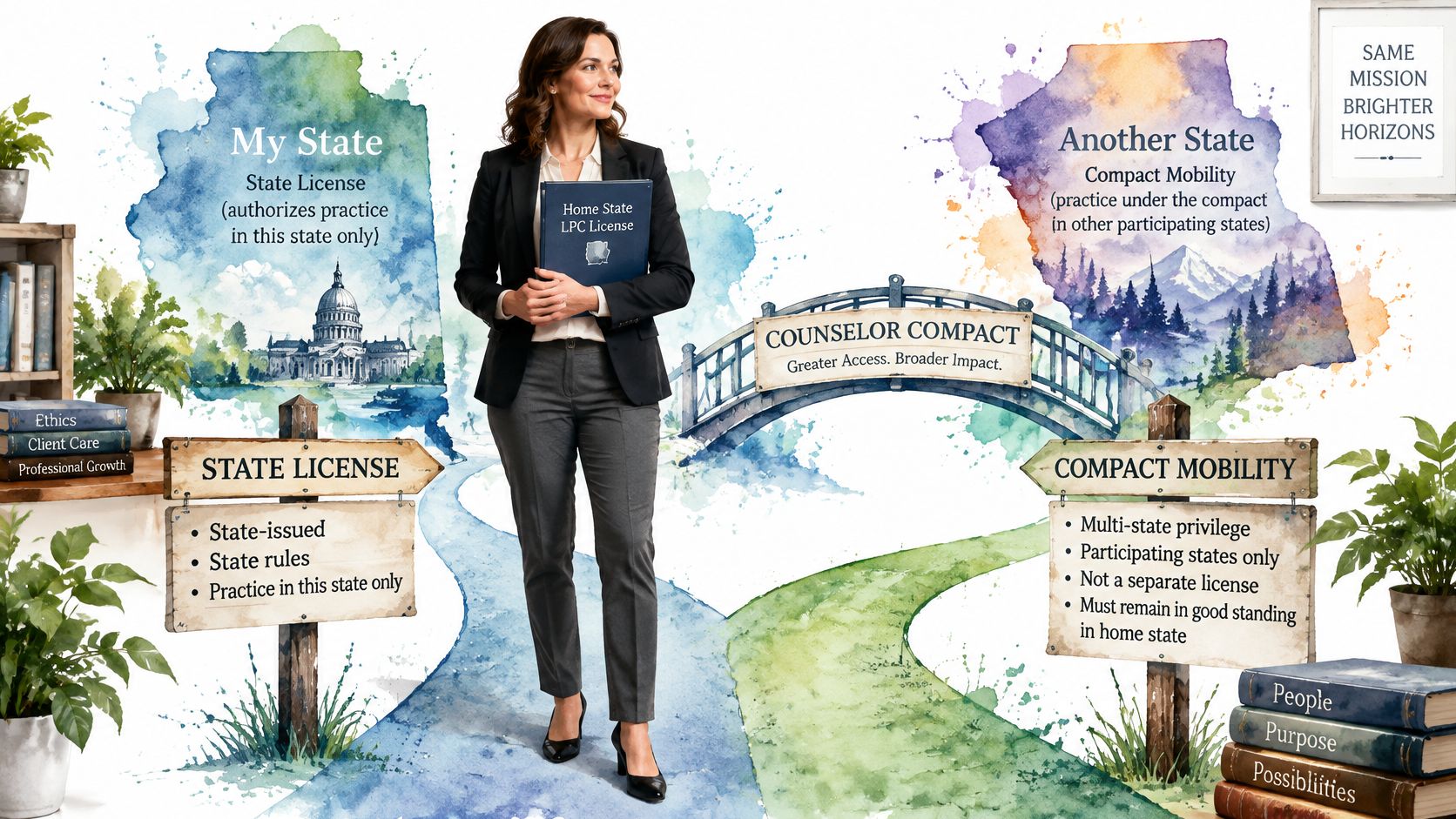
Separate eligibility from permission to practice
Use a destination-specific sequence:
- Check the home license. Confirm that it is unencumbered and eligible for the compact pathway.
- Establish independent authority. Verify that the credential permits the required clinical functions, rather than relying on the word licensed.
- Check the destination's operational status. Distinguish compact participation from an available application pathway.
- Obtain the privilege. Complete the destination-specific process and applicable payment before treating it as authorization.
- Track ongoing obligations. Maintain the home license and monitor each privilege's renewal requirements.
Can an LPC or LMHC provide telehealth when a client relocates? Don't assume an existing therapeutic relationship carries authorization into the client's new location. Record the counselor's home-state residence, the client's physical location, and the jurisdiction whose practice rules apply to the service.
A client traveling temporarily also deserves an authorization check, not just a scheduling adjustment. Ask about location before the appointment and resolve uncertainty before delivering care.
Portability can reduce licensing friction without removing the need to understand destination-state law.
The administrative trade-off is easy to miss: a counselor may gain mobility while taking on more records, privileges, and renewal obligations. Before any cross-state session, confirm the destination's rules and the authorization held.
Where Licensed Counselors Are Actually Available
According to HRSA's behavioral health workforce brief, 40% of the U.S. population, or 137 million people, lived in a Mental Health Professional Shortage Area as of December 2, 2025; the brief also projects a shortage of 99,780 mental health counselors by 2038 under status-quo conditions and reports rural counselor supply of 87.7 practitioners per 100,000 people, compared with 131.2 in metropolitan areas.
These measures describe different access problems. A shortage-area designation concerns mental health services broadly, while the counselor projection addresses a particular workforce. The rural comparison shows why a national total can conceal uneven distribution.
Filter records into a usable access estimate
A hiring manager planning a community service shouldn't stop at the number of licenses associated with the region. Apply these filters in order:
- Active rather than historical. Remove records that don't represent currently valid credentials.
- Practicing in the relevant capacity. Distinguish independent clinical work from supervised roles or non-clinical employment.
- Accessible to the community. Check actual service location and any valid remote-care pathway.
- Compatible with the payer. Determine whether the counselor accepts the insurance or payment arrangement the population uses.
- Authorized for the needed service. Confirm diagnosis, treatment, and billing eligibility rather than inferring them from a title.
Consider a clinic evaluating referral options. A nearby counselor may be licensed and practicing but unavailable to the clinic's patients because of payer participation or an incompatible service offering. Another may appear geographically distant but offer an appropriately authorized remote service.
Neither situation is visible in a basic license total. Even an active-practitioner count doesn't establish appointment capacity without information about workload and availability.
The analytical conclusion is narrower than saying there are enough counselors or too few everywhere. A license count measures a credential population; an access estimate measures whether a particular population can obtain a particular service. Ask which filters a published figure applies before using it as evidence of available capacity.
How to Verify a Counselor's License and Title
Use verification to answer a specific question: is this identifiable person currently authorized for the work being considered? A directory profile, résumé, or employer biography can help locate the person, but it shouldn't replace the official board record.
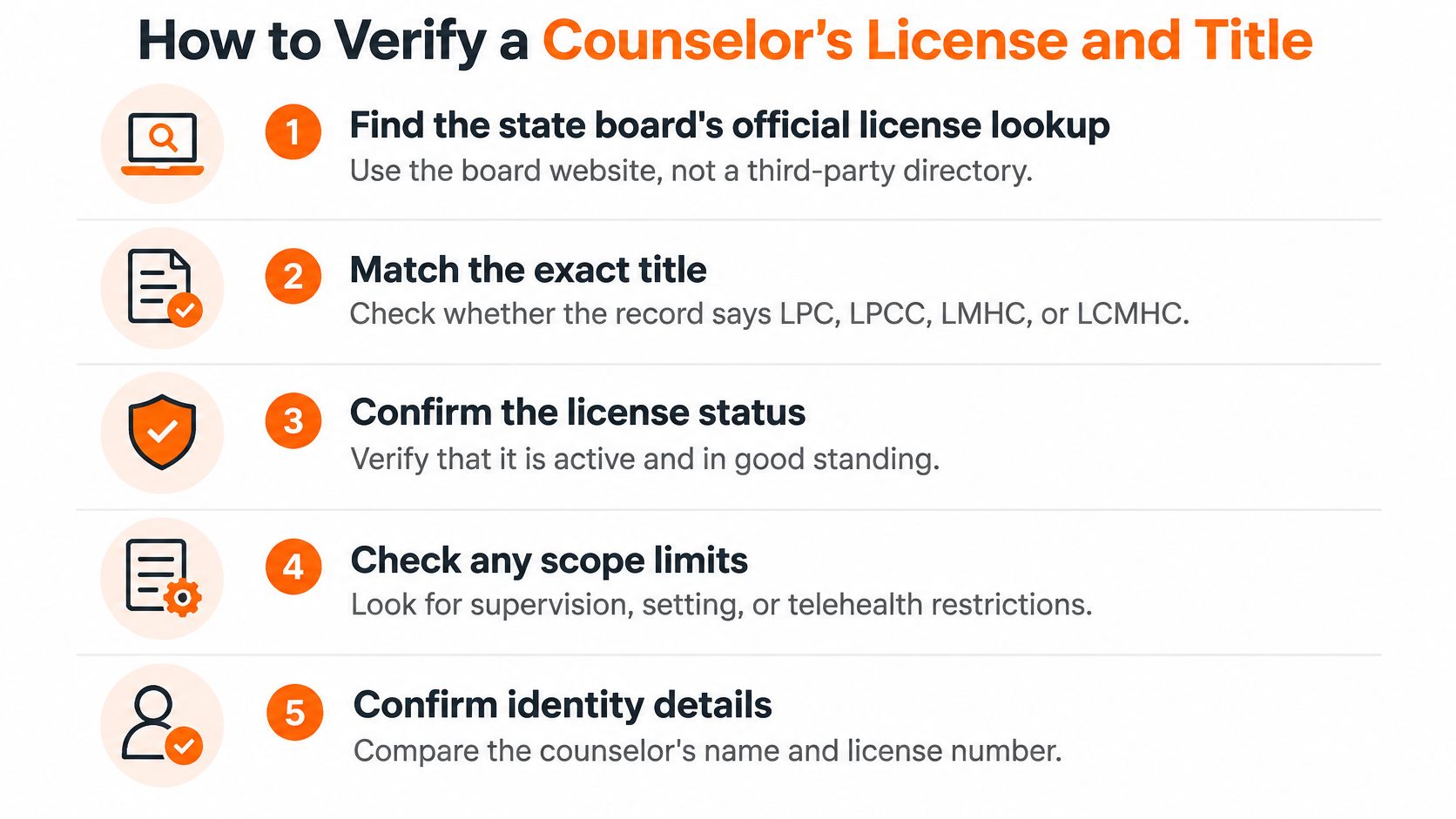
Run the official-record checks
- Find the state board's lookup. Use the issuing authority's search tool rather than treating a third-party listing as current verification.
- Match the exact credential. Record the full license title, not just a general description such as therapist.
- Read the status definition. Active, inactive, expired, and restricted records require different interpretations under the board's rules.
- Confirm jurisdiction and issuance details. Tie the credential to the state that issued it and review the issue date where available.
- Check expiration and renewal information. Don't infer continuing-education compliance from a profile; consult the board's record and instructions.
- Review published restrictions or discipline. Read linked orders and conditions rather than relying only on a status label.
- Establish independent practice authority. Match the authorization to the proposed duties, especially diagnosis or unsupervised treatment.
Resolve identity and missing information
A name match alone doesn't establish identity. Compare the license number and jurisdiction, and reconcile any name differences through the board's process rather than assuming two similar records belong to the same person.
Public lookup tools don't necessarily expose every detail needed for a hiring decision. If supervision conditions, renewal information, or scope remain unclear, seek clarification from the issuing board before approving the work.
Record the state, exact title, license number, current status, and date checked. For a hiring or referral file, also preserve the relevant restriction details and where you verified them. Verification is a dated check, not a permanent guarantee that the record will remain unchanged.
Choose the Right Credential Path for Your State
The right path starts with the decision you're making, not with the most familiar abbreviation. A student needs a qualifying education and application sequence. An employer needs evidence that an applicant's authorization matches the position.
Match the decision to the work
Start with your goal. For enrollment, evaluate whether the program supports the intended state credential. For hiring, define the clinical responsibilities first so you can test the license against the actual job.
Then choose the location. Identify where clients will receive services, not merely where the counselor's employer maintains an office. If the role crosses state lines, include authorization management in the employment plan.
Finally, specify the practice setting. Independent diagnosis and unsupervised treatment call for a different authorization check than supervised training or non-clinical work. Don't substitute a broad occupational category for that assessment.
| Decision | Evidence to obtain before committing |
|---|---|
| Enroll in a program | Academic requirements matched to the intended credential |
| Hire or refer | Official status and authority matched to the proposed services |
| Expand across states | Destination-specific permission and ongoing obligations |
Understanding professional licenses and certificates helps keep educational achievements separate from legal permission to practice. Workforce figures add context, but they don't settle an individual eligibility decision.
You may cite, quote, and link to our ProfessionLens counts with attribution and a link back to the originating page. Preserve each count's definition and date when using it, so readers can distinguish a workforce estimate from a credential total.
Before hiring, referring, or enrolling, confirm the exact title and scope with the issuing board. That check connects the credential to the decision that matters.
Visit ProfessionLens for professional workforce counts organized by profession, geography, and employer, with documented sources and count dates. Use those figures to frame your counseling workforce analysis, then verify individual practice authority through the relevant state board.