Home / Blog / Licensed Professional Engineer Texas: 2026 Count Guide
Licensed Professional Engineer Texas: 2026 Count Guide
ProfessionLens, 2026-11-05
A verified headcount of licensed professional engineers in Texas from the 15 September 2026 licence roll pull is unavailable, so that pull shouldn't be quoted as a current total. Once a dated extract exists, the figure is a count of licence records, not a count of engineers who can practise that day.
A large roll can still mislead a labour-supply study. Inactive holders, expired records, and people who have left practice all sit on the same file as engineers who sealed a drawing last week. Renewal calendars shifting through 2026 can move the same people between "renewed" and "not yet due" without anyone leaving the profession. The useful question isn't how big the roll looks. It's which status, which date, and which population the number describes.
Table of Contents
- Texas Licensed PE Count and Source
- How the Texas Count Breaks Down
- Who Counts as a Licensed Professional Engineer
- Licensing Requirements by Applicant Path
- Active, Inactive and Expired Status Changes the Count
- Renewal Cycles and CE Hours Through 2026
- Practice Authority and Validation Checks
- Cite the Texas Count With Its Source and Date
Texas Licensed PE Count and Source
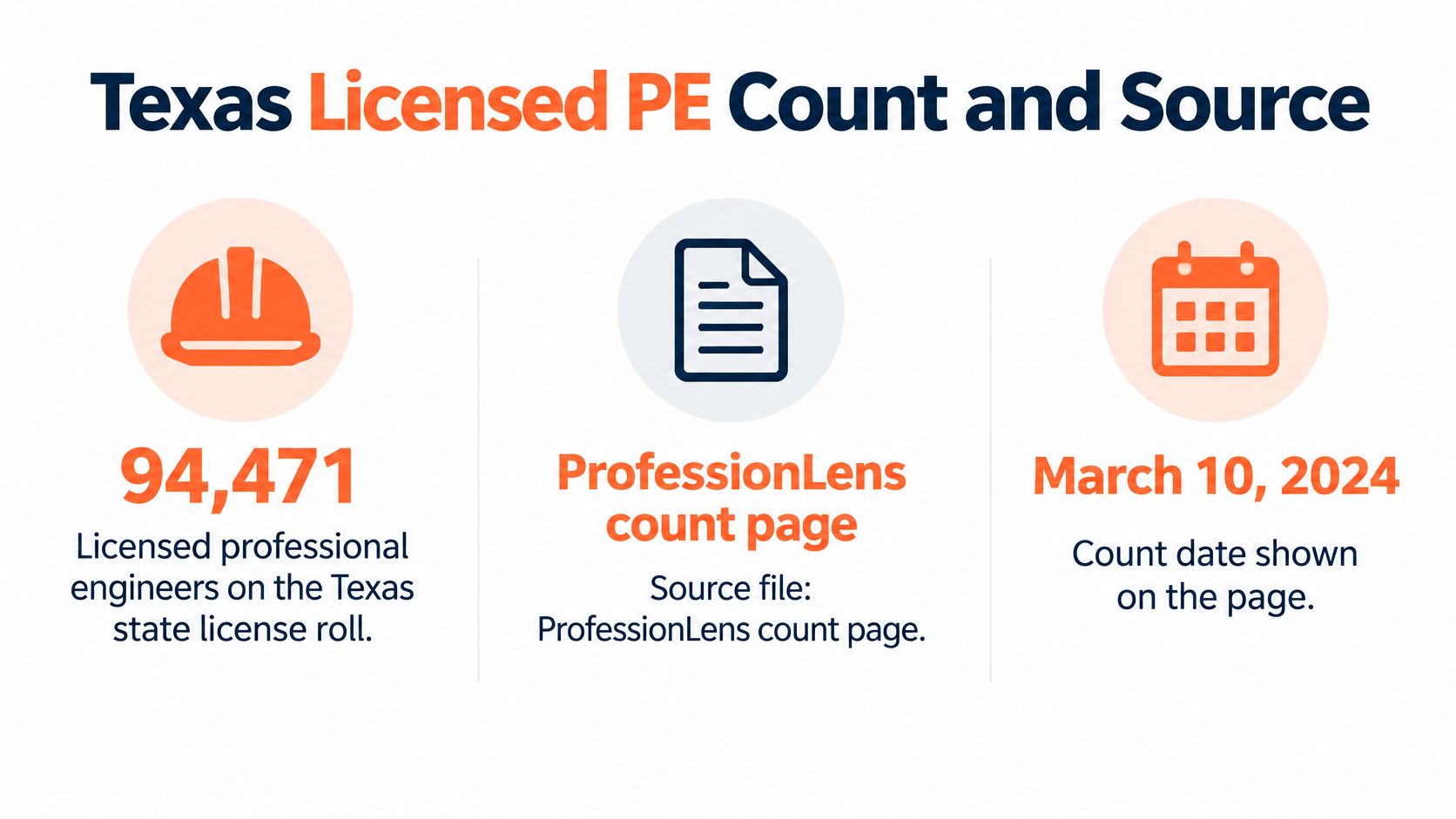
The Texas licensed-PE total for the 15 September 2026 roll pull is not available as a verified figure, so it cannot support a citable headcount. ProfessionLens counts professional engineers in Texas from public licensing rolls, but its published counts may reflect errors, duplicate entries or lapsed licences.
The roll's purpose is public safety, not measuring filled engineering jobs. The Texas Board of Professional Engineers and Land Surveyors' history of licensure records that, after the 1937 New London School explosion, the governor signed the Engineering Registration Act on 28 May 1937. Texas law reserved engineering practice and professional use of the title “engineer” for people licensed under state law. Later legislatures replaced the act in 1965 and renamed the agency in 1997. The roll therefore describes licensing records, not the number of engineers currently working on projects.
What the summary actually measures
| Count measure | Source |
|---|---|
| Licensed professional engineers on the Texas roll | Texas state licence roll, pull dated 15 September 2026; verified total not published |
| Registered engineering firms | Texas Board firm registration records; separate from the individual roll, verified firm total not published |
| Inactive engineer records | Texas state licence roll status field; inactive subtotal not published with the 15 September 2026 pull |
A licence record does not establish that its holder is currently working or available for a project. Firm registrations are a separate population and should not be added to a count of individuals.
Before citing a Texas figure, check its pull date, the statuses included and whether it counts people or firms. A single total can describe the size of a licensing roll, but not available engineering capacity.
How the Texas Count Breaks Down
The Texas professional engineer roll can include people with different licence statuses, so its total does not by itself show how many can practise now. Active and inactive records represent different practice positions; expired records should be distinguished from current licences.
Breakdowns by discipline, region, and employer answer separate questions. A discipline breakdown groups engineers by the field recorded on their licence. A regional breakdown groups them by location, while employer counts estimate how many licensed professionals work at a given organization. These figures are comparable only when their sources and reference dates align.
For employer comparisons, see the largest engineering employers in Texas. Their counts describe professionals associated with employers, not a separate category to add to the state's individual licence total.
Who Counts as a Licensed Professional Engineer
A licensed professional engineer in this count is a person the Texas Board has authorised to offer engineering services to the public and to use the title in that professional sense. Three other groups get folded into "engineers" in workforce tables, and none of them belongs on the licensed roll.
The Texas Board application guidance structures licensure around education, examinations, and experience. Applicants generally need an approved engineering or related-science degree, must pass the NCEES Fundamentals of Engineering (FE) and Principles and Practice of Engineering (PE) examinations, and must pass the Texas Ethics of Engineering examination. Degree evaluations look for at least 8 semester hours of mathematics beyond trigonometry and 20 hours of engineering science, including subjects such as mechanics, thermodynamics, circuits, materials science, transport phenomena, or computer engineering.
Three populations that are not the roll
Engineering graduates hold a degree. A degree doesn't create a Texas licence number, so a graduate isn't a licensed PE in this count.
FE-only candidates have cleared the first exam. They still lack the PE exam, the ethics exam, and a licence. They don't have authority to offer engineering services to the public.
Engineers working under supervision may do real engineering every day. Supervision doesn't substitute for the licence. The record stays outside the licensed total until the Board issues one.
Say a graduate finishes an accredited programme, then spends five years in an unlicensed design role. The degree and the years are real. The person still isn't on the Texas PE roll, because no licence has been issued. The same person, after the Board issues a number, enters the count on the issue date, not on the graduation date.
Our note on professional licences or certificates is the wider version of this split. Certificates, exam passes, and occupational titles describe training. A licence record describes legal authority.
The test is simple. Does the record show a Texas licence number? If it doesn't, the person isn't in the licensed professional engineer count, however long they've worked in engineering.
Licensing Requirements by Applicant Path
Texas uses different experience thresholds for accredited and non-accredited engineering degrees. The Texas Board licensing FAQ lists at least 4 years of qualifying experience for an accredited engineering degree and at least 8 years for a non-accredited degree.
| Applicant path | Qualifying experience | Examinations | Confidential references |
|---|---|---|---|
| Accredited engineering degree | At least 4 years | FE, PE and Texas Ethics exams | 3 references |
| Non-accredited degree | At least 8 years | FE, PE and Texas Ethics exams | 3 references |
| Original licence with exam waiver | Year minimum not stated in the Board FAQ | FE and PE passed or waived, plus Texas Ethics exam | 5 references |
Applicants generally need to pass the NCEES FE and PE examinations and the Texas Ethics of Engineering examination. Where the Board grants an examination waiver, the FE or PE requirement may be waived.
References and the experience record
Standard applicants submit at least 3 confidential reference statements from currently licensed professional engineers familiar with their work. An applicant seeking an original licence with an examination waiver submits 5. The Board FAQ doesn't state a year minimum for the waiver path, so no experience figure is given for it.
Applicants also provide a supplementary experience record describing project dates, employers, job titles, project scope, and the engineering work they personally performed. A job title alone does not document that experience.
Why the waiver row is the odd one
The accredited and non-accredited paths differ in their stated experience minimums, while both list the same examinations and three references. The waiver path allows examinations to be waived and requires five references. Because the FAQ gives no experience minimum for that path, workforce estimates should not assign it the four-year or eight-year threshold.
Filing an application does not add a person to the licensed count. The record enters the roll when the Board issues the licence, not when the applicant submits the file.
Active, Inactive and Expired Status Changes the Count
A licence on file isn't the same thing as legal authority to practise today. Treating the roll as a binary "licensed or not" is how labour-supply, shortage, and recruiting studies overstate capacity.

The Texas Board inactive-status FAQ separates active, inactive, expired, and reactivation. Those aren't labels for the same practising engineer.
Active means the licence can be used to practise, within the competence rules that govern the work.
Inactive is requested before the licence expires. The holder may not practise engineering and is generally exempt from continuing education. People use this when they retire, move into management, or leave engineering for a stretch. The name can remain on a licensed population even though the person can't seal work.
Expired means the licence has lapsed. It must be renewed, or the engineer must reapply. A licence expired for two or more years can't be renewed. The engineer must reapply under the rules in force at that time.
Reactivation is the return path. It takes a written request, the applicable fees, and proof of the required continuing education. Until that packet is accepted, the holder still may not practise.
What the status mix does to a labour study
Say a PE spends a decade in design, moves into a management role, and asks for inactive status before the expiration date. The person is still a licensee. The person isn't available engineering capacity. A later return doesn't restore practice on the day the engineer decides to come back. It restores practice when reactivation is granted.
A count of licensees without a status column can mislead analyses of labour supply, regional shortages, recruiting pools, and employer market share. The large licensed population may overstate who can work this month.
Before you use a status column, check four things.
- Name the status in the sentence. "Licensed" alone hides inactive and expired records.
- Separate non-practising records from the active file before you talk about shortages.
- Don't treat a two-year lapse as a late renewal. That engineer is back in the application rules.
- Date the snapshot. Status changes between pulls, and yesterday's active file isn't today's.
Renewal Cycles and CE Hours Through 2026
| Renewal cycle | CE hours required | Ethics hours required | Who it applies to |
|---|---|---|---|
| One-year renewal cycle | 15 hours | 1 hour | Renewals still on the annual schedule during the 2026 transition |
| Two-year renewal cycle | 30 hours | 2 hours | P.E. licences moved to two-year expiration under Senate Bill 681 |
| Inactive status | Generally exempt | Generally exempt | Holder may not practise; reactivation requires proof of required hours |
Many pages still describe Texas PE renewal as one annual obligation. The Texas Board PE renewal page says Senate Bill 681 is being implemented during the 2026 renewal cycle, with some P.E. licences moving to two-year expiration dates. The hour load moves with the term. A one-year cycle is 15 professional-development hours, including at least one ethics hour. A two-year cycle is 30 hours, including two ethics hours.
The transition isn't one statewide switch
The Board's schedule varies by current expiration month. Some 2026 renewals remain one-year renewals. Later cycles become two-year renewals. Two engineers with the same licence age can face different terms in the same calendar year, solely because their expiration months differ.
Inactive holders are generally exempt from those hours while they stay inactive. Reactivation still requires proof of the hours the return demands. Exemption isn't a permanent waiver.
Why a raw annual comparison misleads
If you compare renewals or "retention" across two years, a shift in calendars can look like exits. Some engineers aren't gone. Their next expiration date moved. Apparent volatility in the Texas licensing population can be administrative timing.
Ask two questions before you publish a retention rate. Is the figure an annual total, or a cohort that shares one expiration rule? And is the count date and the observation window printed next to the comparison?
Take two identical groups of 1,000 active licensees, used here only as an illustration. Group A renews every year, so a 2026 snapshot sees a renewal event for each of them. Group B has just moved to a two-year term, so half of them have no renewal event in 2026. A naive "renewals fell by half" reading treats Group B as attrition. Nothing in practice changed. The calendar did. Publish the renewal cohort, or the observation date, beside the count.
Practice Authority and Validation Checks
Even an active licence doesn't tell you what work that engineer may release. A count can't show practice limits.
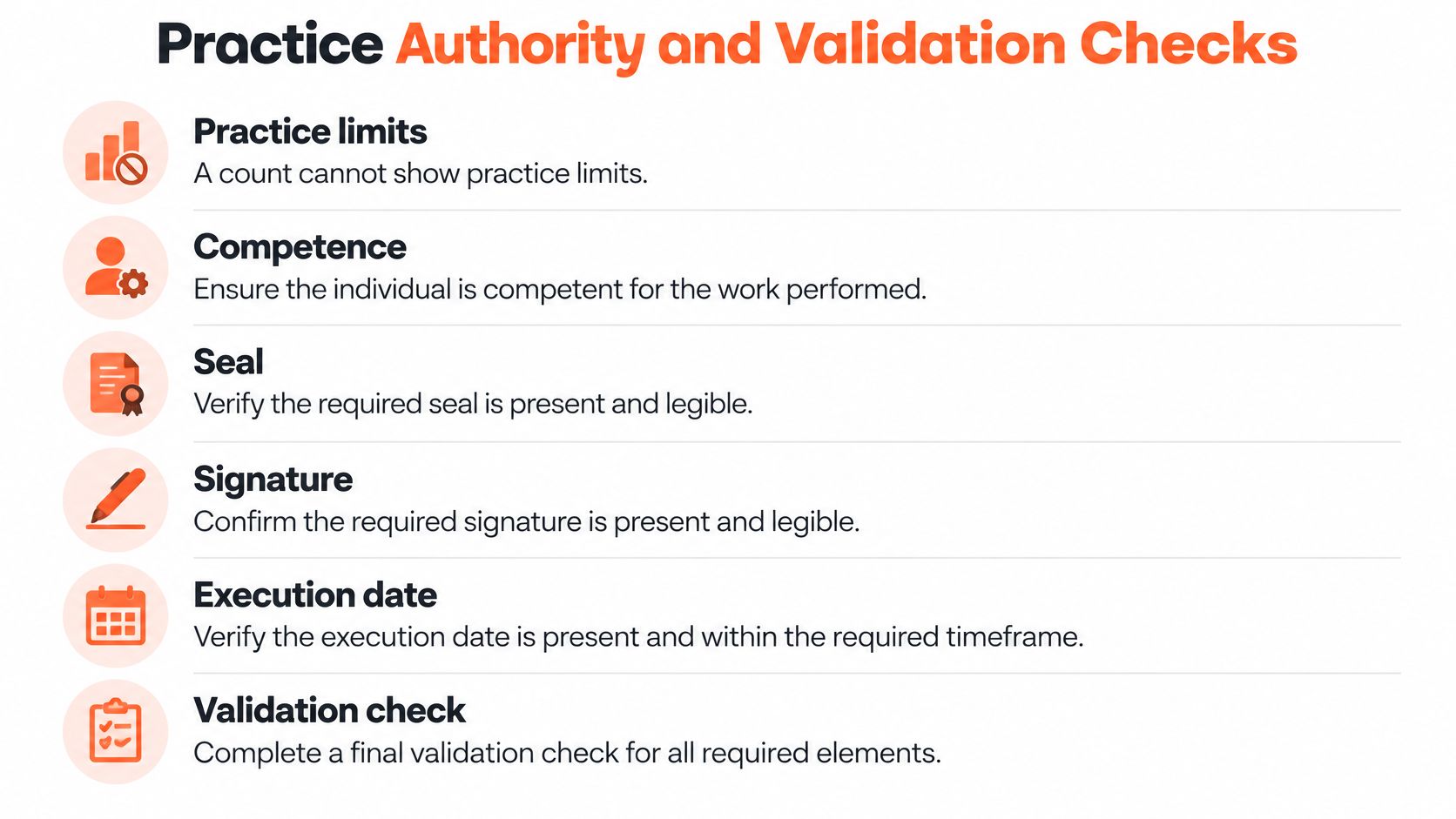
The Texas Board firm and seal FAQ ties practice to responsible charge, competence, document authentication, and firm registration. A Texas PE may practise only within areas of demonstrated competence. Final engineering documents must carry the engineer's seal, signature, and execution date, and the signature must not obscure the engineer's name and licence number. Work a registered firm releases to the public must identify the firm's name and registration number, while the responsible PE signs and seals it. Firms that offer engineering services to the public must be registered with the Texas Board of Professional Engineers and Land Surveyors.
Those fields matter when you compare engineers, and when you compare firms. A headcount of individuals doesn't tell you which firms may offer services, or which person took responsible charge of a set. When a project needs that judgment, outside writing on assessing MEP design expertise is a useful companion to the licence check, because the roll won't rank design quality for you.
Five checks before you use a Texas count
- Check the roll's limits. Counts come from public licensing rolls and federal files as pulled on the count date, and a roll can carry errors, duplicates, or lapsed licences.
- Check the fields that change the reading. Licence status, expiration date, firm registration number, competence area, and continuing-education status each answer a different question. Drop any one of them and the comparison shifts.
- Check renewal timing. A calendar change can move records without any change in who is practising.
- Treat each figure as a snapshot of one count date. Don't stretch it across a year the file doesn't cover.
- Send a weak figure to a second source. Missing status, missing expiration, or a mix of individuals and firms means the number isn't ready for a market comparison.
A count is usable for comparison only when you know what status it measures and when the roll was pulled.
Cite the Texas Count With Its Source and Date
A Texas PE figure is useful only when its measure and count date are clear. ProfessionLens publishes free counts that readers may cite with attribution; its tables are released under CC BY 4.0. For context on the public records used to count licensed professionals, see ProfessionLens's licensed professional data sources.
- Name the measure. Specify whether the figure counts licensed individuals, active licensees, inactive records, or registered firms. These categories describe different populations.
- Give the count date. Use the date printed on the source page. If the page gives no date, say it is unavailable rather than assuming a pull date.
- Credit the source. For a ProfessionLens figure, attribute ProfessionLens and link to the relevant count page.
- Keep missing values missing. Don't fill an unavailable total with an estimate, a rounded guess, or a figure from another date.
Use a citation that states what was counted, when, and where the figure came from: “N licensed professional engineer records on the Texas roll, as of [count date], source: ProfessionLens count page.” Without the measure and date, a total may refer to a different population or point in time, making it unsuitable for comparison.
Confirm the figure on its source page before publishing. A dated roll count describes records at a point in time; it does not, by itself, establish how many engineers are currently available to practise.
ProfessionLens publishes counts by profession, location, and employer, including Texas professional engineers. Visit ProfessionLens to check the engineer count, its status definition, and its count date.