Home / Blog / Top Professional Employer Organizations: Pricing Compared
Top Professional Employer Organizations: Pricing Compared
ProfessionLens, 2026-10-27
Your company requests a PEO proposal, and the per-employee administrative fee looks manageable. Then you open the supporting documents: benefits premiums, payroll taxes and workers' compensation appear separately, while the contract includes notice and transition provisions nobody discussed during the demo. You still don't know what the arrangement will cost or who handles a payroll problem.
Comparing top professional employer organizations means comparing more than their administrative fees. A useful proposal separates the service charge from employment costs, identifies the work your team retains and explains what happens when your workforce changes.
The providers below are assessed on the same buying criteria: pricing disclosure, service bundle, company fit, HR support depth, and exit or change terms. The practical trade-offs matter more than the order of the list.
Each entry ends with a confirm before signing checklist tied to the provider's published offering and the agreement you'll need to review. Product pages aren't substitutes for contract terms, so those checklists identify what to establish in writing rather than assume a particular cancellation policy applies.
Table of Contents
- 1. Justworks
- 2. TriNet
- 3. ADP TotalSource
- 4. Insperity HR360
- 5. Paychex HR PEO
- 6. Rippling PEO
- 7. Sequoia One
- How the seven top professional employer organizations compare on pricing model, fit and costs to confirm
- Choosing the Right PEO Before You Sign
1. Justworks
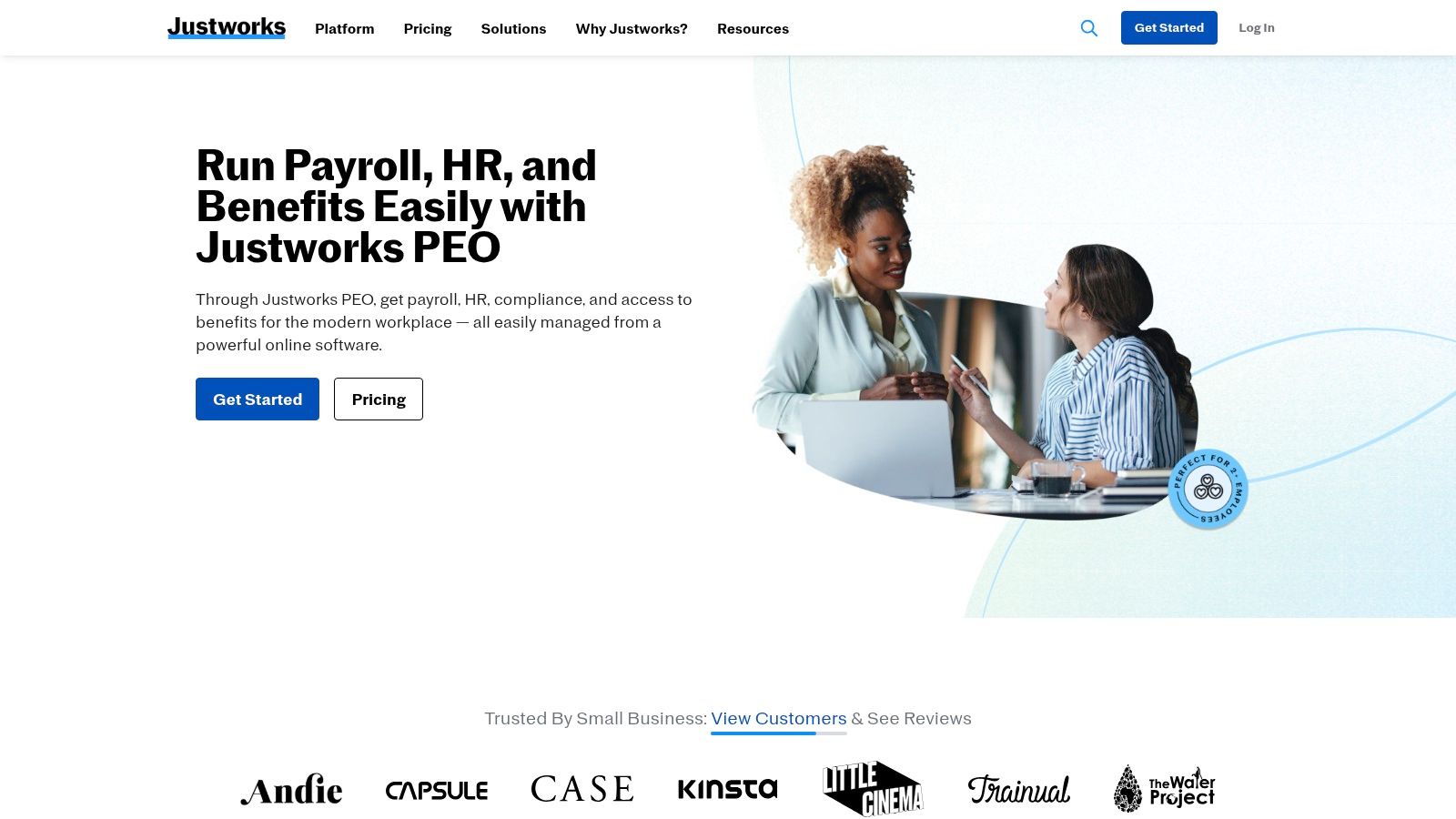
Justworks is a practical starting point when you want a clearly packaged PEO. Its published plan structure makes an initial comparison easier, but it doesn't turn the displayed administrative charge into an all-in employer cost.
Justworks PEO combines payroll, HR tools, compliance support and benefits administration. Its Basic and Plus structure distinguishes the core service from the tier that adds access to medical, dental and vision coverage.
Where the Simplicity Helps
Pricing disclosure and service bundle: Published pricing helps you establish an administrative-fee baseline before sharing detailed workforce information. Still, access to benefits doesn't mean premiums are included in that fee, and integrations don't necessarily replace the subscriptions you already use.
Company fit and HR depth: Justworks suits smaller U.S. employers that want payroll, employee administration and HR support in a straightforward package. Its support and consulting resources are useful, but a business with specialized labor practices should test those requirements directly rather than equate broad availability with industry expertise.
For a brokerage, separate employee administration from agent arrangements before requesting a quote. Employer-size comparisons such as the largest real estate brokerages provide context, but your actual employee roster determines the PEO scope.
Exit and changes: Establish how plan changes, benefits termination and payroll-record transfers work before treating the service as easy to leave.
Confirm before signing
- Plan scope: Identify the exact Basic or Plus services, integrations and separately billed tools.
- Employer cost: Obtain premiums, workers' compensation charges, taxes and any minimum billing requirements.
- Eligibility and exit: Confirm participation requirements, cancellation notice, final payroll handling and benefits end dates.
2. TriNet
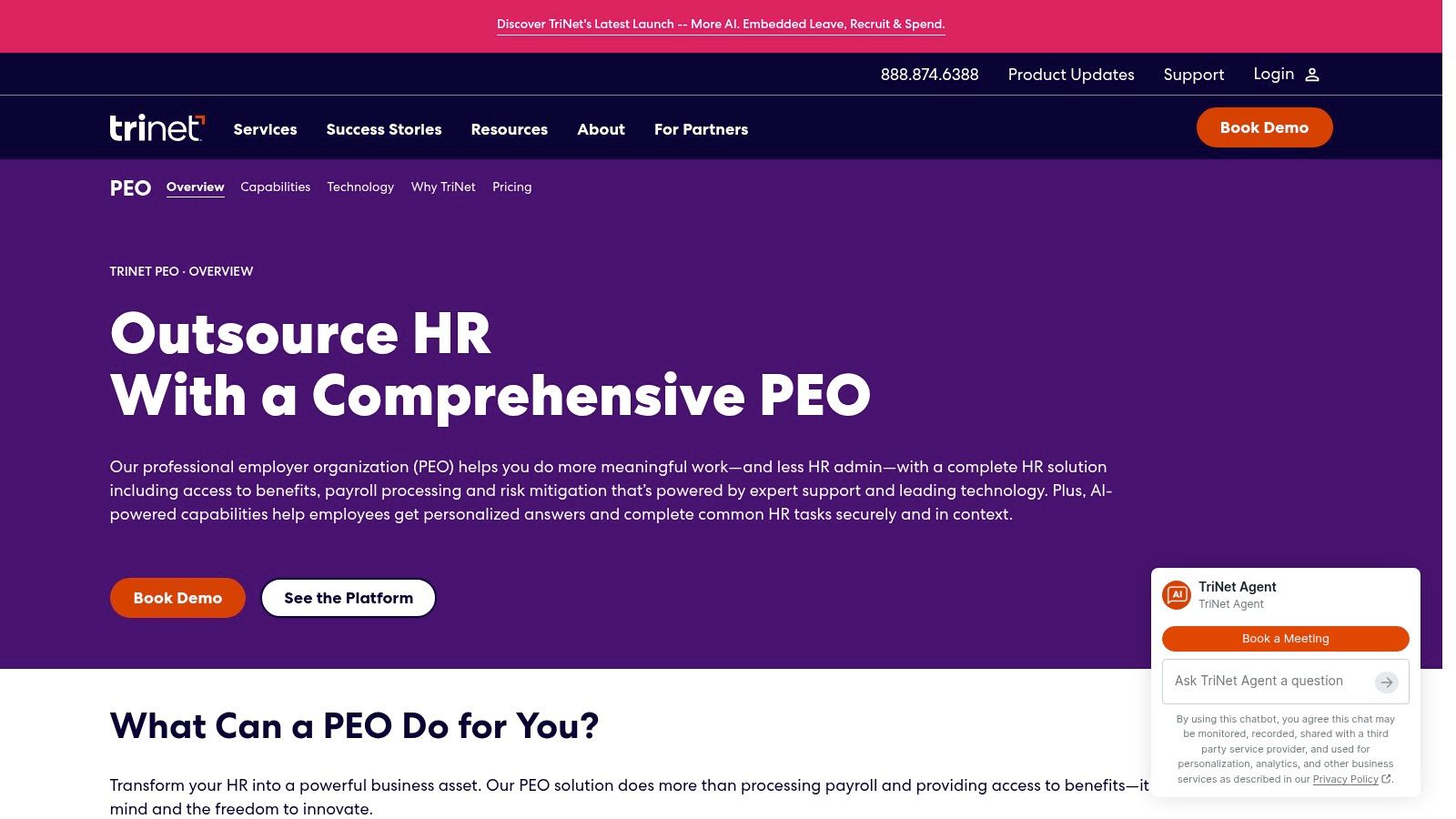
A life sciences employer and a consulting firm can have similar headcounts but very different HR questions. TriNet's industry focus is the reason to evaluate it, not a reason to skip checking the assigned service team's capabilities.
TriNet's PEO offering combines payroll, benefits administration, compliance support, workers' compensation and HR technology, with industry-focused guidance. Its administrative charge is described as a flat per-employee-per-month fee, while the proposal remains customized.
Buying distinction: A flat administrative fee can make that component easier to forecast. It doesn't freeze benefits premiums or other employment costs.
Test the Industry Fit
Pricing disclosure and bundle: Separate the administrative fee from benefits, payroll taxes and optional services. Have TriNet show how the invoice changes when you add employees, change locations or select additional support.
Company fit and HR depth: Technology, financial services, life sciences, consulting and nonprofit employers have a clear reason to shortlist TriNet. Ask the proposed team to explain how it would handle a relevant issue, such as a sensitive employee complaint or a leave request involving multiple jurisdictions.
Don't confuse specialist executive roles with operational HR coverage. The research on sustainability-chief titles across major employer lists examines leadership titles, not who owns routine employment administration.
Exit and changes: Treat optional global workforce support as a separately defined service, not automatic international coverage under the U.S. PEO arrangement.
Confirm before signing
- Fee boundaries: Identify separate premiums, taxes, add-ons and repricing provisions.
- Support ownership: Record the assigned contacts, specialist access and escalation process.
- Service changes: Confirm global-service scope, termination notice and responsibility for transferring payroll and benefits records.
3. ADP TotalSource
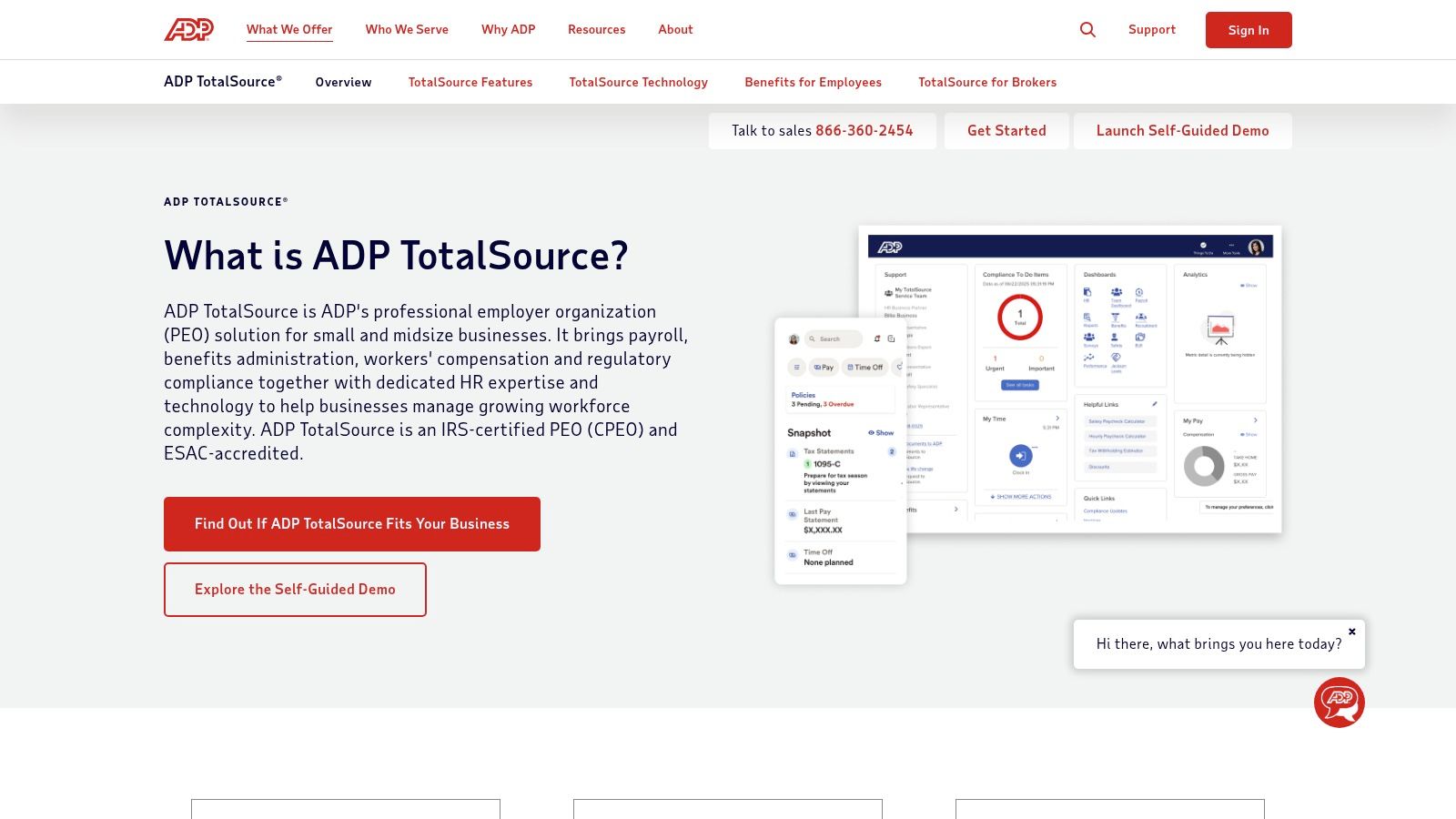
ADP TotalSource deserves a look when workforce complexity is increasing faster than your internal HR capacity. The attraction is the combination of operational services and specialist support, rather than payroll software alone.
ADP TotalSource brings together payroll, benefits, HR support, hiring tools, risk management and workplace safety services. Its stated model includes an assigned HR business partner and access to specialists, alongside employee self-service and mobile tools.
Breadth Needs Clear Ownership
Pricing disclosure: You'll need a custom quote. Give ADP employee locations, job duties, payroll practices and workers' compensation classifications so the proposal reflects the business you run day to day.
Service bundle and company fit: The broad offering can suit an employer expanding across states or replacing several disconnected HR vendors. It may be excessive for a simple workforce that mainly needs reliable payroll and occasional advice.
HR depth: An assigned HR business partner is useful only when the responsibilities are clear. Request a walkthrough showing who receives a tax notice, investigates a payroll discrepancy, advises on an employee issue and follows each matter through resolution.
A specialist directory isn't an escalation process. Your team needs a named route to an answer and a clear owner for unresolved work.
Exit and changes: Document how you retrieve payroll history, employee documents and benefits information. Don't leave data-transfer responsibilities until the replacement provider is waiting.
Confirm before signing
- Included services: Distinguish core payroll and HR support from optional hiring, timekeeping or other tools.
- Account coverage: Establish business-partner responsibilities, specialist access and backup coverage.
- Cost and transition: Request itemized employment costs, notice requirements, export formats and final-service responsibilities.
4. Insperity HR360
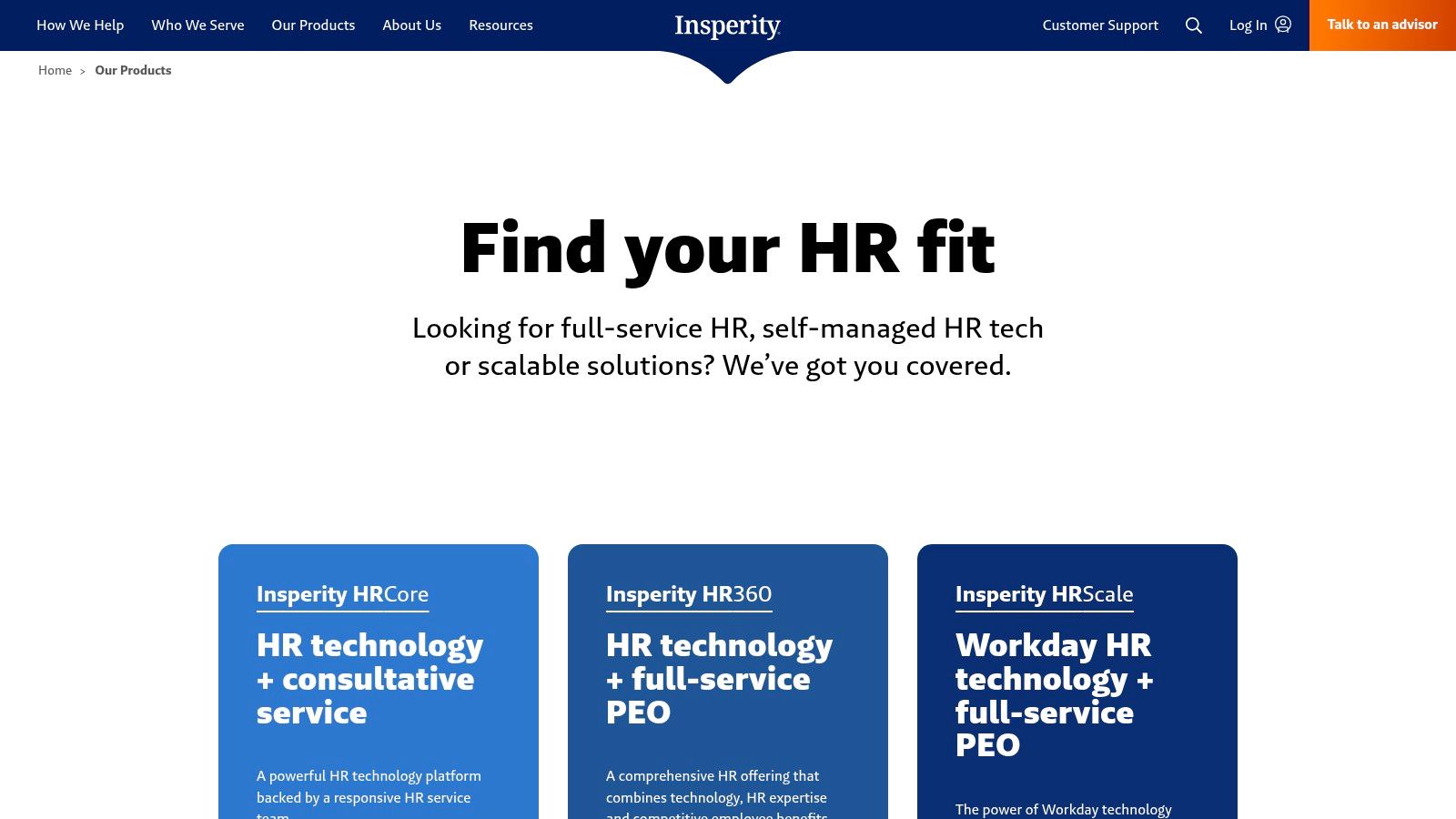
Some owners need help making employment decisions, not another dashboard. Insperity HR360 is worth considering when consultative HR support is a central buying requirement.
Insperity's product lineup positions HR360 as a full-service PEO combining technology, HR expertise, benefits and co-employment. Its separate HRScale offering pairs a PEO model with Workday technology, so establish which service model the proposal covers.
Pay for Advice You'll Use
Pricing disclosure and bundle: HR360 pricing is customized, with the HR service charge described as a fixed dollar amount per employee. That distinguishes the service charge from direct employment costs, including benefits, payroll taxes and workers' compensation.
Company fit and HR depth: The consultative model makes sense when managers need recurring help with policies, performance concerns and employee relations. It's harder to justify if your team mainly wants payroll processing and already has experienced HR leadership.
Make the sales discussion concrete. Ask how the assigned team would help revise a handbook, prepare a manager for a difficult conversation and document the resulting decisions.
Workforce definitions also matter. For employers comparing their organization with large health systems, licensed professional counts and PEO-covered employees answer different questions; prepare a payroll roster rather than substitute an external employer-size measure.
Exit and changes: Clarify how changing service models affects implementation, records, benefits and fees. A broader product lineup doesn't establish an automatic or cost-free migration.
Confirm before signing
- Service identity: Specify HR360 or another model and its included consulting work.
- Fee treatment: Separate the fixed service charge from employment costs and adjustment provisions.
- Transition duties: Establish notice, migration charges, document access and benefits continuity.
5. Paychex HR PEO
Start the Paychex conversation by deciding whether you need co-employment at all. Because the company offers payroll and HR services outside its PEO, you can compare different levels of outsourcing without assuming the broadest package is necessary.
The Paychex payroll and HR service comparison is a useful starting point for distinguishing those models. Paychex HR PEO combines payroll and employment tax administration with HR consultation, employment resources and potential benefits offerings, subject to eligibility and plan terms.
Compare the PEO Against a Leaner Alternative
Pricing disclosure and service bundle: Request an itemized PEO proposal alongside a non-PEO alternative that addresses the same operational problems. Don't compare a full employment-services package against a payroll-only quote and call the difference an administrative premium.
Company fit: Paychex is a sensible candidate for an owner who wants to examine how much HR work to outsource. The decision should turn on benefits requirements, internal expertise and the duties your team wants to retain.
HR depth: Handbook resources and consultation can help with routine management, but establish what consultation includes. Reviewing a policy, advising on an employee dispute and conducting an investigation are different assignments.
Exit and changes: Give the notice and transition provisions close attention. Any applicable transition-fee language should be understood before implementation, alongside responsibilities for final tax administration and benefits termination.
Confirm before signing
- Service model: Identify exactly which PEO agreement and service schedule govern the proposal.
- Benefits eligibility: Verify available plans, participation conditions and separately billed costs.
- Termination provisions: Review required notice, possible transition fees and services that continue or stop after notice.
- Records and taxes: Assign ownership of exports, outstanding filings and unresolved tax notices.
6. Rippling PEO
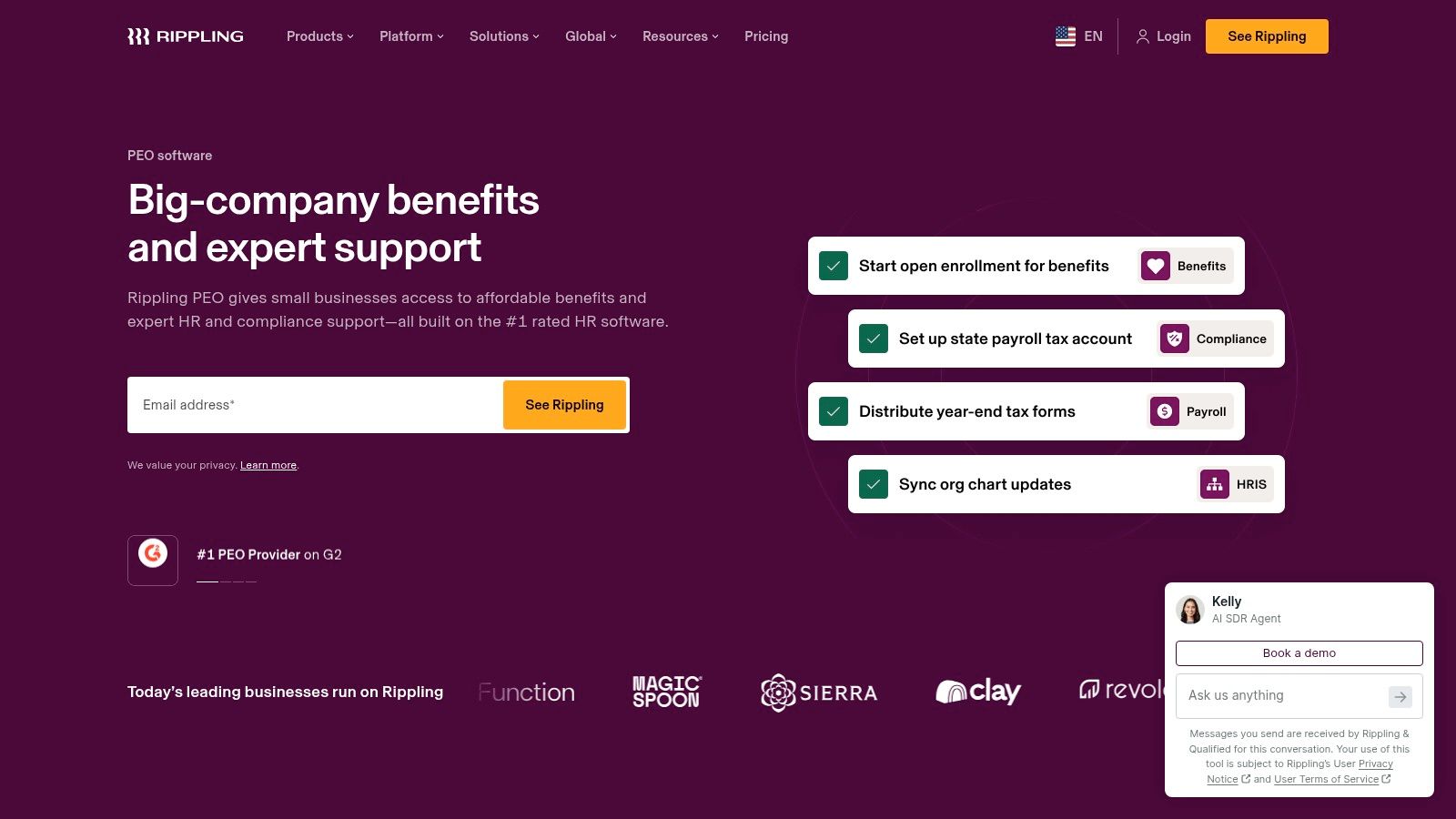
A new hire needs payroll setup, benefits enrollment and access to company systems. Rippling's appeal is connecting those tasks through shared employee information, rather than asking administrators to maintain separate records.
Rippling PEO combines payroll, benefits, workers' compensation and compliance support within a broader platform that also offers HR, IT and finance tools. Those adjacent tools create workflow possibilities, but their availability doesn't mean every module is included in the PEO price.
Test the Workflow and the Handoff
Pricing disclosure and bundle: PEO pricing is customized. General platform or payroll pricing isn't a substitute for a proposal identifying PEO services, software modules, benefits costs and implementation work.
Company fit and HR depth: Rippling is a strong candidate for software-oriented teams that want connected onboarding and employee administration. Employers seeking a traditional, highly consultative HR relationship should test expert access as carefully as they test automation.
Use a realistic demonstration: change an employee's work location and ask which payroll, benefits, approval and compliance tasks update automatically. Then identify which tasks still require a person to review the change.
Automation should reduce duplicate entry, not make it harder to identify who approved an employment decision.
Exit and changes: Rippling describes a route from its PEO to other services while remaining on the platform. That can reduce software disruption, but it doesn't establish unchanged insurance, pricing or tax arrangements.
Confirm before signing
- Module scope: List included HR tools, optional IT or finance products and implementation charges.
- Human support: Establish expert availability, escalation ownership and excluded advisory work.
- PEO departure: Confirm migration work, replacement benefits, payroll-tax setup, ongoing subscriptions and termination notice.
7. Sequoia One
Sequoia One has a more specific buyer profile than a general-purpose small-business PEO. Its startup orientation makes it relevant when compensation planning, benefits strategy and growth-related HR decisions are closely connected.
Sequoia One combines HR and payroll support with benefits and compensation guidance, with positioning aimed at venture-backed technology companies. That specialization is useful when it matches your operating model, but it isn't an advantage for every employer.
Separate PEO Operations From Advisory Services
Pricing disclosure: Pricing is quote-based, so request distinct descriptions of administrative fees, employment costs and any related advisory services. A proposal should make clear which Sequoia services belong to the PEO arrangement.
Service bundle and company fit: Payroll, taxes, HR administration and compliance support address operational needs. Compensation and equity-related guidance may add value for a startup, but establish the specific deliverables rather than assume every planning tool or advisory engagement is included.
HR depth: Test how the team connects advice with execution. If it recommends a compensation change, identify who updates payroll, prepares employee communications and checks benefits implications.
Exit and changes: Guidance on moving beyond a PEO can be useful for a growing company. Still, distinguish transition advice from the actual work of arranging replacement benefits, transferring records and establishing payroll administration outside co-employment.
Confirm before signing
- Offering boundaries: Separate Sequoia One PEO services from related benefits, compensation or advisory engagements.
- Assigned work: Document consulting deliverables, payroll responsibilities and employee-support coverage.
- Total cost: Identify premiums, taxes, implementation work and separately priced services.
- Growth and exit: Confirm notice, transition assistance, data access and any continuing service commitments.
How the seven top professional employer organizations compare on pricing model, fit and costs to confirm
| Item | Pricing model | Best fit | Standout feature | Costs to confirm |
|---|---|---|---|---|
| Justworks | Published PEO tier pricing | Small U.S. businesses seeking straightforward HR and benefits | 24/7 support; Plus includes medical, dental, and vision | Benefits, other employer expenses, and eligibility requirements |
| TriNet | Customized quote; flat per-employee administrative fee | Businesses seeking industry-focused HR support | Industry expertise and optional global workforce support | Benefits premiums, payroll taxes, add-ons, and contract terms |
| ADP TotalSource | Customized quote | Growing or multi-state businesses needing broad HR services | Assigned HR partner and specialist teams | Service options, account support, and full quote details |
| Insperity HR360 | Customized quote; fixed-dollar-per-employee service charge | Employers seeking consultative HR guidance | HR expertise paired with technology; HRScale offers Workday | Benefits, payroll taxes, and workers' compensation |
| Paychex HR PEO | Quote-based | Businesses comparing PEO and non-PEO service options | Payroll and tax services combined with HR consultation | Benefits eligibility, itemized fees, notice terms, and transition fees |
| Rippling PEO | Custom pricing | Businesses prioritizing automation and integrated HR and IT workflows | Connected platform with automated workflows | Included services, compliance support, benefits, and transition costs |
| Sequoia One | Quote-based | Venture-backed technology startups | Compensation and equity guidance alongside HR and benefits | Which benefits or advisory services are included in the PEO offering |
Choosing the Right PEO Before You Sign
Shortlist providers that match your headcount, employee locations and company type. Then send each the same workforce information, including compensation, benefit elections, job duties, payroll frequency and current insurance arrangements. Comparable inputs are necessary for comparable proposals.
Ask for total employer cost, rather than only a service-fee comparison. Separate wages and payroll taxes from administrative fees, benefits premiums, workers' compensation, implementation charges and optional software. Also distinguish employer-funded costs from employee contributions so the proposal doesn't make one arrangement appear cheaper through different accounting.
Put the Proposal Through an Operating Test
Run each finalist through a payroll correction, an employee moving states, a leave request and a termination. Identify what the provider handles, what your managers retain and who resolves exceptions. For cross-border hiring, don't treat a U.S. co-employment arrangement as automatic coverage abroad; establish the legal employer and service scope in each jurisdiction.
Use the comparison table as a checklist, but make the contract the deciding document:
- Cost changes: Identify what can be repriced, when changes take effect and how you receive notice.
- Service ownership: Record responsibility for tax notices, benefits issues and unresolved employee cases.
- Exit mechanics: Check termination notice, transition-fee provisions, final payroll and outstanding filings.
- Continuity: Establish when coverage ends, how replacement benefits begin and how records transfer.
Benefits and employee support deserve attention alongside cost. In research commissioned by NAPEO, McBassi & Company found that PEO clients had an employee-turnover rate 12% lower than comparable non-PEO businesses in 2024, according to the published study announcement. That comparison doesn't establish that a particular provider will improve your retention or offset its fees.
Review the broader PEO pros and cons against your internal capacity before committing. You're buying an operating relationship, not just outsourcing a set of transactions.
I'd choose the provider that produces a clear cost breakdown, defines accountability and explains the exit process without ambiguity. A lower headline fee isn't compelling if your team still has to coordinate the work you expected the PEO to own.
ProfessionLens publishes professional workforce counts, employer comparisons and documented research that help you distinguish organizational scale from the employee population a PEO would cover. Visit ProfessionLens to explore free count pages and ranked employer lists as you build your workforce-planning assumptions.